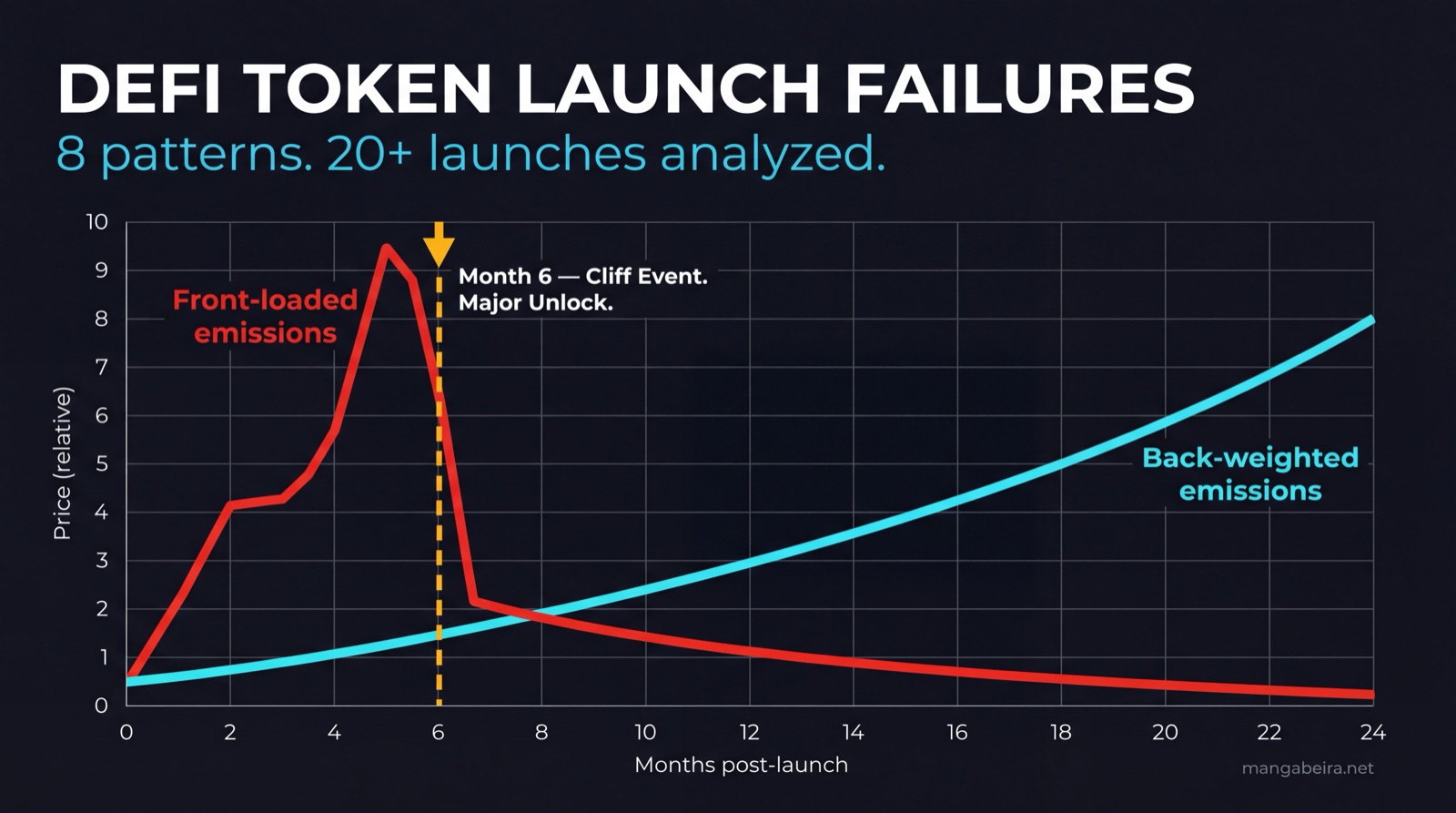
The token chart told the story before launch day. Every time.
I've gone back through on-chain data for more than 20 DeFi protocol launches across multiple market cycles. The wallet concentration, the emission schedule, the float mechanics: none of it was hidden. It was public, readable, and almost universally ignored by the teams building the launches.
Protocols that avoided these failure patterns didn't have better technology. They had better pre-launch diagnostics. They read the data their own tokenomics design was generating and adjusted before the token hit the market.
This is a post-mortem. Eight failure patterns that appear on every collapsing chart. Starting with the query that keeps bringing readers here: the Ethena emission curve.
The Ethena Emission Curve Problem and Why It Guarantees Selling Pressure
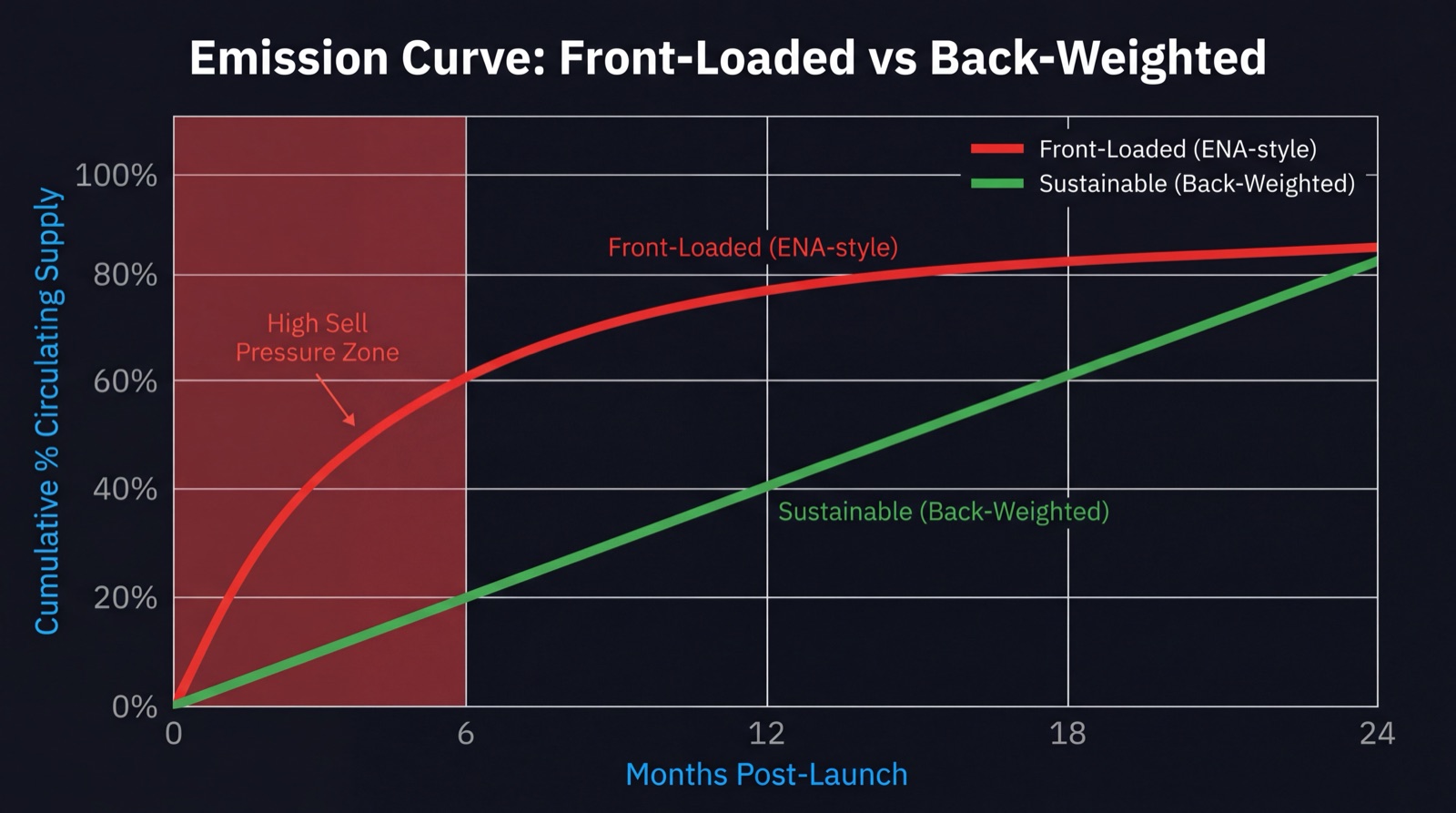
Ethena's ENA vesting curve front-loaded supply to early investors and team with a 6-month cliff, then linear release over 18 months. The schedule was public before trading began. Sophisticated participants read it and positioned short. Price followed the supply curve, not protocol TVL. The emission design had no matching demand mechanic, so it was a scheduled sell event from day one.
That's not a criticism of Ethena specifically. Their protocol mechanics are more defensible than most DeFi launches. It's an observation about what happens when vesting schedules and demand design aren't built together.
The emission curve is a supply forecast. If supply grows faster than demand in months 1 through 6, the launch is a sell event by design. Protocols with back-weighted emission schedules, where rewards increase as the protocol matures, consistently outperform front-heavy curves in 90-day price retention. The curve is a signal before the token launches. Most founders don't read it that way.
The diagnostic: map your emission schedule against projected demand growth. If supply outpaces demand in the first six months, adjust the curve before launch, not after.
Farm-and-Dump Emission Schedules and How They Collapse Token Price
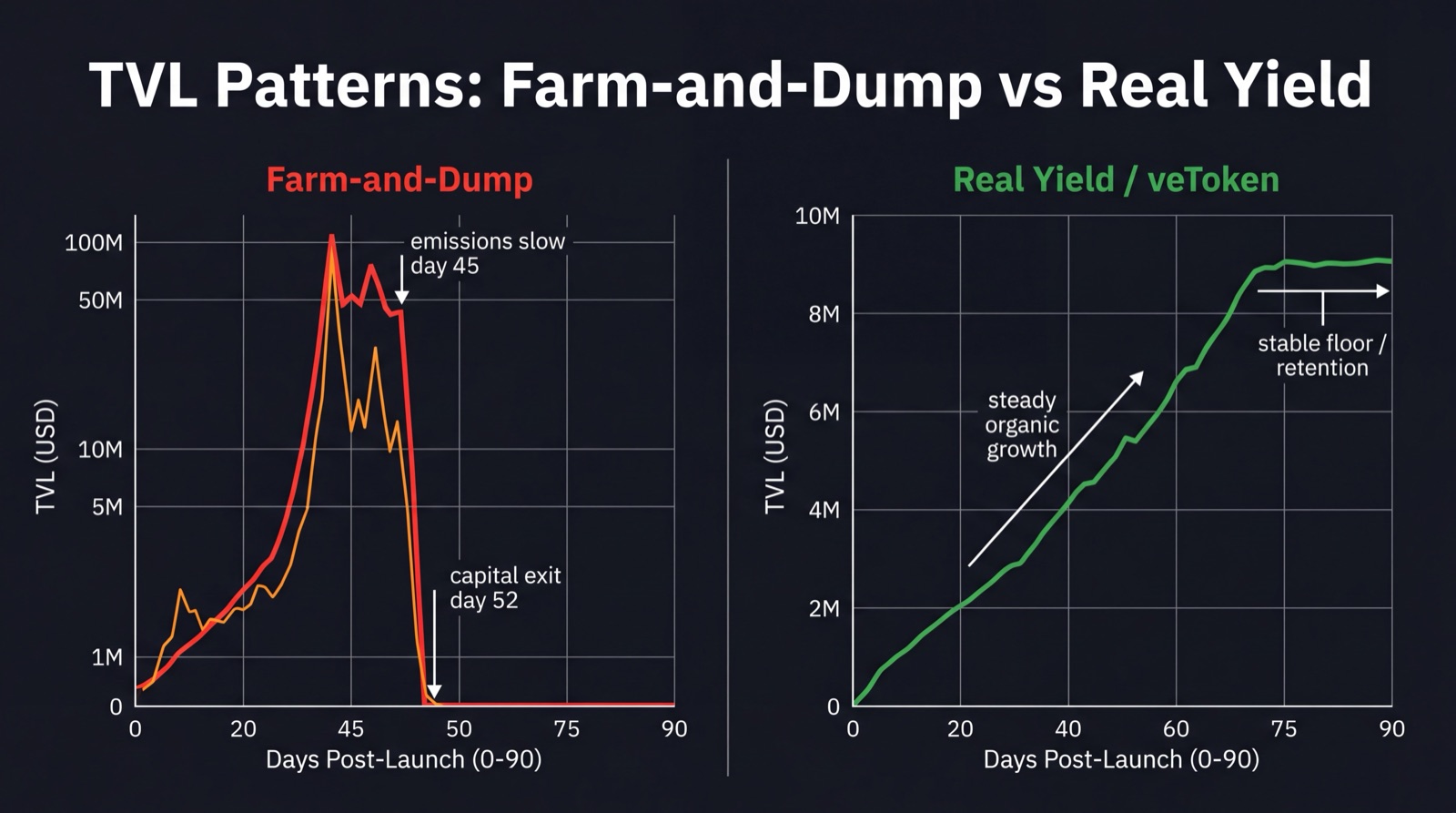
High APY attracts TVL. TVL attracts attention. Attention looks like traction. Then emissions slow, mercenary capital exits, and the chart collapses. The farm-and-dump emission schedule is the oldest failure pattern in DeFi, and it repeats across every cycle because the structural incentive never changes.
Liquidity mining programs that pay rewards in the native token create continuous sell pressure. Every block adds new supply. Farming wallets harvest and sell continuously. They never accumulate. When rewards slow, capital exits all at once. Token velocity is high. Holder concentration doesn't improve. That's the on-chain signature.
Data from token tracking platforms is consistent: protocols with uncapped liquidity mining and no emission controls see average TVL drawdowns of 60-80% within 90 days of peak APY. The capital was loyal to the rate, not the protocol.
Three fixes work. First, vesting on rewards: farmers earn the full amount locked, or take a 50% haircut for immediate liquidity. Second, real yield programs that pay in stablecoins or ETH instead of native tokens, eliminating reflexive sell pressure. Third, protocol-owned liquidity, where the protocol holds its own LP position. That position doesn't leave when the rate drops. For a deeper look at how to structure each of these options, designing tokenomics that drive protocol growth covers the mechanics of each model.
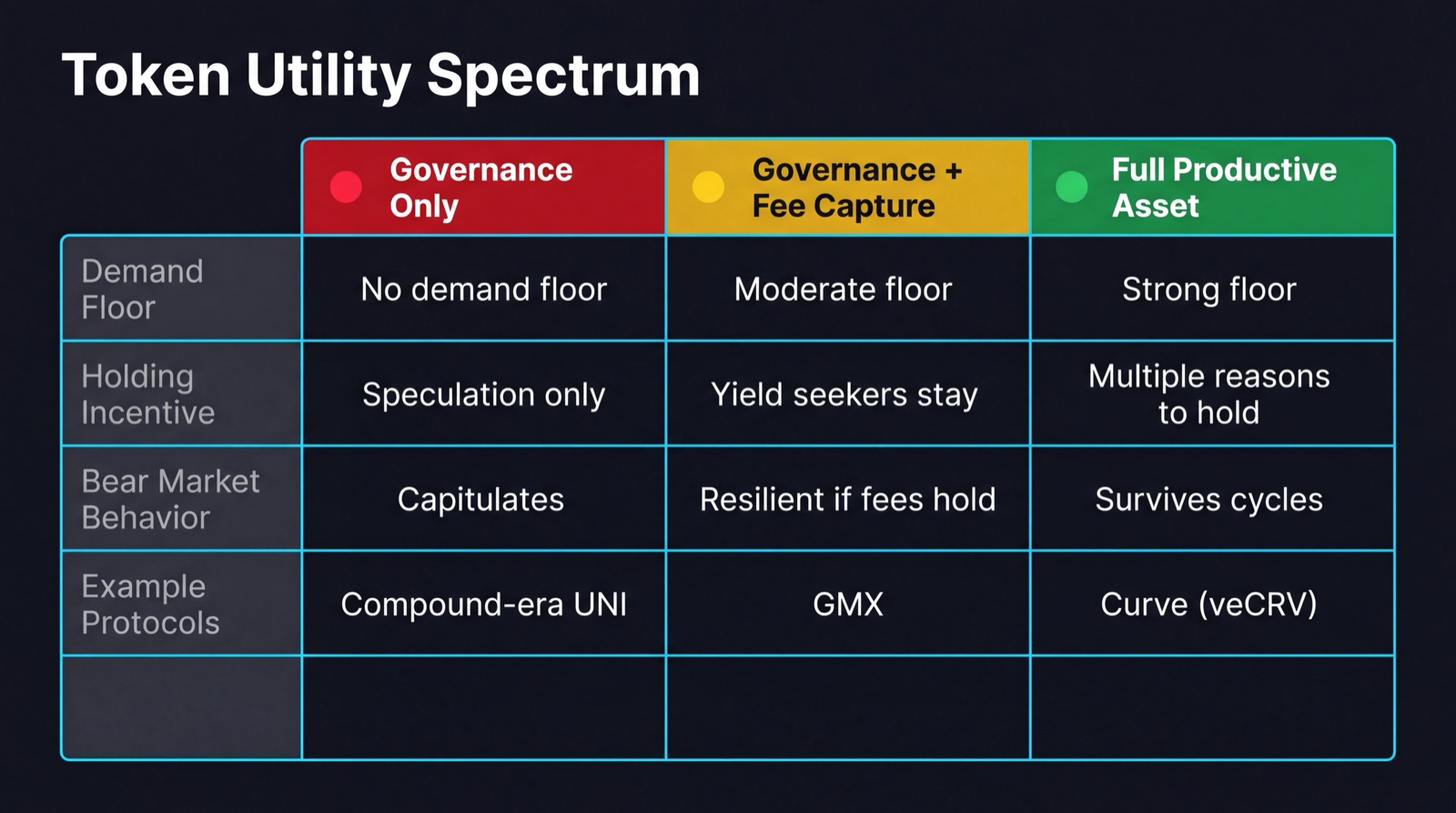
Governance Tokens With No Demand Floor and Why They Have No Fundamental Bid
A governance token with no fee capture has no fundamental bid. Voting rights don't create buying pressure. They create the appearance of utility without the economics. During bull markets, narrative holds the price. In consolidation or bear conditions, there's no floor. Holders have no reason to stay except the bet that someone else will value governance rights more later.
The team frames the token as community ownership. Technically true. Economically empty unless that ownership includes a claim on protocol revenue.
The protocols that solved this added fee switches. When protocol fees flow to token stakers, the token becomes a productive asset with a real bid. Uniswap's ongoing fee switch debate exists because the market understands this: UNI trades at a significant discount to its potential value because the fee switch hasn't flipped.
Design the token as a productive asset from day one. Fee capture, discount access, required collateral for protocol functions, buyback mechanics tied to protocol revenue: any of these creates a demand floor. Governance alone doesn't. The test: why would a rational actor hold this token for 12 months? If the only honest answer is "price appreciation," the demand design isn't done.
The Low Float/High FDV Trap and Why It Sets Up a Price Correction
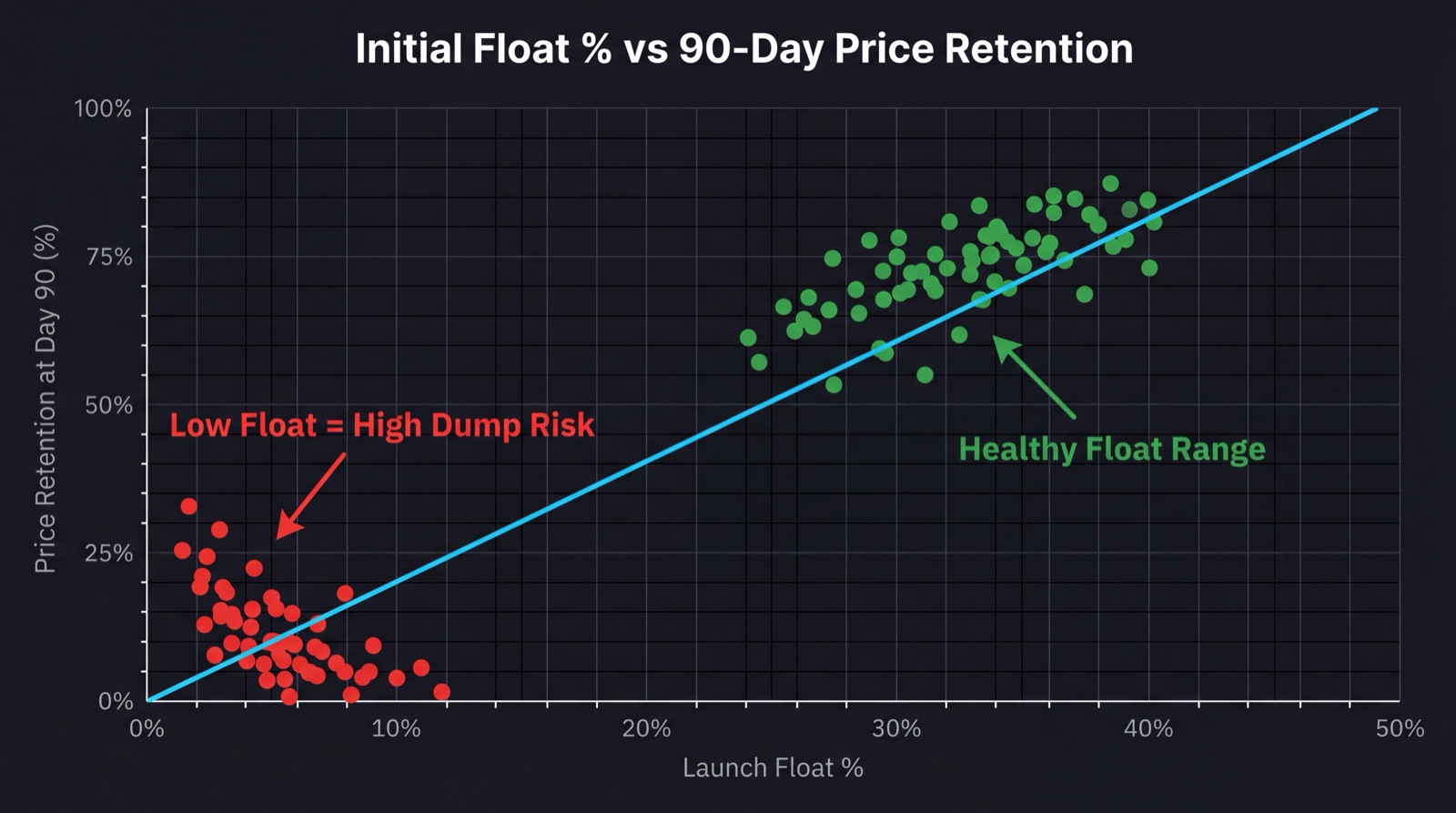
Launching with under 5% circulating supply creates artificial scarcity on day one. Price pumps on thin volume. FDV looks enormous. The project gets coverage. Then the vesting schedule releases the remaining 95%, sophisticated participants who positioned short before the cliff collect their gains, and retail holders who drove the initial price absorb the correction and exit last.
This is visible on-chain before it happens. Wallet concentration shows where tokens sit. Vesting schedules are public. Any informed participant can read the cliff date and act on it.
Business Wire's 2023 analysis found that 56% of ERC-20 token listings showed signs of insider trading in the 24 hours before listing announcement. Low float launches are the structural condition that makes this possible: when insiders hold most of a thin-float token, information asymmetry is a design feature, not a bug.
Token tracking data shows the pattern clearly. Tokens launching with under 10% initial float underperform tokens launching with 20-40% float over the following 6 months. High float tokens have rougher day-one price discovery but stabilize faster because the market is dealing with real supply depth.
The fix: higher initial float with linear vesting over 3-4 years. Vesting events become non-events instead of scheduled corrections.
Insider Allocation Cliffs and Why the Market Prices Them In Before You Do

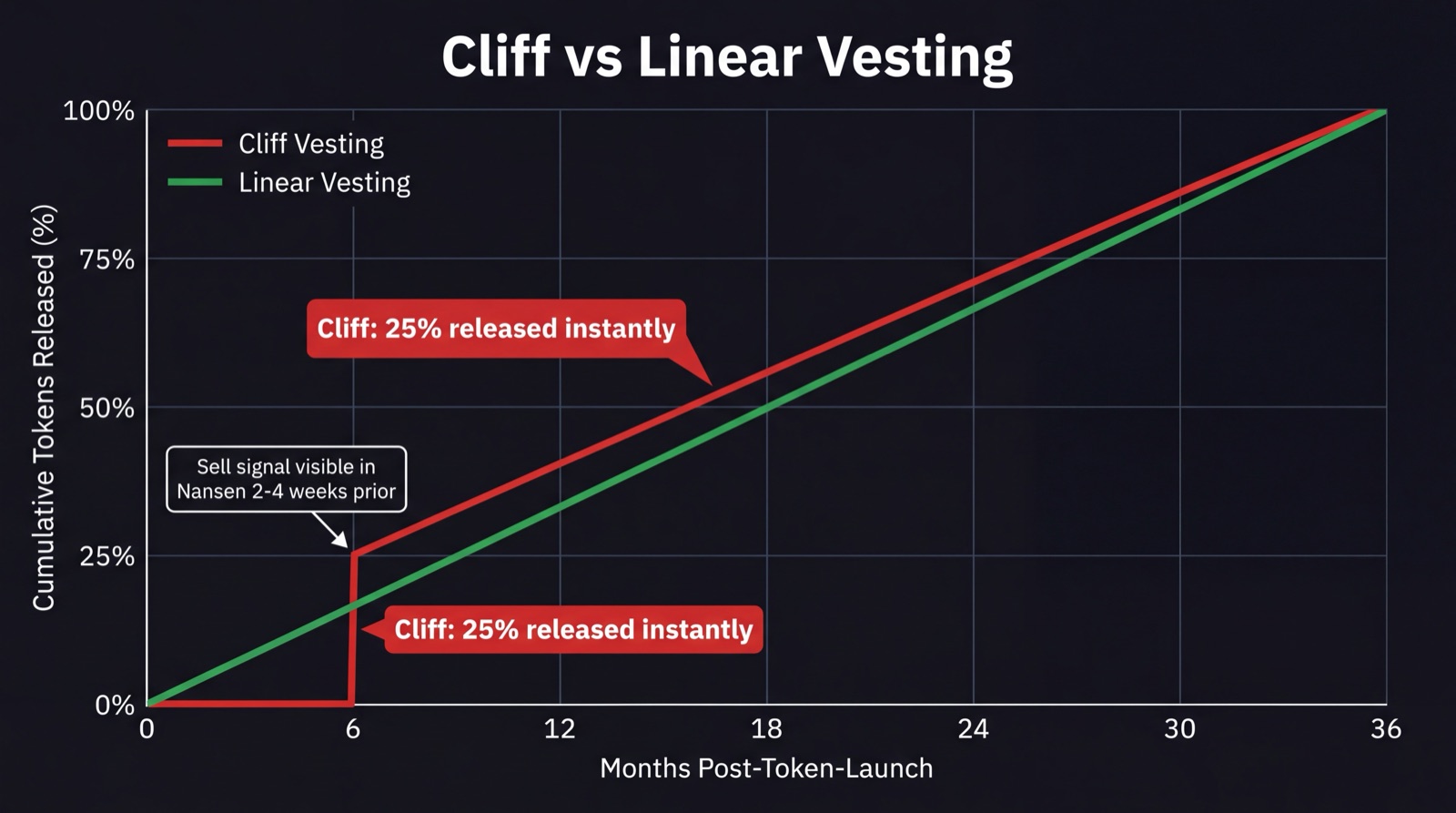
The 6-month cliff on 20-30% team and VC allocation is a publicly known sell event. Savvy DeFi participants track wallet vesting schedules via Nansen and Dune. When a large cliff approaches, they short the token or exit positions before the event. Retail holders who stayed see the price drop without understanding the mechanics, which is exactly what the participants who read the schedule were counting on.
The community reads the token allocation table. When they see 20-30% going to team and VCs with a 6-month cliff, they know those wallets will sell. The chart will confirm it regardless of what the team says publicly.
Linear vesting over 3-4 years with no cliff removes the event risk. No single date when a large block becomes liquid. Supply enters gradually. The market has time to absorb it without any participant having a structural advantage from the schedule.
Smart Contract Risk as a GTM Problem: Why Launching Unaudited Is a Disqualifier
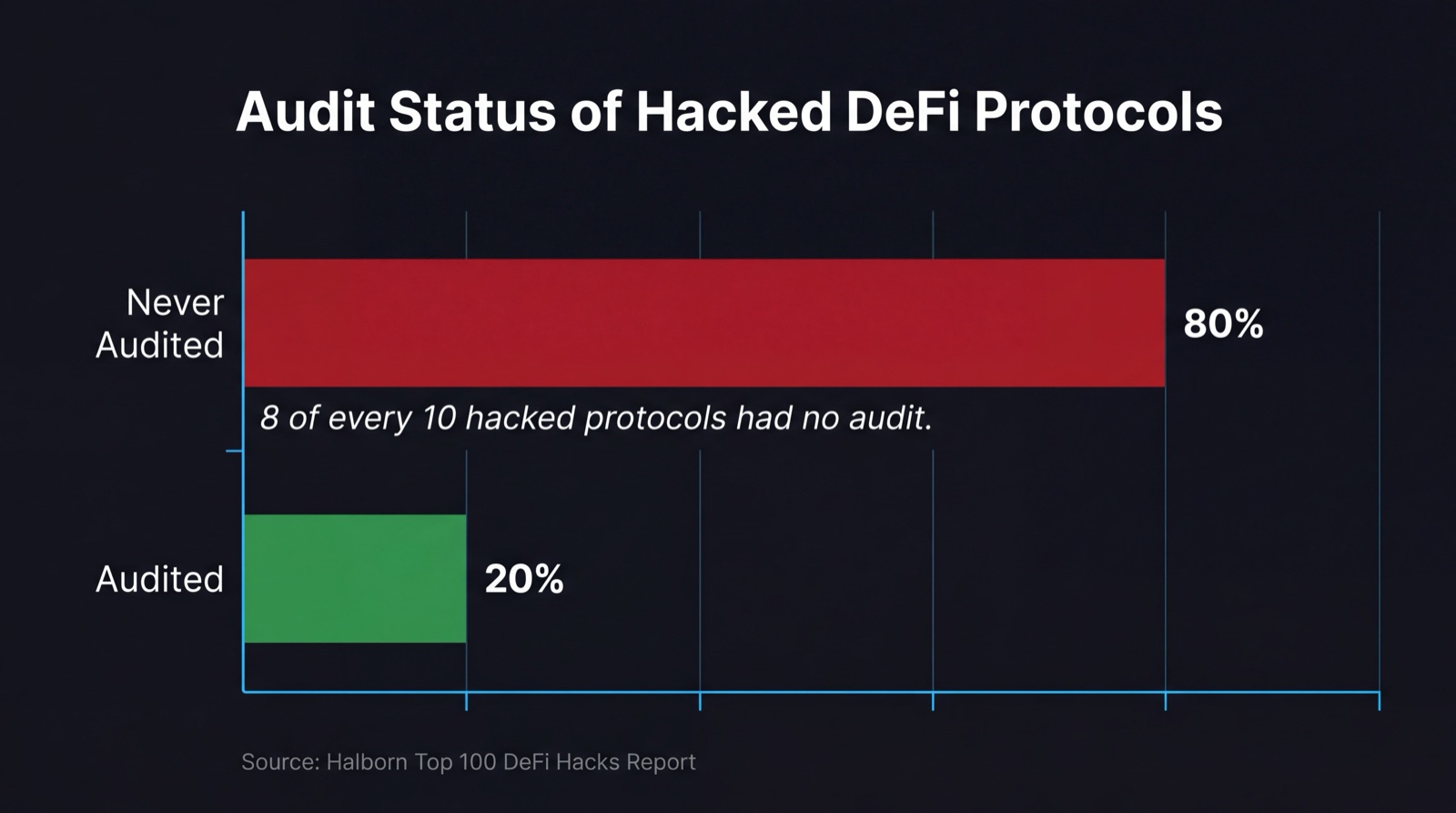
An unaudited smart contract isn't a launch risk. It's a launch disqualifier. Halborn's analysis of the top 100 DeFi hacks found that only 20% of hacked protocols had ever been audited. The attack surface is largest at launch: code is new, edge cases haven't been stress-tested in production, and attackers actively target new releases. An exploit post-launch ends the protocol.
The audit isn't a checkbox. It's the primary third-party trust signal available to users depositing real capital into a contract they can't read themselves.
CertiK, Hacken, Trail of Bits, and OpenZeppelin are the recognized firms. A one-page summary from an unknown firm isn't an audit. It's a document that looks like one.
Budget for the audit before the launch budget. It's the foundation the rest of the launch sits on.
Launching Without an Indexed Presence and What It Costs Your Token
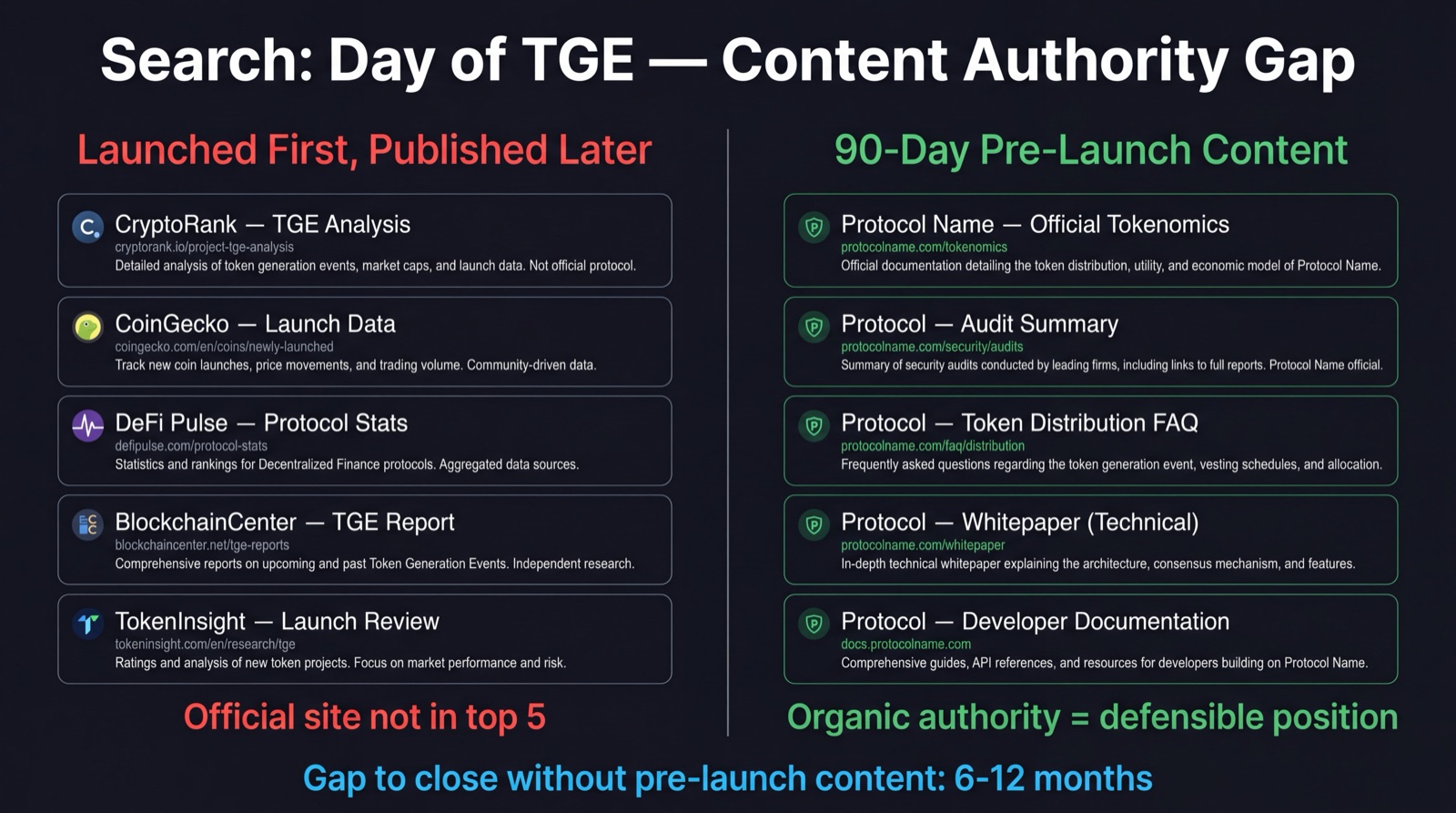
If Google can't crawl your protocol's site before launch day, there's no organic search floor. Every query returns competitor results or nothing. Building search authority takes months: a site live for two weeks has none. The community launches into a vacuum where people actively researching the protocol find no primary source, only aggregators and competitor content.
The fix is a 90-day pre-launch content operation. Publish the docs. Publish the tokenomics breakdown. Publish the audit summary. Publish the protocol explainer. Get these pages indexed and building authority before the TGE. That's 90 days of compounding vs. zero days if you launch first and publish later.
Search presence also functions as a credibility signal independent of Twitter follower counts. A protocol with indexed documentation, a readable tokenomics page, and a published audit summary communicates institutional readiness before any investor conducts due diligence.
The same principle applies to CMC and CoinGecko listings. Incomplete listings with missing links, blank descriptions, and no site verification are trust signals in the wrong direction. Protocol directory presence is crawlable and indexable.
The Airdrop Retention Problem and Why Most Recipients Sell Within a Week
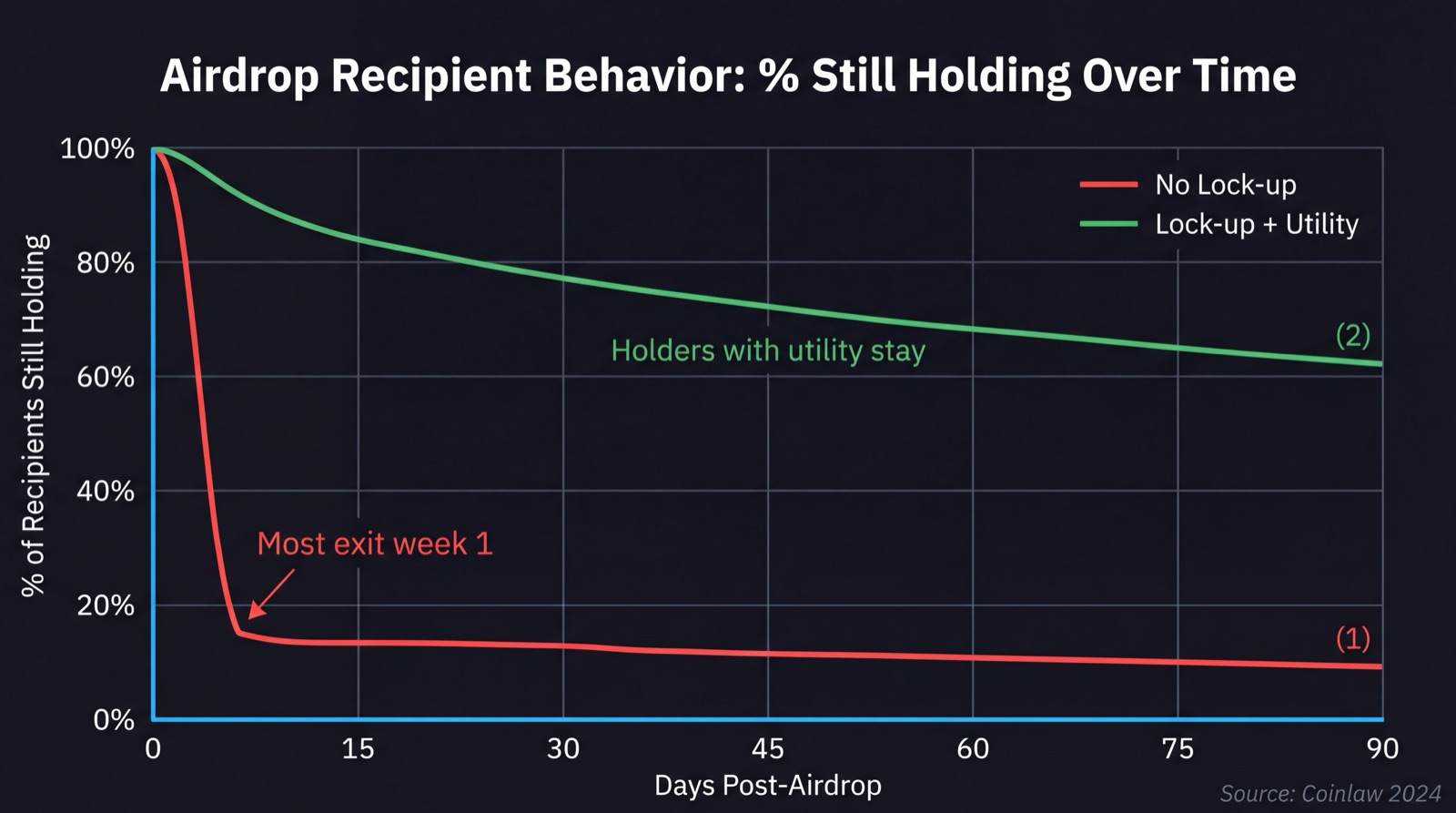
Airdrops with no lock-up and no utility requirement produce mercenary holders. Coinlaw's 2024 analysis found the vast majority of airdrop recipients liquidate within the first week. That's rational behavior: the expected value of holding a volatile new token with no lock-up is lower than the certain value of selling today. Founders build the airdrop expecting community. The on-chain data shows a one-time sell event.
The protocols that retained airdrop recipients changed the mechanics. Lock-up periods, utility requirements, and additional rewards for staking received tokens all change the calculus. The tokens stay in wallets. Those wallets become protocol users.
The most effective retention airdrops I've tracked tied receipt to an action: receive tokens only after completing a protocol interaction, boost allocations for users who lock for 6 months, build the airdrop into a points system requiring sustained usage to claim. Each mechanic filters for genuine protocol interest rather than token speculation. If you're rethinking the airdrop entirely, eight alternatives that produce stickier retention covers the mechanisms with on-chain evidence on what held holders past 90 days.
Five On-Chain Signals That Predict Token Launch Failure Before Trading Begins
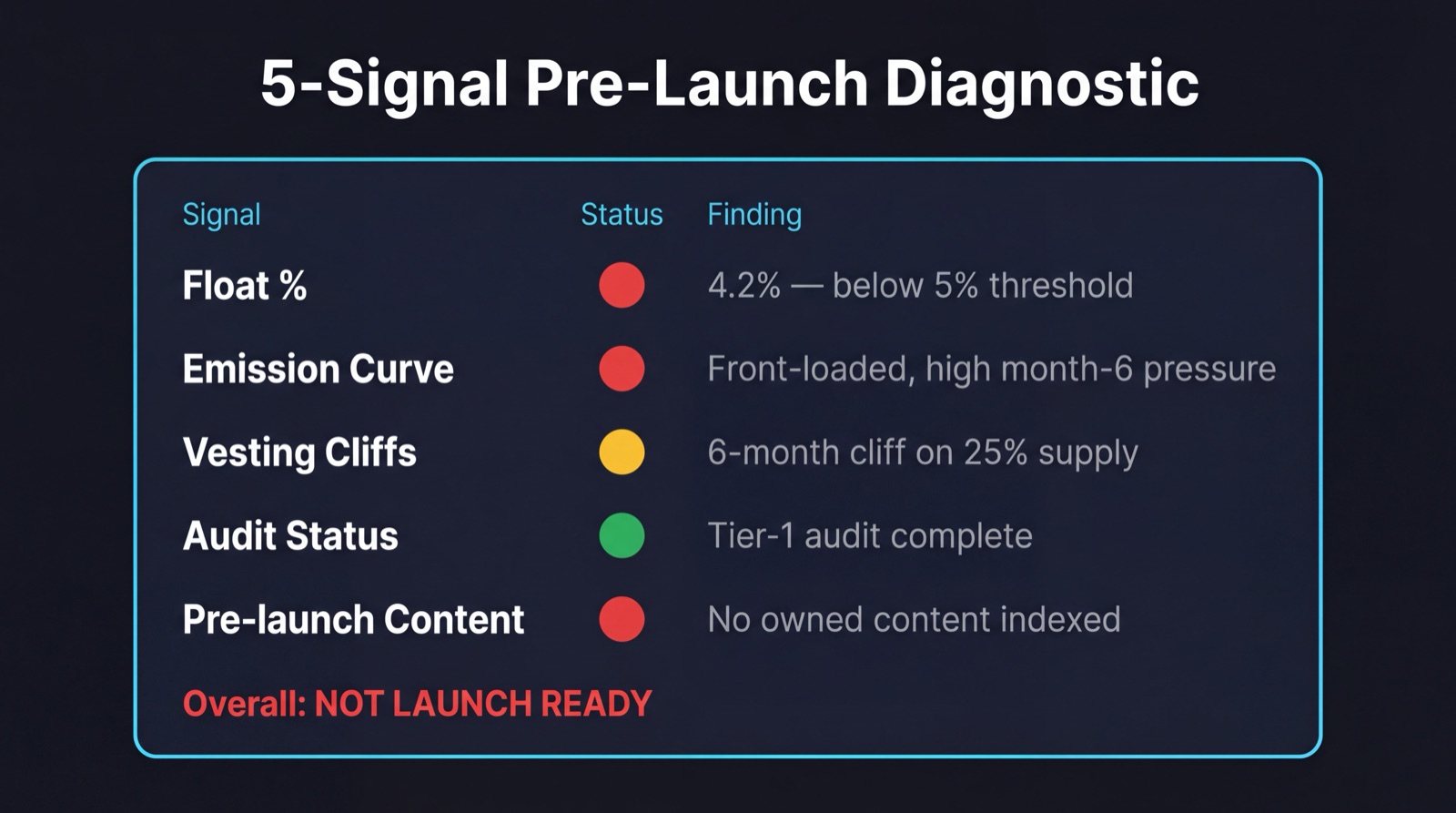
After reviewing 20+ launches, these are the five diagnostics I run before forming any view on whether a token will hold value past 90 days. All five are readable before the first trade.
1. Emission curve shape. Is supply front-loaded or back-weighted? More than 30% of supply vesting in the first 6 months, with no demand sink, is a sell machine. Model the sell pressure against demand projections on paper before the token trades.
2. Float percentage on day one. Under 10% circulating float with high FDV is a warning sign. Under 5% is a red flag. The visible price is a thin-market price that corrects when supply arrives.
3. Wallet concentration at launch. If the top 10 wallets hold 60%+ of circulating supply on day one, the token is centralized with extra steps. Concentration at this level produces volatility that retail participants absorb disproportionately.
4. Audit presence and source. A published report with findings and team responses from CertiK, Hacken, Trail of Bits, or OpenZeppelin, linked from the protocol's main site and findable in under 30 seconds. Not a self-reported review. Not a partnership announcement with an audit firm.
5. Protocol revenue mechanics. Does the token have a claim on protocol revenue? Quantify it: how much fee revenue flows to token holders at current TVL? At 10x TVL? If the numbers are defensible at realistic projections, the token has fundamental support.
These aren't predictions. They're diagnostics. Run them before the launch, not after. For the full pre-launch GTM sequence that builds on these signals, the DeFi launch framework for Web3 founders covers the complete checklist from tokenomics through distribution.
The on-chain data is available. The patterns are documented. The failure modes repeat because most founders build the launch they want rather than reading what the data is designing for them.
The practical sequence: six months before launch, model your emission curve against demand projections. Three months out, check wallet concentration and initial float. Sixty days out, confirm the audit is complete and the site is indexed. Thirty days out, review your airdrop mechanics against the retention data.
Each step surfaces a problem when it's still fixable. After the token trades, the design is locked. You can't restructure a vesting schedule post-launch without triggering community backlash. You can't rebuild organic search authority in two weeks. You can't retroactively audit a contract after an exploit.
The founders who run clean launches don't have better tokenomics instincts. They run the diagnostics early enough to act on what the data shows.
Frequently Asked Questions
What percentage of DeFi token launches fail?
Most DeFi tokens lose 80-90% of their launch value within the first year. Post-mortem analysis consistently surfaces the same structural patterns across unrelated protocols and market cycles. Emission curve design, low float mechanics, and unaudited contracts account for the majority of documented failures.
What is the Ethena ENA emission curve and why does it matter?
Ethena's ENA token launched with a front-loaded vesting schedule: early investors and team received allocations that vested on a 6-month cliff, then released linearly over 18 months. This guaranteed sustained sell pressure from earliest holders regardless of protocol performance. The schedule was public before trading began. Any protocol with a similar front-heavy curve faces the same structural outcome.
What is low float high FDV in crypto?
Low float/high FDV describes tokens launched with a small circulating supply, under 10% of total, but priced as if the full supply were circulating. The visible price is artificially high because it's set in a thin market. When the vesting schedule releases remaining supply, price corrects to reflect real market depth. Sophisticated participants position short before the correction because the cliff dates are public.
How do I check if a DeFi token has insider allocation cliffs?
Check the project's published tokenomics page for team and investor allocation percentages. Use Nansen or Dune Analytics to track wallet addresses associated with token allocations. Any wallet holding a large locked balance with a visible vest date is a future cliff. Cross-reference cliff dates with the current token chart to see how previous cliff events moved price.
Why do airdrops fail to retain DeFi users?
Airdrops with no lock-up or utility requirement create mercenary holders. Recipients have no incentive to hold a volatile token when they can sell at certain value today. Protocols that retain airdrop recipients add lock-up periods, staking requirements, or points systems that filter for genuine protocol users rather than token speculators.
What is the minimum circulating supply for a healthy DeFi token launch?
Most analysts recommend 20-40% circulating supply on launch day. Under 10% creates artificial scarcity that invites manipulation. Under 5% is a structural red flag. Higher initial float produces rougher day-one price discovery but faster stabilization as supply and demand reach equilibrium at real market depth.
How long should DeFi team token allocations vest?
Linear vesting over 3-4 years with no cliff is the market-accepted standard. A 6-month cliff on 20-30% team and VC allocation creates a known sell event. The market prices it in advance by positioning short before the cliff date. Linear vesting removes the event risk by distributing supply release over time with no single large liquid date.
Which smart contract auditors are trusted in DeFi?
The recognized firms are CertiK, Hacken, Trail of Bits, and OpenZeppelin. A published report with findings and team responses, linked from the protocol's main site, is the standard. A one-page summary from an unknown firm, a self-reported review, or a partnership announcement with an audit firm is not an equivalent trust signal.
References
- Solidus Labs via Business Wire (2023). Crypto Insider Trading Intelligence Report. 56% of ERC-20 token listings since 2021 showed signs of insider trading in the 24 hours before announcement. businesswire.com
- Halborn (2025). Top 100 DeFi Hacks Report. Only 20% of the top 100 hacked DeFi protocols had ever been audited. halborn.com
- CoinLaw (2024). Token Airdrop Statistics. Over 64% of airdrop recipients sold their tokens at TGE. coinlaw.io
- Nansen. Wallet tracking and on-chain vesting schedule analysis platform. nansen.ai
- Dune Analytics. On-chain protocol data, TVL metrics, and token distribution dashboards. dune.com
- DefiLlama. Protocol TVL tracking and cross-protocol launch performance data. defillama.com
Gabriel Mangabeira is a Web3 growth consultant at mangabeira.net. He works with post-PMF DeFi protocols on distribution systems and GTM mechanics.
Ready to diagnose your protocol's growth gaps?
A structured Web3 Growth Audit across 6 dimensions: website, dApp, social, community, SEO, and PR. Delivered in 72 hours.
Run the Growth Audit →