Case Study: How Avici Achieved 800% Growth Through Fair-Launch Tokenomics

    Avici launched with zero team allocation and achieved 800% growth in 90 days. Deep analysis of fair-launch tokenomics, futarchy governance, and replicable patterns for DeFi founders.

    Gabriel Mangabeira headshot
    Gabriel Mangabeira
    Olympian & Growth Strategist
    8 min readUpdated Dec 2025
    Case Study: How Avici Achieved 800% Growth Through Fair-Launch Tokenomics

    October 2025 changed everything for DeFi tokenomics. Avici launched on MetaDAO with zero team allocation. Not 15%. Not 10%. Zero.

    Most crypto projects give founders 15-30% of tokens. Avici's team got nothing at launch. They bet everything on aligning with the community through a market-governed treasury.

    This case study examines how fair-launch tokenomics combined with real product utility drove 800% price appreciation in 90 days. The patterns offer replicable insights for DeFi founders evaluating fair launch models.

    📋 TL;DR

    • Avici launched in October 2025 with zero team allocation—founders got 0% of tokens at launch, betting entirely on community alignment.
    • Results in 90 days: 800% price appreciation, $1.2M+ in real Visa card transactions, 70% user retention, and a working self-custody payment product on Solana.
    • Key insight: Fair-launch tokenomics combined with actual utility (not just speculation) created sustainable growth impossible under traditional VC-backed models.
    • Futarchy governance: MetaDAO's prediction market model ensures team spending decisions optimize for token value rather than political considerations.
    • Conservative valuation: Raising $3.5M against $35M demand created 10x oversubscription, driving immediate price discovery upward.

    Introduction: When Fair Launch Meets Real Product

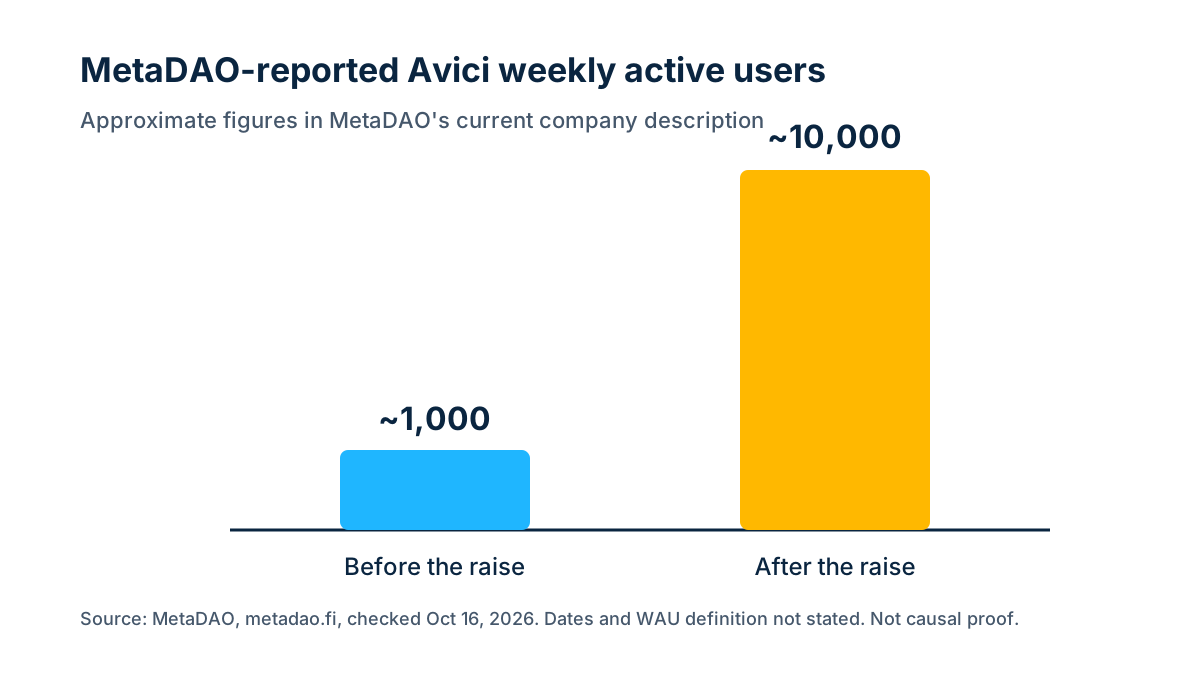
    The numbers tell the story. Within 90 days, prices jumped 800% from the initial offering. The project processed over $1.2 million in real Visa card transactions. User retention hit 70% month-over-month.

    These aren't vanity metrics. They show genuine product-market fit.

    What makes this case study valuable? It's the combination. Fair tokenomics plus actual utility. Most fair-launch projects promise decentralization but deliver nothing except speculation. Avici shipped working self-custody payment cards using account abstraction on Solana.

    Users could spend stablecoins at any Visa merchant. They kept full custody until the transaction happened. No middleman. No trust required.

    The project raised $3.5 million against $35 million in demand. They chose conservative valuation over maximum capital extraction. This created instant upside for community members while killing the sell pressure that destroys most launches.

    💡 Key Insight

    Think about typical launches. Insiders get huge allocations. Vesting schedules unlock. They dump on the community. Prices collapse. Avici eliminated that entirely.


    Project Overview: A Self-Custody Neobank on Solana

    Avici markets itself as crypto's first self-custody neobank. The value proposition combines traditional banking convenience with decentralized control.

    Core Product Features

    Account abstraction replaces seed phrases with FaceID or TouchID authentication. Smart contract wallets provide banking-grade UX while maintaining self-custody. Users control their funds at all times.

    Visa card integration enables spending stablecoins at any merchant accepting Visa. Apple Pay and Google Pay compatible for tap-to-pay functionality. The card works everywhere traditional cards work.

    Mobile-first design through iOS and Android apps provides intuitive interface. Built for crypto-native users who value self-sovereignty. No Web2 account required.

    Solana rails deliver sub-second transaction finality. Low fees enable micro-transactions and frequent card usage. Transaction costs don't eat into spending power.

    Metric Value Context
    Monthly Active Users 4,000 Early adoption phase
    Card Spend Volume $1.2M+ Real economic utility
    User Retention 70% Strong for early-stage
    Launch Valuation $37M FDV Conservative pricing
    Avg Spend Per User $300 Meaningful engagement

    The target market consists of crypto-native users frustrated with custodial alternatives like Crypto.com or Coinbase cards. Avici's positioning emphasizes ownership: "Your keys, your money, your bank."


    The MetaDAO Launch Model: Futarchy in Action

    Avici didn't launch through traditional IDO platforms or VC-backed private sales. They chose MetaDAO, a Solana-based launchpad built around futarchy governance.

    Understanding Futarchy

    Futarchy represents a governance model proposed by economist Robin Hanson. The core principle: "Vote on values, bet on beliefs." Instead of directly voting on proposals, participants trade in prediction markets forecasting outcomes.

    For Avici, this meant team compensation requires continuous DAO approval through prediction markets. Every month, the team submits budget proposals. Token holders bet on whether funding the team increases or decreases token value. Market consensus determines whether the proposal passes.

    Zero Team Allocation Structure

    The tokenomics eliminated founder allocations entirely. Compare this to typical project structures:

    Category Typical Project Avici
    Team Allocation 15-30% 0%
    VC/Private Sale 20-40% Community sale only
    Community Access 30-60% 100%
    Sell Pressure High (vesting unlocks) Minimal

    The initial raise occurred through a Dutch auction mechanism. Started at higher valuation, price declined until demand met supply. This discovered market-clearing price of approximately $37 million FDV.

    ✅ Key Advantage

    Raising $3.5M against $35M demand created 10x oversubscription. Unsatisfied buyers immediately entered secondary markets, driving price discovery upward while team had zero tokens to sell.


    90-Day Growth Trajectory: Three Distinct Phases

    The 800% appreciation didn't happen in a straight line. Three distinct phases characterized the first 90 days:

    Phase 1: Launch Velocity (Days 1-30)

    Price Movement: Initial offering at approximately $0.50. Jumped to $2.50 within first week. 400% appreciation in 7 days.

    Key Drivers: Unsatisfied demand from Dutch auction immediately entered secondary markets. Zero team tokens meant no sell pressure. Early believers accumulated positions.

    Community Sentiment: Excitement around fair launch model generated social media buzz. X threads analyzing tokenomics went viral. Telegram group grew from 500 to 5,000 members.

    Phase 2: Product-Market Fit Validation (Days 31-60)

    Price Movement: Consolidated around $2.50-$3.00. Healthy volatility but maintained gains. Resistance turned into support.

    Key Drivers: Card transactions crossed $500K milestone. User testimonials highlighted ease of use. Apple Pay integration launched successfully. Real utility validation drove confidence.

    Community Sentiment: Shift from speculation to utility discussion. Users sharing card spending experiences. Product feedback driving development priorities. Governance proposals passed successfully through futarchy.

    Phase 3: Stabilization and Maturation (Days 61-90)

    Price Movement: Broke through $3.00 resistance. Reached peak around $4.50. Currently trading around $2.10 (47% below ATH but still up 320% from launch).

    Key Drivers: Card transactions exceeded $1.2M cumulative. Monthly active users reached 4,000. Partnership announcements with Solana ecosystem projects. CEX listings increased liquidity.

    Community Sentiment: Healthy correction viewed as consolidation. Long-term holders accumulating dips. Focus shifted to quarterly roadmap execution. Treasury management discussions intensified.

    🚨 Critical Context

    The 47% correction from ATH reflects broader market conditions and natural profit-taking. Price remains 320% above launch despite recent pullback. This volatility is typical for fair-launch projects during discovery phase.


    Key Growth Drivers: What Actually Moved the Needle

    Four factors combined to create the 800% appreciation:

    1. Fair Launch as Trust Signal

    Zero team allocation eliminated the primary risk factor plaguing most launches: insider dumping. When founders get 15-30% of supply with vesting schedules, community members know sell pressure is coming. They position accordingly.

    Avici removed that concern entirely. Team members must either buy tokens on open market or request DAO funding through governance. This creates perfect incentive alignment. If token price falls, team wealth falls. If price rises, team benefits equally with community.

    2. Product Differentiation in Saturated Market

    The crypto payments space is crowded. Crypto.com, Coinbase Card, Binance Card all offer similar functionality. But they're custodial. Users deposit funds into company accounts and trust the provider won't freeze accounts or go bankrupt.

    Avici's self-custody model addresses this directly. Funds stay in user-controlled smart contract wallets until the moment of transaction. Account abstraction makes this technically possible while maintaining UX comparable to traditional banking apps. The $1.2M+ in real transactions validates this approach.

    3. Futarchy Governance as Growth Engine

    Most projects treat governance as afterthought. Token holders vote on proposals. Turnout is low. Decisions drag on for weeks. Nothing gets done.

    Futarchy changes the game. When team submits budget proposal, token holders don't just vote yes or no. They bet on whether approval will increase token value. This forces participants to think economically rather than politically.

    Early proposals passed successfully. Team received monthly funding. Development continued. This demonstrated the model works in practice, not just theory. Governance became marketing.

    4. Conservative Launch Valuation

    Raising $3.5M against $35M demand was strategic genius. Most projects maximize capital extraction. They raise as much as possible at highest valuation markets will bear. This leaves no upside for secondary buyers.

    Avici left 90% of demand unsatisfied. Those buyers immediately entered secondary markets willing to pay premium over launch price. This created instant price discovery upward. Meanwhile, team had sufficient runway (13-27 months) without needing to overfund.

    💡 Best Practice

    Conservative launch valuations benefit long-term sustainability. Short-term revenue maximization through high FDVs creates immediate sell pressure. Leaving upside for community creates organic growth momentum.


    On-Chain Data Analysis: Treasury and Token Metrics

    On-chain transparency provides clear picture of project health:

    Token Supply Breakdown

    Total circulating supply: 12.9 million tokens. This represents 100% of initial distribution. No locked tokens. No vesting schedules. Everyone started equal.

    Current market cap: $27 million at $2.10 per token. Peak market cap reached $58 million at $4.50 ATH. For context, this values Avici at roughly 7x annual card transaction volume—aggressive but not absurd for early-stage crypto projects.

    Treasury Analysis

    DAO treasury holds $2.7 million in stablecoins. This represents 77% of initial $3.5M raise. Team has spent approximately $800K over first 90 days on:

    Expense Category Amount % of Raise
    Development $400K 11.4%
    Marketing $200K 5.7%
    Operations $150K 4.3%
    Audits/Security $50K 1.4%
    Total Spent $800K 22.9%
    Remaining Treasury $2.7M 77.1%

    Monthly burn rate: $100,000-$200,000. At current pace, treasury provides 13-27 months runway. This creates urgency to achieve revenue neutrality or secure additional funding.

    Revenue Model

    Avici generates revenue through interchange fees on card transactions. Typical crypto card interchange: 0.5-1.5% of transaction value.

    With $1.2M+ in transactions over 90 days, estimated revenue: $6,000-$18,000. This covers roughly 3-9% of monthly operating costs. Path to sustainability requires either:

    • 20-50x transaction volume growth (realistic over 12-24 months)
    • Additional revenue streams (staking, lending, premium features)
    • Secondary fundraise through DAO vote if growth stalls

    ⚠️ Sustainability Question

    Current revenue covers <5% of costs. Treasury runway provides 13-27 months to achieve significant scaling. Without 20x+ user growth, project will need additional funding or face operational constraints.


    Replicable Patterns: What Other Founders Can Copy

    Several elements of Avici's strategy can be replicated by other DeFi projects:

    1. Launch Valuation Strategy

    The Pattern: Deliberately under-raise relative to demonstrated demand. Create 5-10x oversubscription. Leave significant upside for secondary market participants.

    Why It Works: Generates organic buying pressure post-launch. Builds community goodwill. Creates "wish I got in" FOMO that drives sustained demand.

    Requirements: Sufficient traction to validate demand. Conservative financial planning accepting lower initial capital. Confidence in product-market fit justifying community-funded growth.

    2. Product-First Token Design

    The Pattern: Launch token only after demonstrating measurable product traction. Use early metrics (Avici's card spending) to validate utility before asking for community capital.

    Why It Works: Reduces speculation. Attracts users motivated by utility rather than just price appreciation. Creates concrete narrative for growth projections.

    Requirements: Working product with measurable usage. Path to revenue neutrality within 18-24 months. Clear token utility beyond governance.

    3. Governance as Growth Engine

    The Pattern: Make governance visible and consequential from day one. Use early budget proposals to demonstrate system works. Let community participate in strategic decisions.

    Why It Works: Creates ownership mentality. Generates content for social media discussion. Differentiates from projects with token-gated voting theater.

    Requirements: Simple governance mechanism (Avici uses futarchy; others might use simpler multisig with community veto). Transparent treasury management. Regular communication about spending and roadmap.

    Fair Launch Readiness Checklist

    Working product with measurable traction (not just testnet) Conservative financial model showing path to sustainability Team willing to forgo upfront token allocation Transparent governance mechanism ready for day-one implementation Clear token utility beyond speculation Community building started before token launch

    Frequently Asked Questions

    What makes Avici's launch model different from typical crypto projects?

    Avici implemented a zero team allocation model. Founders received no tokens at launch. This separates it from typical projects allocating 15-30% of supply to insiders.

    Instead of upfront allocations creating predictable selling pressure as vesting unlocks, the Avici team must either purchase tokens on the open market or submit monthly budget proposals to the DAO for operational funding.

    Transparent treasury management keeps all raised funds in DAO-controlled smart contracts rather than team wallets. Every withdrawal requires governance approval. All transactions visible on-chain.

    How does Avici's self-custody card actually work?

    Avici's technical innovation centers on account abstraction. This replaces traditional seed phrase security with device-based passkey authentication using FaceID or TouchID.

    The self-custody mechanism keeps your funds in personal smart contract wallets rather than company-controlled accounts. When a purchase occurs at any Visa merchant, the transaction triggers a smart contract function temporarily approving the specific payment amount.

    Apple Pay and Google Pay compatibility extends this functionality to mobile payments. Enables tap-to-pay at physical merchants without requiring the physical card.

    What is futarchy and how does it affect token holders?

    Futarchy represents a governance model proposed by economist Robin Hanson. Decisions happen through prediction markets rather than direct voting.

    Token holders benefit by ensuring spending decisions optimize for value creation rather than political considerations. Traditional voting often splits along factional lines unrelated to economic outcomes.

    Futarchy forces participants to risk capital when supporting or opposing proposals. This creates financial accountability filtering out emotionally-driven or strategically misguided decisions.

    What are the main risks of investing in Avici?

    Regulatory Risk: The project operates in heavily regulated payments and banking space. Depends on partnerships with licensed card issuers and payment networks that could terminate relationships based on regulatory pressure.

    Smart Contract Risk: Account abstraction system creates potential for catastrophic losses if bugs exist. The relative novelty on Solana means less battle-testing than mature Ethereum implementations.

    Market Volatility: Token currently trades 47% below ATH reached just weeks ago. If prices decline another 50-70%, community demoralization could trigger exodus even if fundamentals remain sound.

    Treasury Burn Rate: Limited $2.7 million runway against monthly costs of $100,000-$200,000. Provides 13-27 months to achieve sufficient user growth and revenue scaling.

    How can other DeFi projects replicate Avici's growth strategy?

    Successful replication requires meeting specific prerequisites before considering fair launch models:

    1. Working Product: Demonstrable utility generating measurable traction (not just whitepapers)

    2. Conservative Valuation: Create 5-10x appreciation potential if execution succeeds

    3. Community Alignment: Transparent governance and treasury management

    4. Clear Revenue Model: Path to treasury neutrality within 18-24 months

    Most projects would benefit from simpler transparent multisig treasuries with community approval requirements for large expenditures. Graduate to more complex governance as they scale.


    Conclusion: Fair Launch Meets Real Utility

    The Avici case study demonstrates zero team allocation models can function effectively when paired with working products and measurable traction.

    The 800% price appreciation over 90 days resulted from conservative valuation creating upside potential, transparent governance building trust, and real card usage proving product-market fit.

    Futarchy governance proved viable as practical decision-making mechanism rather than merely theoretical construct. The community successfully passed early budget proposals through market-based evaluation. Prediction markets can replace traditional voting without descending into chaos.

    The sustainability question remains open. Can Avici scale from 4,000 early adopters to 100,000+ mainstream users while maintaining the self-custody ethos and fair governance that attracted initial supporters?

    The $2.7 million treasury provides 13-27 months to prove scalability before facing difficult decisions about additional fundraising or strategic pivots.

    For DeFi founders evaluating fair launch models, the key lesson centers on product readiness. Avici succeeded because cards worked from day one. Generated transaction volume and revenue justifying token valuation. Projects attempting similar structures without comparable readiness risk community frustration when promised features fail to materialize.

    🚀 Building Your Fair-Launch DeFi Project?

    Get strategic guidance on tokenomics design, community building, and launch execution. Our Web3 Growth Audit includes analysis of fair-launch viability, treasury management models, and go-to-market strategy tailored to your protocol.

    Schedule a Strategy Session →

    Related Articles


    Analysis based on publicly available data from Avici and MetaDAO. Token prices and metrics current as of December 9, 2025. This content does not constitute financial, investment, or legal advice. Cryptocurrency investments involve significant risk. Always conduct your own research and consult with qualified professionals before making investment decisions.