Your Discord has 14,000 members. Your Twitter following grew 40% last quarter. Your governance forum gets 80 posts a month. And your protocol's organic referral rate is under 3%.
All three of those growth metrics are audience metrics, not advocacy metrics. Audience members show up when there's something in it for them: an airdrop, a yield opportunity, a token listing they don't want to miss. Advocates do something different. They explain the protocol to their own networks, pull in new wallets, and defend the project in spaces where you're not present — without being paid.
Most DeFi protocols have never actually met their advocates. Not because those people don't exist, but because the standard community dashboard doesn't show them. Community-led growth in DeFi doesn't start with building a program. It starts with finding who's already there.
This article covers what signals to look for, which mechanisms actually produce advocates instead of just participants, and a 30-day playbook you can run inside your existing community.
Why Your DeFi Community Isn't Producing Advocates (Yet)
The vanity metric trap
Three metrics show up in almost every community report. None of them predict whether anyone is actually sending friends to your protocol.
Discord member count tells you reach, not depth. Join-and-lurk is default behavior. Airdrop seasons inflate it massively. The number looks good in a board update and means almost nothing for organic referrals.
Governance proposal votes sound like engagement. In practice, most protocols barely hit quorum. A lot of wallets vote once, claim a reward, and never return. That's airdrop behavior, not stakeholder behavior.
Telegram member count measures broadcast reach. Members receive announcements. They don't initiate conversations or bring in new wallets.
The definition that matters
An advocate is someone who uses the protocol themselves (active wallet, not dormant), refers others without being paid to (attributable on-chain), and explains or defends the protocol in spaces where you're not present.
In most active DeFi communities, 2 to 5% of total members meet all three criteria. The rest are audience. The problem isn't that advocates don't exist. It's that most protocols don't know which 2 to 5% they are.
Why this happens
Growth teams report member count because it's the easiest thing to put in a slide. The actual advocacy signal sits in on-chain data most teams aren't pulling: governance participation rate across multiple proposals, multi-epoch liquidity with no incentive correlation, referral attribution in wallet cohort data. The protocols that have figured out community-led growth use different mechanisms. Three of them actually work.
The 3 Mechanisms That Convert Users into Evangelists
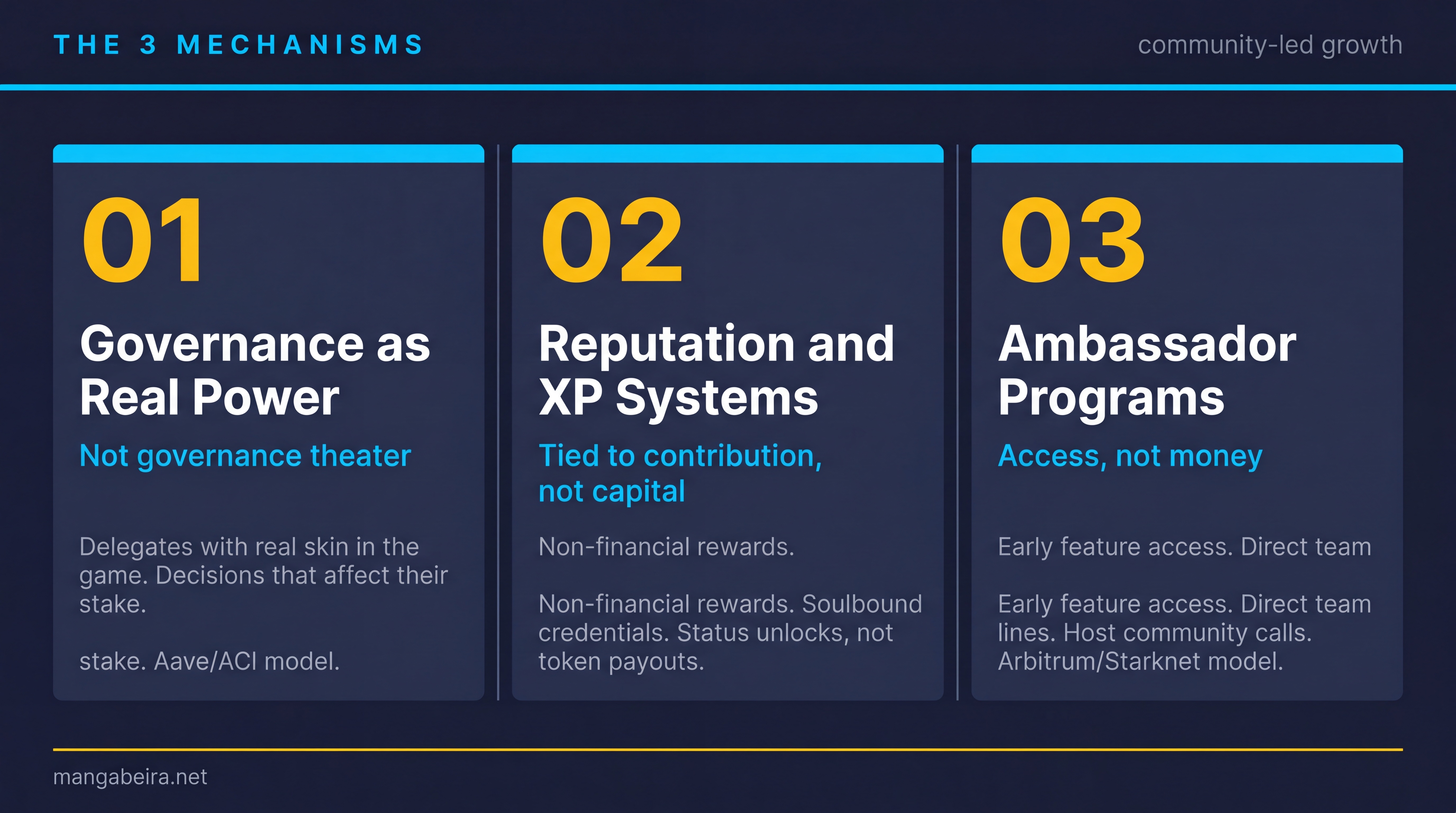
Mechanism 1: Governance as real power, not governance theater
Aave's governance system gives delegates actual influence over risk parameters, treasury allocation, and protocol direction. The Aave Chan Initiative (ACI) has become one of Aave's most effective distribution channels. They write governance posts, explain proposals to the broader community, and bring in new participants because they have real skin in the game. Their advocacy is authentic because they have genuine decision-making power.
Compare that to the standard governance setup: a proposal goes live, wallets vote yes or no, quorum sits at 3%, and nobody who voted mentions it afterward.
The test: does a vote require actually reading the proposal to vote correctly? If wallets can click "yes" on anything without consequence, it's theater. If delegates who vote wrong face real outcomes because their stake is exposed to the risk they approved, that creates stakeholders.
Failure mode: Voting rewards. Paying people in tokens to vote attracts extractors, not advocates. Extractor behavior is predictable: vote, claim the reward, never return. Voting rewards look like participation on a dashboard and produce almost no advocacy.
Mechanism 2: Reputation and XP systems tied to contribution, not capital
Galxe and Layer3 campaigns that reward non-financial contribution surface a different type of wallet than yield incentives do. Writing governance summaries, translating documentation, moderating Discord, onboarding new users: these require real effort. The wallets that complete them are investing time, which is a stronger signal than capital.
Contribution tasks that mint a non-transferable credential create a verifiable record of advocacy behavior. Status within the community becomes something the credential earns, and status is what advocates actually share.
Failure mode: XP farming. If the reward is financial (tokens, airdrops), you'll attract capital, not community. XP should unlock access and status, not cash. That's the design choice that separates contribution systems from farming programs.
Mechanism 3: Ambassador programs that give access, not money
Ambassador programs at Arbitrum and Starknet gave participants early access to protocol features, direct lines to the core team, and the ability to host official community calls. The advocacy was organic. Ambassadors shared because they had something exclusive worth sharing.
Programs that pay per tweet buy reach, not advocacy. Audiences can tell the difference between someone who genuinely believes in a protocol and someone paid to post about it. The former converts. The latter rarely does.
Key distinction: An ambassador who earns money from the protocol will eventually weigh whether the pay is worth their reputation. An ambassador who earns status and access has no such calculation to make. That's a fundamentally different incentive structure.
Which Channel Carries Which Advocacy Job
Channels serve different jobs in an advocacy program. The mistake is running all of them the same way.
| Channel | Primary job | Advocacy potential |
|---|---|---|
| Discord | Community depth: governance discussion, power user interaction, direct feedback | High — proto-evangelists are already here |
| Retention and conversion: owned relationship, survives platform migration | High — no algorithm interference | |
| Telegram | Broadcast: announcements, price updates, rapid distribution | Low — reach without depth |
Email is the highest-converting channel for DeFi protocols, but most teams underinvest in it because it doesn't feel crypto-native. Discord is where you'll find your proto-evangelists. But once identified, the relationship you build should span both Discord and email — one for depth, one for durability. For more on how to sequence these channels across your protocol's growth stage, the full channel comparison covers the decision matrix.
The On-Chain Signals That Identify Your Proto-Evangelists
Your proto-evangelists are already in your community. They've been there for months. You haven't found them because the standard DeFi KPI stack doesn't surface them. These three signals do.
Signal 1: Governance participation across multiple proposals
Not the token listing vote. Look for wallets that have voted on 3 or more proposals in 90 days, across different proposal types. This filters out airdrop claimers. Multi-proposal participation over 90 days is someone who's actually paying attention.
SELECT voter, COUNT(*) as vote_count
FROM [your_governance_votes_table]
WHERE block_time > NOW() - INTERVAL '90 days'
GROUP BY voter
HAVING COUNT(*) >= 3
Starting point only — adapt the table name to your governance contract's actual event logs.
Signal 2: Multi-epoch liquidity provision
Wallets that entered a pool before your last incentive program and are still there after it ended. That's someone who stayed when the financial reason to stay went away. That's a believer, not a farmer.
Signal 3: Referral attribution patterns
Wallets that generated 2 or more referrals, or wallet clusters — new wallets funded from the same address, or onboarded within 48 hours of an existing active member's transaction. That's advocacy with no incentive at all.
Combining the signals
A proto-evangelist meets at least 2 of the 3 criteria. Meeting all three is rare. Those are your tier-1 targets. In most protocols with 5,000 or more Discord members, this filter returns 15 to 30 people. Small list. Extremely high signal quality.
Most protocols using Collab.Land or Guild.xyz can match on-chain signals back to Discord usernames. Your governance voter who also has 2 referrals and multi-epoch LP is probably the person who writes thoughtful posts in #governance. The link is already there.
The 30-Day Advocate Activation Playbook
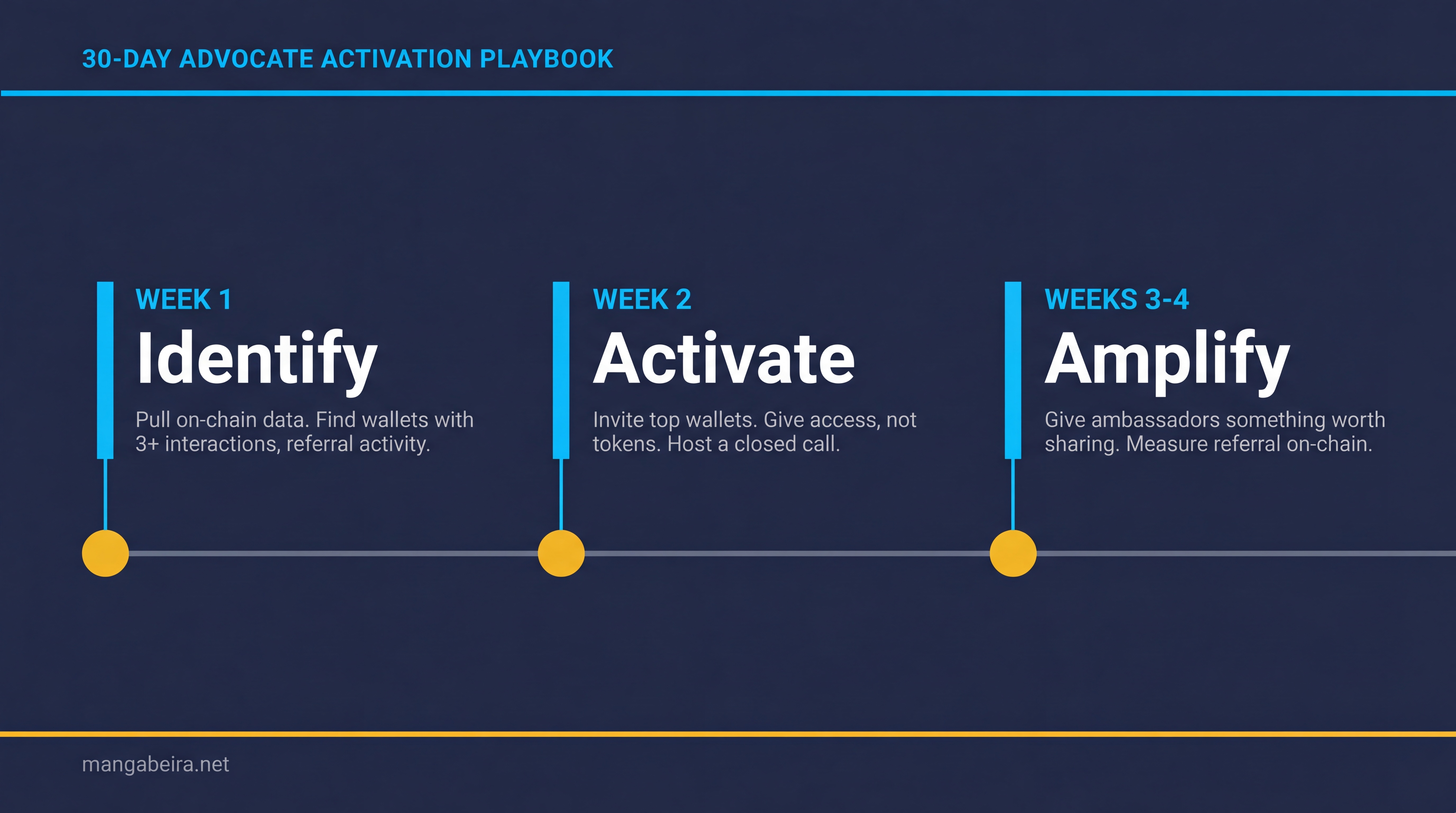
This is not a community management calendar. It's a targeted sprint: 30 days, 10 to 30 people, three phases. No new tool, no new program name, no budget line.
Week 1: Identify
Run the 3-signal filter on Dune. Pull governance participation (3 or more proposals, 90-day window), LP duration (2 or more epochs, entered before last incentive program), and referral attribution (2 or more referrals, or wallet cluster patterns). Cross-reference with Discord via Collab.Land or Guild.xyz. Tag each person by their strongest signal. Prioritize by signal count: anyone with 2 to 3 signals is tier 1.
Deliverable: A list of 10 to 30 people, their strongest signal, and their Discord handle.
Ready to map your protocol's advocate pipeline?
A Web3 Growth Audit surfaces exactly these signals across all 6 pillars: on-chain behavior, governance participation, community depth, referral attribution, and more.
Map Your Advocate Pipeline →Week 2: Activate
Do not send a mass message. This is 1:1 personal outreach that references something specific they did. Acknowledge their contribution. Ask for their opinion on something real. Give them exclusive access: pre-announcement governance context, a direct call with the core team, or early feature access before public launch.
What not to offer: token compensation. The moment you offer to pay them, you've changed the relationship from community member to contractor. Their advocacy stops being authentic and starts being a service. This is the single most common mistake in ambassador program design.
Target: 10 to 15 people contacted, 4 to 6 who engage with the exclusive access offer. Those move to Week 3.
Weeks 3 and 4: Amplify
Give them something worth sharing. Early access to a protocol update with context not yet public. A "first look" role they can reference. An invitation to co-author a governance proposal or protocol post.
Track on Dune (new wallets attributable to their network), on Discord (new members who mention the advocate's name in #introductions), and in governance (new participants they brought in). The 30-day benchmark: 5 to 10 advocates activated in Week 2 should produce 3 to 8 new wallets by Day 30. Small numbers. The highest-quality cohort you'll acquire all quarter.
Frequently Asked Questions
How do DeFi protocols build community-driven growth?
Through three mechanisms that produce authentic advocacy rather than paid participation: governance systems that give community members real decision-making power, reputation and XP systems that reward contribution over capital, and ambassador programs that offer access and status rather than token payments. The protocols that have done this best (Aave, Arbitrum, Uniswap) started by identifying who was already advocating before they built formal programs around it.
What is community-led growth in Web3?
In Web3, community-led growth means that community members drive protocol adoption through their own networks and on-chain behavior, not because they're paid to, but because they have genuine stake and status in the ecosystem. It's measurable on-chain: referral attribution, governance participation rate, and multi-epoch liquidity are all verifiable signals, not self-reported behavior.
How do you turn DeFi users into advocates?
The 30-day playbook covers this in three phases: identify using on-chain signals (governance participation, LP duration, referral patterns), activate through 1:1 personal outreach with exclusive access, then amplify by giving advocates something worth sharing. No token payments required.
What on-chain signals identify community advocates?
Three signals: governance participation across 3 or more proposals in 90 days, liquidity provision that predates and outlasts incentive programs, and referral attribution or wallet cluster patterns. A wallet that meets 2 of 3 criteria is a proto-evangelist. For the full measurement stack, the DeFi attribution framework covers referral attribution in depth.
Want a structured read on your protocol's community growth signals?
A Web3 Growth Audit covers community, on-chain behavior, governance participation, and referral attribution across all six pillars. Async delivery, no calls required.
Map Your Advocate Pipeline →Related Articles
- DeFi Attribution for Growth Marketers — Track referrals and measure advocate-driven acquisition in a decentralized environment.
- The Web3 Growth Marketer's DeFi Playbook — The full distribution framework for growth operators at post-PMF DeFi protocols.