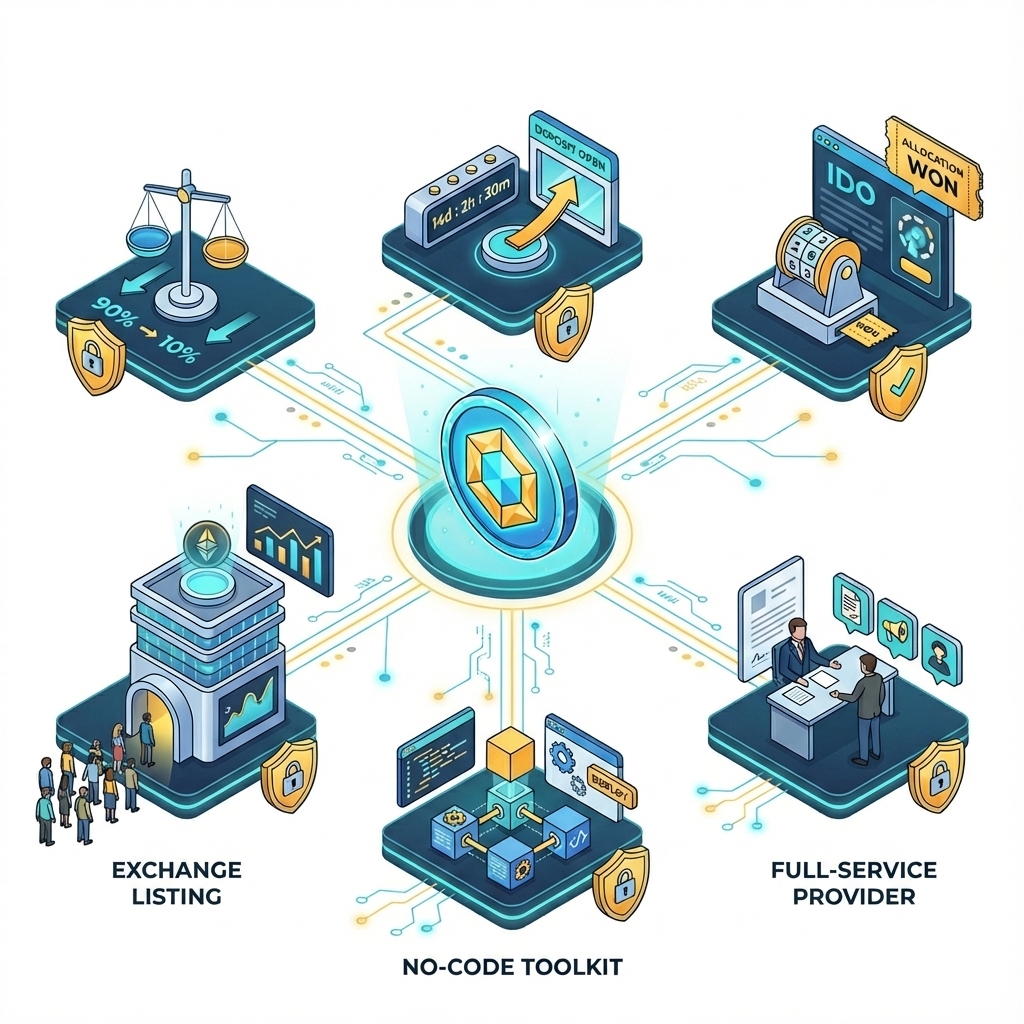
DeFi token launches in 2026 demand more than smart contracts and liquidity pools. Evidence from 118 token generation events in 2025 shows 84.7% of projects saw valuations drop post-launch, revealing a market shift from speculation to system-level integration.
Community consensus on Reddit and X shows traditional IDO launchpads failing 90% of the time, while Liquidity Bootstrapping Pools (LBPs) deliver fair distribution and real price discovery. Veteran DeFi investors explicitly recommend: "The true way to have an effective IDO is through Balancer's LBP...tokens get real price discovery and fair distribution."
This guide synthesizes community wisdom from Reddit r/defi, X conversations, and 2025 launch data to help founders navigate framework selection, avoid structural failures, and build sustainable token economies.
📋 TL;DR
- • Liquidity Bootstrapping Pools achieve 0% bot success rate: LBP mechanisms (99/1 weight ratio declining to 50/50 over 2-7 days) prevent front-running. Traditional DEX launches see bots capture 60-80% of initial liquidity.
- • Multi-chain deployment increases participation 25-40%: Cross-chain token standards (LayerZero OFT, Chainlink CCT) solve fragmented liquidity across 50+ blockchains.
- • Traditional IDO launchpads have 90% failure rate: Reddit community consensus reveals structural flaws in lottery-based allocation systems. Apollo (PAID) staking disaster resulted in 60% investor losses.
- • Regulatory compliance is mandatory: EU MiCA light paper filing required (cost: $20k-$50k), EU AI Act compliance deadline August 2, 2026. U.S. launches require Reg D/S exemptions or geo-blocking.
- • Community maturity shift (late 2025): Reddit tone changed from "wen moon" speculation to adoption metrics. Security audits now expected, not optional. Governance-only tokens face immediate skepticism without revenue sharing.
How to Choose Your DeFi Launch Framework (Decision Guide)
Before evaluating frameworks, answer these six questions that determine what's actually possible:
1. What Is Your Token's Economic Purpose?
- Fee capture (protocol revenue → token holders) → Product-First launch
- Governance only → High risk; Reddit consensus: "governance tokens are pointless without revenue sharing"
- Security/collateral (staking, restaking) → Alignment-heavy launch with lockups
- Incentive routing (liquidity mining) → Utility-first with strict vesting
🚨 Governance Token Warning
Reddit consensus (2025): Governance-only tokens create "theater" without real power. Arbitrum DAO voted against 750M token unlock; foundation proceeded with 50M anyway, proving governance was advisory not binding. Solution: Combine governance with revenue sharing (GMX, Curve, Lido models).
2. What Product Exists Today?
| Product Stage | Recommendation | Data Point |
|---|---|---|
| Mainnet with 6+ months operation | Product-First launch | 42% less post-TGE dumping |
| Testnet only | Points system (delay token 6-18 months) | Reduces regulatory risk |
| Design + docs | Too early; build MVP first | High failure risk |
| Just whitepaper | No credible framework will accept | Launch not viable |
3. What's Your Realistic Budget?
Balancer LBP via Copper/Prime Launch ($5k-$10k)
Timeline: 2-6 weeks
Polkastarter IDO or Thirdweb multi-chain ($10k-$100k)
Timeline: 3-5 months
DAO Maker with marketing or full-service providers
Timeline: 4-6 months
Binance Launchpad or custom app-chain
Timeline: 6-24 months
💡 Budget Breakdown
Security audits: $40k-$250k. Marketing: 70% of total budget recommended. Legal/compliance: $20k-$100k. Post-launch maintenance: 15-20% annually. Multi-chain deployment adds 30-50% premium over single-chain launches.
4. What Distribution Do You Control?
Reddit data (2025) reveals a surprising finding: "450K Discord members with zero contributors failed faster than 15K Discord with 500+ weekly contributors."
| Real Community Metric | Benchmark | What It Signals |
|---|---|---|
| Quest completion rate | 20-30% | Active participation vs. passive spectating |
| Governance proposals (community-initiated) | 2-5/month | Members care enough to propose changes |
| Developer contributions | Weekly activity | External developers building on infrastructure |
| Post-airdrop retention | >40% @ 30 days | Recipients believe in long-term value |
⚠️ Vanity Metrics That Don't Predict Success
Total Discord members, Twitter followers, Telegram group size, email list subscribers (without engagement data). Arbitrum airdrop example: 57% liquidated within first week. Build contributor networks, not spectator audiences.
5. What's Your Regulatory Threshold?
- EU/U.S. compliance required: Full-service providers with MiCA support ($500k-$1M+). MiCA deadline: Full enforcement 2026, light paper filing mandatory.
- Emerging markets: Dubai VARA, Hong Kong, Singapore incorporation ($30k-$100k). Clear regulatory frameworks available.
- Decentralized/global: Offshore foundation + LBP with geo-blocking. Compliance through exclusion vs. registration.
6. Who's Your First Real User?
Different user types require fundamentally different launch frameworks:
- Retail DeFi users: LBP or Community Fairlaunch for fair distribution
- Other protocols (B2B): Protocol-to-protocol GTM with integration grants and revenue sharing
- Institutions: Product-First with comprehensive compliance, multiple audits
- Power users/whales: Alignment-heavy launch with long vesting periods
The Six Framework Categories (2026 Landscape)
1. Liquidity Bootstrapping Pools (LBPs)
Best for: Fair distribution, anti-bot protection, bootstrapped budgets
How it works: Smart pools shift token weight from 99/1 (extreme starting price) to 50/50 over 2-7 days. Patient participants get better prices; bots pay premiums and watch value decay.
Leading Platforms:
Balancer LBP via Copper/Prime Launch
0% platform fees, extensively audited Balancer V2 contracts
Fjord Foundry
LBP implementation with community focus
✅ Community Validation (Reddit, Dec 2025)
Veteran DeFi investors explicitly recommend: "The true way to have an effective IDO is through Balancer's LBP...tokens get real price discovery and fair distribution" [r/defi, experienced investors]
0% bot success rate vs. 60-80% in standard Uniswap launches
$5k-$10k (gas + minimal liquidity)
2-6 weeks, low complexity
2. Fair Launch 2.0 (Community Deposit Pools)
Emerging innovation (late 2025): Eliminates timing games through deposit window mechanics.
How Fair Launch 2.0 Works:
3-day deposit window
No FOMO, timezone-independent participation
Average price allocation
All participants receive same average price
30-day linear vesting
Prevents cliff dumps, gradual unlock
Built-in profit signal
Post-launch price targets 3x deposit price
💡 Why It Works
Alice deposits Day 1, Bob deposits Day 3. Both receive identical average price calculated across entire window. Zero advantage to depositing first. Anti-bot immunity: Average price mechanics eliminate front-running opportunity. Reddit quote: "This is the way to have a fair launch without sniper bots" [r/defi]
Budget: $15k-$40k (custom contract development + audit)
Timeline: 6-10 weeks development + 4-6 weeks audit
Status: Custom implementation only (no productized platform yet as of Dec 2025)
3. Decentralized Launchpads (IDO Platforms)
Examples: Polkastarter, DAO Maker, Seedify, Red Kite
🚨 Critical Community Warning: 90% Failure Rate
Reddit consensus (r/defi, r/CryptoCurrency): Traditional IDO launchpads create perverse incentives leading to coordinated dumps.
The mechanism: (1) Launchpad token holders stake for lottery allocation → (2) Oversubscription ratios reach 50:1 → (3) Few receive allocation → (4) Mass unstaking → (5) Coordinated dump of launchpad token
Real example: Apollo (PAID) staking disaster: 60% investor losses within 72 hours. Community verdict: "Just expensive pump and dump ponzi schemes"
When they still work:
- • Early-stage startups with working products seeking community funding
- • Projects comfortable with launchpad token dependency and lottery dynamics
- • Budget: $10k-$100k (platform fees 2-8% of raise)
💡 Alternative Recommendation
Use LBP mechanisms instead to avoid lottery dynamics and structural incentive misalignment. Budget for coordinated selling pressure from launchpad token holders who didn't receive allocations if you choose this route.
4. Exchange Launchpads (IEOs)
Examples: Binance Launchpad, KuCoin Spotlight, Gate.io Startup
Best for: VC-funded projects with mature products seeking maximum exposure
| Advantages | Trade-offs |
|---|---|
| Access to 100M+ users (Binance) | Strict vetting (6-12 month process) |
| Instant exchange listing post-IEO | High costs ($100k-$500k platform fees) |
| Institutional-grade KYC/AML handled | U.S. persons typically excluded |
| 5-10x participation vs. IDOs | Significant token allocations to platform |
Budget: $100k-$500k+ | Timeline: 6-12 months from application to launch
5. No-Code Frameworks & Developer Toolkits
Examples: Thirdweb, PrimeDAO, OpenZeppelin Contracts
Best for: Technical founders wanting customization without full custom development
Thirdweb Advantages:
Audited Templates
ERC-20, vesting, governance contracts pre-built
Multi-Chain Support
30+ networks: Ethereum, Polygon, Arbitrum, BSC, Avalanche
Cross-Chain Standards
Chainlink CCT integration for unified tokens
Open-Source
Main costs: audits for customizations + gas fees
Budget: Low to medium (open-source, $40k-$80k audits if customizing) | Timeline: 4-8 weeks | Complexity: Medium (requires coding knowledge)
6. Full-Service Launch Providers
Examples: Blockchain App Factory, Antier Solutions, Coinbound
Best for: Non-technical founders or enterprises requiring turnkey solutions
| Service Included | Description |
|---|---|
| Smart Contract Development | Gas optimization, custom logic implementation |
| Multiple Security Audits | Top-tier firms, comprehensive reviews |
| Tokenomics Design | Emission schedules, vesting, utility models |
| Legal & Compliance | Entity formation, regulatory navigation |
| Exchange Coordination | DEX + CEX listing support |
| Marketing & Community | Brand development, influencer coordination |
Budget: $100k-$500k+ (all-inclusive packages) | Timeline: 6-12 months for complete implementation
Multi-Chain Architecture: Why It's Mandatory in 2026
DeFi's total value locked fragments across 50+ Layer-1 blockchains and Layer-2 solutions. Multi-chain projects see 25-40% higher participation rates.
| Standard | Architecture | Networks | Best For |
|---|---|---|---|
| LayerZero OFT | Mint/burn cross-chain messaging | 30+ networks, 14,000+ tokens | Maximum network coverage |
| Chainlink CCT | CCIP oracle network security | Major chains + L2s | Institutional-grade security |
| Wormhole | Established bridge infrastructure | Ethereum, Solana, Terra ecosystems | Proven security track record |
Optimal Multi-Chain Strategy (Three-Phase Implementation):
Phase 1: Deploy Omnichain Token
Use LayerZero OFT or Chainlink CCT for unified token across networks. Single deployment maintains supply integrity.
Phase 2: Seed Liquidity Simultaneously
Target 3-5 major DEXs: Uniswap (Ethereum), PancakeSwap (BSC), QuickSwap (Polygon), Trader Joe (Avalanche), Raydium (Solana)
Phase 3: Cross-Chain Incentive Balance
Monitor chain-specific volumes, adjust incentive programs directing liquidity toward highest organic activity chains
⚠️ Cost Consideration
Multi-chain deployment adds 30-50% premium over single-chain launches. Separate audits required per chain, bridge security reviews essential. Best practice: Start with 2-3 chains (Ethereum + Arbitrum + Polygon), expand based on demand.
Security Audits: Community Expectations (2025 Shift)
🚨 Security Audit Anti-Pattern
Reddit consensus (Dec 2025): Inadequate security audits = reputational suicide before launch. Community quote: "Skip audits at your reputational peril" [r/defi security discussions]. Protocols emphasizing pre-launch security (Haven1, multiple audits, bug bounties) receive explicit community praise. Founders rushing to launch face immediate rejection.
Minimum 2026 Standards
Different firms (not just one). Cross-verification essential.
$50k-$250k pool minimum. Ongoing vulnerability rewards.
Limited TVL cap first 30 days. Gradual expansion.
Forta, OpenZeppelin Defender. Automated threat detection.
Cost: $40k-$250k depending on protocol complexity
Timeline: 4-8 weeks per audit (non-compressible)
Measuring Launch Success (Beyond TVL)
Reddit principle (2025): "If your launch framework optimizes for TVL before learning, it is already broken."
Six Evaluation Metrics
| Metric | What to Measure | Benchmark |
|---|---|---|
| Capital Efficiency | Incentive spend per retained user (not per deposited dollar) | <$50 per 90-day user |
| User Quality | Token velocity, lock ratios, mercenary vs. aligned participants | 4-7x velocity, 45-60% locked |
| Time to Signal | How fast you learn if mechanisms work | LBP: 2-7 days, Traditional: 3-6 months |
| Community Health | Quest completion, governance proposals, developer contributions | 20-30% quests, 2-5 proposals/mo |
| Composability | Can other protocols build on your infrastructure? | Integration count, revenue through partners |
| Narrative Strength | Community organic advocacy vs. paid promotion dependency | Legibility on CT, Discord, governance forums |
💡 Token Velocity: Healthy vs. Speculative
Healthy 4-7x annually: Indicates organic trading activity balanced with holding incentive.
Speculative >10x: People trade but don't hold. Bad for protocol stability.
Top protocols maintain 45-60% token lock ratios (30+ days). When half your tokens are locked, you have stakeholders, not speculators.
FAQ: DeFi Launch Frameworks 2026
What's the average cost to launch a DeFi token in 2026?
Bootstrapped (<$50k): LBP via Copper/Prime Launch
Standard ($50k-$250k): IDO with audits and moderate marketing
Enterprise ($500k-$1M+): Exchange IEO or full-service provider
Cost breakdown: Security audits $40k-$250k, marketing 70% of budget recommended, legal/compliance $20k-$100k, post-launch maintenance 15-20% annually.
How long does it take to launch?
Fast track (2-6 weeks): LBP with existing community
Standard IDO (3-5 months): Development, audit, community building, launchpad application
Enterprise launch (6-12 months): Comprehensive compliance, multiple audits, exchange negotiations
Custom app-chain (12-24 months): Full blockchain development, testnet coordination, validator recruitment
Which framework provides best anti-bot protection?
Balancer LBP: 0% bot success rate through 99/1 starting weight ratio creating economic disincentives. Gradual decay to 50/50 over 2-7 days rewards patience over speed.
Fair Launch 2.0: Average price mechanics eliminate front-running opportunity entirely.
Standard DEX launches: 60-80% bot capture rate (avoid without LBP or similar protection).
Should my token include revenue sharing or just governance?
Yes, include revenue sharing. Reddit consensus (2025): Governance-only tokens are "pointless theater."
Arbitrum case: DAO voted against 750M token unlock; foundation proceeded with 50M anyway, proving governance was advisory not binding.
Working models: GMX (30% fees to staked GMX), Curve (veCRV holders receive trading fees), Lido (10% staking rewards to DAO treasury).
Structure: Smart contract-enforced fee distribution + multi-sig treasury (3-of-5, 5-of-7) + time-locked governance.
Can I launch on multiple chains simultaneously?
Yes. Multi-chain launches see 25-40% higher participation rates.
Options:
- • LayerZero OFT (omnichain standard, 30+ networks, mint/burn architecture)
- • Chainlink CCT (institutional-grade security via CCIP)
- • Separate deployments with established bridges (Wormhole, Axelar)
Best practice: Start with 2-3 chains (Ethereum + Arbitrum + Polygon), expand based on demand.
Cost: 30-50% premium over single-chain (separate audits per chain, bridge security reviews).
2026 Launch Strategy: Key Principles
Projects with 6+ months mainnet operation before token launch show 42% less post-TGE dumping.
Minimum two independent audits, public bug bounty ($50k+ pool), phased rollout with TVL caps.
MiCA compliance (EU), clear jurisdictional strategy. Institutional capital flows to compliant protocols.
Fragmented liquidity across 50+ chains demands cross-chain presence. 30-40% higher TVL utilization.
"450K Discord with zero contributors failed faster than 15K with 500+ weekly contributors."
Optimize for retention and real usage. Token velocity 4-7x healthy; >10x indicates speculation.
Governance alone creates zero economic holding incentive. Follow GMX, Curve, Lido models.
The Bottom Line: Optimal 2026 Launch Framework
Community consensus (Reddit, X, veteran DeFi investors) points decisively toward Liquidity Bootstrapping Pools (Balancer LBP via Copper/Prime Launch) for fair distribution and price discovery.
Why LBP Wins for Most Founders
- ✓ 0% bot success rate vs. 60-80% in standard launches
- ✓ 0% platform fees (Copper/Prime Launch)
- ✓ Fair distribution without lottery dynamics
- ✓ Automatic DEX liquidity pool creation post-sale
- ✓ Community validation: "True way to have effective IDO"
When to Choose Alternatives
| Need | Framework | Trade-off |
|---|---|---|
| Maximum exposure | Binance Launchpad | Sacrifice decentralization for 100M+ users |
| Multi-chain focus | Thirdweb + LayerZero OFT | 25-40% participation increase |
| Non-technical founder | Full-service providers | Turnkey solution at $100k-$500k |
| B2B/infrastructure | Protocol-to-protocol GTM | Integration grants + revenue sharing |
| Pre-token stage | Points system | Delay tokenization 6-18 months |
Critical Success Factors:
1. Product Validation First
6+ months mainnet before token launch
2. Multiple Security Audits
Minimum two independent firms
3. Regulatory Compliance
Integrated from day one (MiCA, jurisdictional strategy)
4. Multi-Chain Deployment
LayerZero/Chainlink standards
5. Revenue-Sharing Tokenomics
Not governance-only
6. Real Community Metrics
Contributors > spectators
The 2026 landscape rewards substance over speculation, compliance over chaos, and sustainable mechanisms over short-term hype. Choose frameworks aligning with these principles.
Related Articles
DeFi Growth Guide for Web3 Founders
The complete growth system covering tokenomics, liquidity loops, and community building. Start here for the foundational framework.
Read the Main Guide →Case Study: 800% Growth Through Fair-Launch Tokenomics
How Avici used a MetaDAO futarchy launch with zero team allocation to grow 800% in 90 days.
Read the Case Study →References & Data Sources
- • 118 TGE performance analysis (2025): 84.7% post-launch valuation drops
- • Reddit r/defi community consensus on IDO launchpads and LBP superiority
- • Multi-chain deployment data: 25-40% participation increase
- • LayerZero OFT: 30+ networks, 14,000+ bridgeable tokens
- • Balancer V2 LBP: 0% bot success rate documentation
- • EU MiCA regulation: December 2024 implementation, 2026 full enforcement
- • Community metrics: Reddit analysis Dec 2025 (450K Discord vs. 15K Discord case study)
- • Arbitrum governance failure: DAO vote override case study
- • Security audit expectations: Reddit r/defi security discussions Dec 2025
- • Apollo (PAID) IDO disaster: 60% losses case study
- • Token retention analysis: 42% less dumping with 6+ month mainnet operation
Methodology Note
This article synthesizes community wisdom from Reddit (r/defi, r/CryptoCurrency, r/solana), X/Twitter conversations, and documented 2025 token launch data. Framework recommendations prioritize community consensus and empirical evidence over marketing claims. All budget ranges and timelines represent 2025-2026 market conditions and may vary by project complexity.
Disclaimer
This content is for informational purposes only and does not constitute financial, legal, or regulatory advice. Token launches involve significant risks including regulatory uncertainty, technical vulnerabilities, and market volatility. Consult qualified legal and financial professionals before launching any token project. The author has no commercial relationships with mentioned platforms or service providers. Framework recommendations reflect community consensus as of December 2025 and may not apply to all jurisdictions or project types.