85% of 2025 DeFi token launches traded below their TGE valuation. The median return was -71%. The products weren't all bad. The token systems were. Analysis of 100+ protocol launches reveals a consistent pattern: failures trace back to four design decisions made before a single user ever connected their wallet.
Markets have changed how they read tokenomics. High FDV signals founder ego. Complex vesting schedules signal low product confidence. Governance-only utility signals a team that ran out of ideas. These aren't subjective reads. They're the conclusions 100+ investors are drawing after watching the same structural failures repeat across 2024 and 2025.
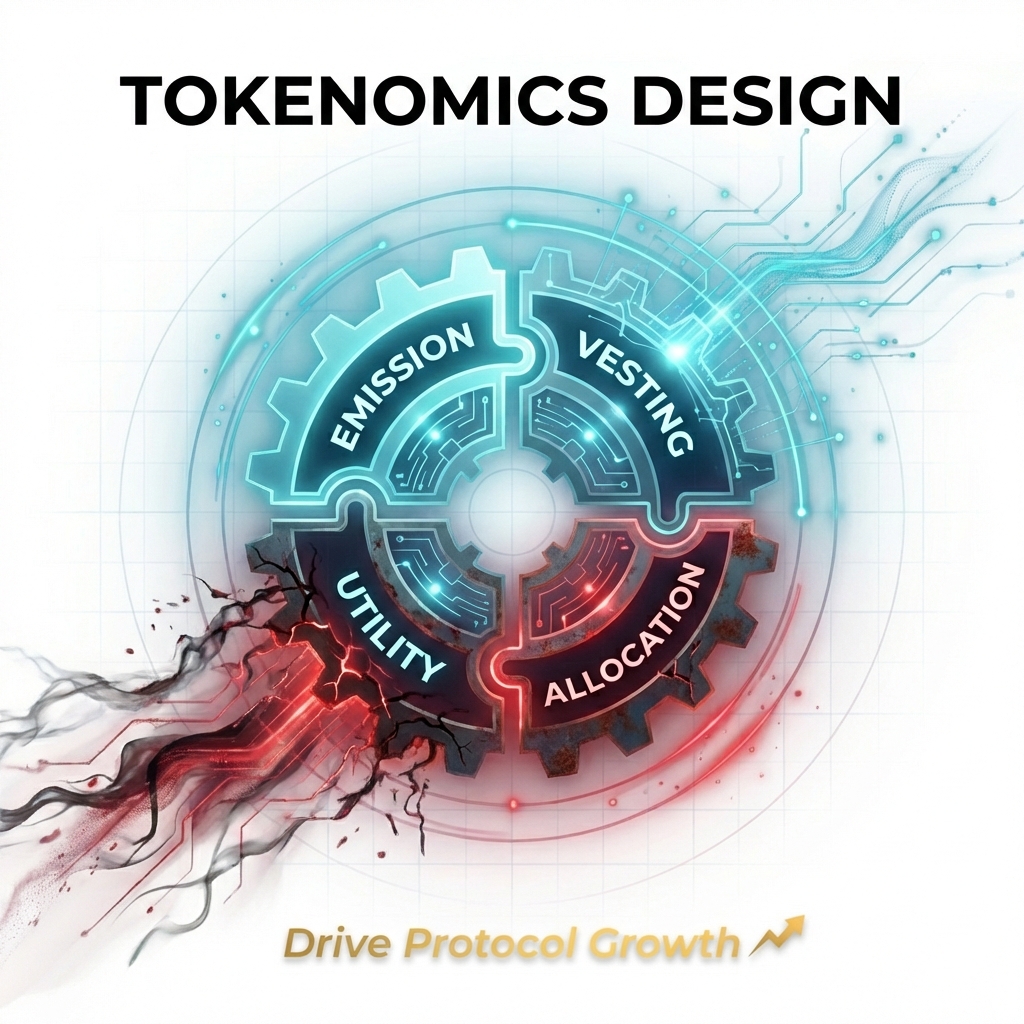
This analysis covers the four decisions that determine whether a protocol builds a sustainable growth flywheel or bleeds its treasury chasing yield it can't afford. Each decision is grounded in data from live protocols and the governance events that validated these patterns in late 2025.
⚡ TLDR
85% of 2025 token launches traded below TGE. Median return: -71%. These are design failures, not market conditions.
The market has shifted from Tokenomics 1.0 (emissions-driven) to Tokenomics 3.0 (revenue-backed). This is now the baseline expectation, not a differentiator.
Four structural decisions drive protocol sustainability: emission model, community allocation, vesting design, and utility-sink balance.
Red flags investors now screen for: high FDV, low float, VC allocations above 30%, governance-only utility, and cliff unlocks.
Use the DeFi Tokenomics Simulator to model all four variables before TGE.
The Data on 2025 Token Launches
The numbers aren't ambiguous. Community analysis of 2025 DeFi launches shows 85% of new tokens trading below their TGE price, with median returns at -71%. The community response on X and Reddit was consistent: "brutal," "structural failure," "the same mistakes, again."
What's notable is that the failures weren't random. They clustered around a recognizable set of design choices. High FDV with low circulating float. VC allocations that loaded insider exits into 6 and 12-month cliffs. Emission schedules built for fundraising cycles, not sustainable growth. Tokens that governed forum posts instead of protocol mechanics.
From Tokenomics 1.0 to 3.0: What the Market Now Expects
The evolution across 2025 was fast. Q1 brought a "back to basics" movement. Fixed supply models gained traction. Revenue sharing via buybacks became table stakes. By Q3, AI-dynamic emission mechanisms had emerged. By Q4, Tradable Vesting Schedules and Initial Weighted Offerings represented the frontier of alignment design.
The market labeled this "Tokenomics 3.0." Sustainable revenue models. Regulatory integration. Deflationary mechanics tied to actual fees. This isn't a trend anymore. It's the baseline expectation for protocols launching in 2026.
The strongest signal came on December 28, 2025, when Uniswap's fee switch went live after a community vote that ran December 19-26. The market immediately re-rated UNI. Analysts stopped applying governance-token models. They started applying P/E ratios. That single activation demonstrated what the market had been signaling all year: revenue-backed tokens trade differently.
⚠️ Pattern Warning
85% of 2025 DeFi launches traded below TGE. Median return: -71%. The common thread isn't bad timing or bear markets. It's token systems designed for fundraising, not utility. Monad ($MON) launched at a $2.6B FDV and delivered -7.6% vs ICO. Plasma ($XPL) had no supply cap and 80% locked. Berachain ($BERA) ran uncapped emissions. All three were cited in community "red flag tier lists" within weeks of launch.
Three specific protocol trajectories captured what goes wrong and why:
Monad ($MON) launched at a $2.6B fully diluted valuation. The market had nowhere to go but down. Community feedback was direct: "ego-driven tokenomics that priced out any realistic upside." Post-launch TVL hit $185M, underperforming competitors with more conservative launch parameters.
Plasma ($XPL) drew sustained criticism for uncapped supply with 80% locked at TGE. Community analysts categorized it as a structural dilution risk immediately. No hard cap means no scarcity premium to model.
Berachain ($BERA) ran emissions-driven mechanics with uncapped supply. Community reception was harsh. "Structural failure" was the consistent label in post-launch analysis threads.
The Four Decisions That Determine Token Sustainability
These aren't the only decisions in token design. But they're the ones that compound. Get any one of them wrong and the others can't compensate. Get all four right and the system builds momentum instead of fighting itself.
Decision 1: Emission Model
Emissions are demand rental, not demand creation. That distinction matters. A protocol can pay users in newly minted tokens to participate. But when emissions slow or stop, that demand leaves. Protocols that generate revenue earn demand. Protocols that emit tokens only rent it.
Three emission archetypes dominate DeFi design. Exponential decay (Bitcoin-like halving) reduces rewards predictably over time, creating clear expectations for long-term holders. Piecewise linear decay (used by Curve and Pendle) reduces emissions at fixed intervals, combining predictability with governance control. Fixed supply with no ongoing emissions forces the protocol to earn through fees rather than print through inflation.
The benchmark most-cited by tokenomics analysts is Curve's epoch-based schedule: approximately 15.9% annual reduction, hardcoded. Not governance-controlled. Not subject to founder discretion. Predictable by design. That predictability is what allows sophisticated participants to model long-term positions.
💡 Key Insight
Emissions create temporary demand. Revenue creates durable demand. Protocols paying stakers in newly minted tokens are burning runway. Protocols paying stakers in fees earned are building equity. The market prices this difference in multiples, not basis points.
The practical guidance from 2025 data: design for a 5-10 year emission horizon. Keep year-one emissions at or below 25% of total supply. Use decay schedules that reduce predictably over time. Front-loaded models create yield expectations the protocol can't sustain. When yield drops, users exit. When users exit, TVL falls. When TVL falls, the protocol has less revenue to fund operations. The spiral runs one direction.
Decision 2: Community vs. Insider Allocation
The 2025 benchmark shifted. Above 50% to community and ecosystem is now the floor, not the ceiling. Protocols that treated this as optional paid for it in post-TGE community sentiment and price action.
The contrast between successful and failed allocation models was stark in 2025. Sentient ($SENT) allocated 65% to community, capped emissions at 2%, and locked unused rewards permanently. Community response was "community-first" and "bullish on scarcity." The token was cited repeatedly as the reference case for correct allocation design. Edge-X ran a pre-TGE campaign with clear XP multipliers and documented $202M in revenue before launch. MetaDAO's $AVICI and $UMBRA tokens returned +472-1,065% against ICO price, attributed directly to low FDV and built-in refund mechanisms.
The failure pattern was equally consistent. Monad's VC-heavy structure combined with high FDV meant the market priced in future dilution immediately. Berachain's emissions-driven, insider-heavy model drew "structural failure" labels before the first month closed.
Protocol Community Allocation Post-TGE Performance Community Signal Sentient ($SENT) 65% Positive "Community-first" Edge-X High + $202M pre-rev Bullish "Fair launch vibes" MetaDAO ($AVICI) High + low FDV +472–1,065% vs ICO "Structural innovation" Monad ($MON) Low / VC-heavy -7.6% vs ICO "Ego-driven" Berachain ($BERA) Low / emissions-driven Below TGE "Structural failure"
The investor read, articulated clearly by Simon Dedic (@sjdedic) after 100+ investments: "Tokenomics reveal founder ego via high FDV." Great products can survive bad tokenomics. Bad tokenomics almost never survive without great products, and even then they create drag that costs years to unwind.
Decision 3: Vesting Design
Surprise cliff unlocks are the single most consistent complaint in 2025 tokenomics discussions. Not emissions. Not governance. Cliff events. Large chunks of supply becoming liquid on a predictable date, creating a sell window that sophisticated participants trade against months in advance.
The market is transparent about this. When Initia ($INIT) and Kaito ($KAITO) launched with 76-82% of supply locked and near-term cliff events visible on the unlock calendar, community analysis immediately modeled the bleed. "Ongoing dilution," "outdated amid AI shifts," "deferred pain." The price action followed the prediction.
Curve's 4-year lock model remains the cited benchmark for long-term alignment. When half your stakeholders are committed for four years, governance is substantive rather than speculative. Token holders have time horizon alignment with the protocol itself.
✅ Best Practice
Protocols with 6-month minimum vesting see 42% less token dumping in year one. Curve's 4-year lock model is the alignment benchmark for DeFi. Q4 2025 introduced Tradable Vesting Schedules (TVS), which allow flexibility without sacrificing lock commitment. AlignerZ Labs ($A26Z) used IWO/TVS mechanics and drew community praise for "no extraction possible."
The practical framework: minimum 12-month cliff plus 24-month linear vesting (36 months total) for all insider allocations. Publish the unlock calendar before TGE, not after. Transparent schedules don't prevent price impact from cliff events. They do prevent the trust destruction that comes from surprises. And trust, once lost in crypto communities, rarely returns.
One 2025 innovation worth tracking: Tradable Vesting Schedules. TVS allows insiders to sell their vesting position to another holder who believes in the long-term thesis, rather than forcing binary hold-or-dump decisions at cliff dates. This transfers the selling pressure from a concentrated cliff event to a distributed secondary market. Early community reception in Q4 2025 was positive. "Vesting with a pulse" was the community shorthand.
Decision 4: Token Utility and Sink Design
The governance paradox has been documented extensively. Tokens that only vote on forum posts are "widely mocked as valueless" by 2025 market participants. The token must govern real protocol parameters to justify holding it. Not sentiment. Not aesthetics. Fees. Emissions. Treasury disbursement. Things that actually change what the protocol does and who profits from it.
The Uniswap fee switch illustrates the valuation delta precisely. Before activation: UNI was a governance instrument with limited utility. After activation (December 28, 2025): UNI became a yield-bearing asset with P/E-comparable metrics. Nothing changed about the product. The token's relationship to protocol revenue changed.
Hyperliquid ($HYPE) provides the clearest revenue-to-burn case study from 2025. The protocol generated $874M in revenue, directed 12-15% into deflationary burns, and became the top-cited "elite" example of sustainable token design. Community reception was rare praise: specific, data-driven, and sustained across months rather than fading after the launch window.
🚨 Critical
A governance-only token with no control over protocol parameters is not a governance token. It's a participation certificate. Markets price the difference. A token that controls fee rates trades differently than a token that controls forum votes. The distance between those two designs is the distance between Hyperliquid and most of the 85% that failed.
Two metrics to track once your token is live. Token velocity: the ratio of annual trading volume to market cap. The healthy range is 4-7x. Below 4x suggests illiquidity or speculative hoarding. Above 7x suggests payments-mode usage with no holding incentive. Both extremes need intervention. Lock ratio: the percentage of circulating supply locked in governance, staking, or vesting at any given time. Top protocols maintain 45-60%. When more than half of supply is locked, token holders are stakeholders, not speculators.
Red Flags That Signal Structural Failure Before TGE
Analysis of 100+ protocol launches across 2024-2025 isolates the design choices that consistently precede underperformance. These aren't edge cases. They're recurring patterns, often visible in the whitepaper or tokenomics documentation before a single trade occurs.
🚩 Red Flags: Pre-TGE Design Screening
1. High FDV, Low Float
Circulating supply below 10% of total supply at TGE prices perfection into the launch and removes upside for new buyers. The market models the dilution immediately. Monad's $2.6B FDV launch is the 2025 reference case. Community analysis called it "priced out of upside before day one."
2. Uncapped Supply
No hard cap removes the scarcity premium. Investors can't model a supply ceiling. Plasma ($XPL) and Berachain ($BERA) were cited in community "red flag tier lists" specifically for this. A hard cap doesn't guarantee success. The absence of one guarantees skepticism.
3. VC Allocation Above 30%
Large insider allocations create structural sell pressure at cliff dates. VCs invest to exit. If their combined allocation exceeds 30%, the math of supply at cliff events is visible to every informed participant. They'll position accordingly before the unlock. Community buyers face a known headwind.
4. Emissions Without Protocol Revenue
Yield paid in newly minted tokens depletes demand rather than building it. When emissions slow, the users who came for yield leave. The protocol is left with lower TVL and fewer users than before the emission campaign started. Solstice ($SLX) presale failed at 23% fill rate. Community blamed high valuation and large TGE unlock combined with no demonstrated revenue.
5. TGE Before Mainnet Utility
Launching a token before the product works is creating speculation without a retention anchor. When the product eventually launches, early buyers have already priced in hype. TEN's communication failures during launch led to a "serious failure" outcome, with community frustration centering on the gap between token launch and actual utility delivery.
6. Governance-Only Token Utility
Governance that doesn't control anything real isn't governance. A token that allows holders to vote on blog post topics or UI color schemes has no utility. The token must control fees, emissions, treasury, or risk parameters. The Uniswap fee switch activation proved the valuation difference. Before: governance instrument. After: yield-bearing equity analog.
7. Cliff Unlocks Within 12 Months of TGE
Any large unlock event visible on the calendar becomes a trading target. Initia ($INIT) and Kaito ($KAITO) launched with 76-82% locked and near-term cliffs. Community analysis modeled the bleed before it happened. The actual price action followed the prediction. Visible cliff events create predictable sell windows. Sophisticated participants use those windows. Retail buyers absorb the impact.
8. Short Vesting (Under 6 Months) for Team or Investors
Per Delphi Digital analysis from 2025: "Complex vesting schedules often show low product confidence rather than alignment." The inverse is also true. Very short vesting periods suggest founders aren't confident enough in their own product to stay locked for a standard cycle. Simon Dedic (@sjdedic) documented this read directly: "Tokenomics reveal founder traits like ego via high FDV or low confidence via over-engineered vesting."
9. Airdrop-Heavy, Commitment-Light Distribution
Unlocked airdrops attract mercenary capital that exits immediately. The 2025 general pattern: "free money" airdrops drove 85% below TGE as recipients sold immediately with no commitment skin in the game. Contrast with Hylo ($HYLO), which tied allocations to actual commitment, stress-tested the design through crashes, and documented $107M TVL with 0 liquidations.
10. Over-Complex Vesting Without Rationale
Complexity in vesting design signals one of two things: the team is trying to obscure something, or they don't know what they're optimizing for. Neither is a good signal. Sophisticated investors read complex vesting as low confidence. Community participants can't model it. The result is lower trust, lower conviction, and less organic holding behavior.
Modeling Three Common Founder Scenarios
The four decisions above don't operate in isolation. Emission rate compounds with vesting design. Community allocation multiplies governance participation. Revenue backing transforms how the market prices the token entirely. The scenarios below illustrate how these interactions play out in practice.
DeFi Tokenomics Simulator
Model emission schedules, dilution curves, and vesting scenarios before your token launch. Free tool, no signup required.
Scenario 1: Pre-Revenue Protocol, Community-First Launch
Profile: No revenue yet. Small team with strong community signal. 18-month runway. Pre-TGE user base engaged through Discord, Farcaster, and X.
The temptation in this position is to price the token against future potential. High FDV, low float, small circulating supply at launch. The market has shown this ends badly. Instead, the data points toward Sentient's model: allocate 65% to community, cap emissions at 2%, lock unused rewards permanently.
The key design choice is the emission schedule. A long decay prevents early participants from modeling a cliff. When users know emissions will run for 7-10 years with gradual reduction, they can build long-term positions. When they see front-loaded emissions that peak in year one and crater in year two, they trade the cycle rather than participate in the protocol.
What the DeFi Tokenomics Simulator surfaces in this scenario: inflation rate at Month 6 (the first critical test of community patience), dilution percentage at Month 12 (the first insider cliff window), and governance concentration as early community allocation compounds. These are the numbers to stress-test before the whitepaper is final.
💡 Key Insight
Pre-revenue protocols that over-allocate to community survive longer. They also attract better investors, who model alignment rather than short exits. Edge-X documented $202M in pre-launch revenue through transparent community campaigns before touching token mechanics. The revenue came first. The TGE followed it.
Scenario 2: Post-Revenue Protocol, Real Yield Launch
Profile: $500K or more in monthly revenue. Product-market fit demonstrated. Preparing for TGE with institutional interest. The protocol earns. The question is how to make that earning visible to token holders.
This is where the Uniswap and Hyperliquid cases converge. Both protocols made the decision to connect token holding to revenue participation. Both saw immediate market re-rating. Uniswap's fee switch (voted December 19-26, activated December 28, 2025) changed how analysts modeled UNI: from governance instrument to equity analog. Hyperliquid's $874M in annual revenue flowing into 12-15% deflationary burns changed $HYPE from "governance token" to "yield-bearing asset."
The design decision in this scenario isn't whether to connect revenue to the token. That's table stakes in 2026. The decision is the split between buybacks and distributed yield. Buybacks reduce circulating supply and benefit holders proportionally without creating taxable events. Distributed yield creates direct income but concentrates benefit on large holders who are already long. Both work. The choice depends on the stakeholder composition you're trying to attract.
✅ Best Practice
Revenue changes the market's mental model of a token. From governance instrument to yield-bearing equity. Uniswap's fee switch activation in December 2025 validated this shift definitively. Aster ($ASTER) saw post-TGE TVL increase 95%, attributed directly to revenue-driven yield mechanics. The market was waiting for the protocol to earn its token's valuation.
The simulator scenario for post-revenue protocols should model the compounding effect of buybacks over 24 months against projected revenue growth. Even modest revenue growth with consistent buybacks creates supply dynamics that improve the long-term holder thesis significantly. Run the numbers before the tokenomics whitepaper locks.
Scenario 3: Over-Engineered Tokenomics, Recovery Path
Profile: Already launched. High FDV, 15% circulating supply, 6-month VC cliff approaching. Governance-only token. Community sentiment deteriorating. This matches the failure profile of the 85%, and it's recoverable, but the window is short.
The Aave governance case from December 2025 is instructive here. The DAO rejected a core team grant proposal (December 22-26 vote). The founding team's response wasn't silence. Stani Kulechov published a new "RWA and Consumer" strategy pivot on January 2, 2026. The market responded to transparency as a signal. Governance rejection plus honest pivot built more trust than approval plus silence would have.
Recovery levers, ordered by feasibility and speed:
First: activate utility. Connect the token to fee distribution or treasury governance. This doesn't require a new product. It requires a governance proposal that the community can vote on. The market will re-rate the token within weeks of activation, as Uniswap demonstrated.
Second: run a community buyback program using treasury funds to absorb cliff event sell pressure. Frame it as alignment, not price defense. The distinction matters for community perception.
Third: propose a governance vote to extend team and investor lock-ups. This signals confidence rather than desperation if proposed proactively, before the cliff. Founders who extend their own vesting post-launch consistently receive positive community reaction.
Fourth: publish transparency. Unlock calendar, dilution model, emissions projection. The Curve Finance grant rejection from December 18-23, 2025 (17.45M CRV proposal for Swiss Stake AG, rejected by Convex and Yearn bloc) demonstrated something important: fiscal scrutiny now applies even to founding teams. The market respects protocols that model their own dynamics publicly.
⚠️ Recovery Warning
Recovery from poor tokenomics design requires governance action, not just communication. Transparency is a prerequisite for recovery, not a substitute for it. Announcing problems without proposing concrete changes generates more cynicism than silence does. Aave's Jan 2, 2026 pivot worked because it paired acknowledgment with a new strategic direction. The sequence matters.
What Three Major Governance Votes Signal for 2026
Three governance events between October 2025 and January 2026 reveal how token markets are maturing, and what founders launching in 2026 need to model. These aren't case studies from a distance. They're verified governance records with dates, vote outcomes, and documented market responses.
Uniswap: Fee Switch and the P/E Re-Rating
Forum proposal posted November 10, 2025. Voting period: December 19-26. Implementation: December 28 (timelock execution). The result was immediate. Market participants who had modeled UNI as a governance instrument revised their framework. Analysts began applying price-to-earnings ratios rather than governance-token multiples. The token's relationship to protocol revenue changed, and the market priced the change within days.
The signal for 2026 founders: revenue-backing transforms a token's market classification, not just its yield. The re-rating isn't gradual. It happens at activation. Protocol teams that delay this connection are delaying the re-rating.
Aave: Brand Conflict and the Transparency Dividend
BGD Labs proposed changes to the Aave brand governance structure (December 17, 2025 forum post). Snapshot vote ran December 22-26. Record community turnout. Rejection. The proposal was authored by the team's own development partner. Community voted it down anyway.
What followed was more instructive than the vote itself. Stani Kulechov posted a new "RWA and Consumer" strategic direction on January 2, 2026. The market read this as strength. A founding team that responds to governance rejection with transparency and a new direction demonstrates that decentralization is real, not performative. The trust dividend from that response was measurable in community sentiment within weeks.
The signal for 2026 founders: governance rejection plus transparent pivot builds more long-term trust than governance approval plus silence. If your DAO rejects a proposal, the response matters more than the vote outcome.
Curve: Core Team Grant Rejection
Michael Egorov (Curve Finance founder) posted a 17.45M CRV grant proposal for Swiss Stake AG on December 14, 2025, covering the 2026 roadmap. Voting ran December 18-23. The Convex and Yearn bloc rejected it. A core team proposal, from the protocol's founder, failed.
This is governance maturity. The large holders who accumulated voting power through the Curve Wars applied fiscal scrutiny to the team that built the protocol. The community interpretation was positive overall: decentralized governance working as designed. No special privileges, even for founders.
The signal for 2026 founders: design governance expecting that concentrated holders will eventually exercise their power against you. Protocols where governance is real attract better long-term participants. Protocols where governance is theater attract mercenary capital that exits as soon as emissions slow.
Frequently Asked Questions
What is the most common tokenomics mistake in 2025?
High FDV combined with low float and VC-heavy allocations. Markets price in the upcoming dilution immediately. 85% of 2025 launches made this structural choice and traded below TGE as a result. The median return was -71%. Monad at $2.6B FDV is the reference case. Community analysts flagged the outcome before launch. The actual performance matched the prediction.
How do I calculate token dilution for my protocol?
Dilution = (new tokens issued ÷ current circulating supply) × 100. A protocol with 10% circulating at TGE on a standard 4-year linear vesting schedule will see roughly 30-40% dilution by Month 12, depending on emission pace. The compounding effect is what most founders miss. Use the DeFi Tokenomics Simulator to model your specific schedule across multiple time horizons.
What percentage of tokens should go to the community?
The 2025 benchmark is above 50% to community and ecosystem. Protocols above this threshold consistently outperformed in community sentiment and post-TGE stability. Sentient ($SENT) at 65% is the current best-practice reference. That's not a ceiling. AlignerZ and MetaDAO ran higher community allocations and saw the strongest post-TGE community reception in 2025.
Is a governance-only token viable in 2026?
No. Governance-only tokens with no control over fees, emissions, or treasury are categorized as valueless by 2025-2026 market participants. The token must govern real protocol parameters. Uniswap's December 2025 fee switch activation is the clearest validation: the same product, the same governance structure, completely different market valuation once revenue was attached to the token.
What is the real yield shift and why does it matter?
Real yield means protocol rewards are paid in revenue-derived assets, like ETH, USDC, or protocol fees, rather than newly minted tokens. The shift from Tokenomics 1.0 (printing tokens to pay stakers) to real yield is the defining market change of 2024-2025. Hyperliquid earned $874M in revenue and returned 12-15% in deflationary burns. Aster saw post-TGE TVL increase 95% on revenue-driven yields. Protocols that generate and distribute revenue now trade at different multiples, not just different prices.
How long should team and investor vesting be?
Minimum 12-month cliff plus 24-month linear vesting, totaling 36 months for all insider allocations. Shorter schedules consistently signal low product confidence to sophisticated investors. Curve's 4-year lock is still the long-term alignment benchmark. Tradable Vesting Schedules (TVS), introduced Q4 2025, offer an option for founders who need flexibility: vesting positions become tradable rather than binary hold-or-dump decisions at cliff dates.
What is the token velocity target for DeFi protocols?
4-7x annually (annual trading volume divided by market cap). Below 4x suggests speculation or illiquidity. Above 7x suggests payments-mode usage with no holding incentive. Both extremes need attention. Below 4x: examine your liquidity depth and community size. Above 7x: examine sink mechanisms, whether staking yields are compelling enough, and whether holders have reasons to hold beyond short-term speculation.
How did Uniswap's fee switch change token valuation in 2025?
Uniswap's fee switch was voted on December 19-26, 2025, and activated December 28. The immediate market response: analysts stopped applying governance-token valuation frameworks and started applying P/E ratio models. UNI was re-rated from "governance instrument" to an equity-like asset. The product didn't change. The token's relationship to protocol revenue changed. That distinction drove the re-rating. It's the clearest real-time validation that revenue-backed tokens trade in a different category.
What tokenomics innovations are gaining traction in 2026?
Five mechanics gained strong community traction through Q4 2025 and into early 2026: Tradable Vesting Schedules (TVS) for flexible lock structures, dynamic mint-burn (dMdB) for responsive supply management, ve(3,3) models for governance-liquidity alignment, Initial Weighted Offerings (IWO) for fair price discovery, and AI-dynamic emission adjustments that respond to protocol usage metrics in real time. All five prioritize alignment and sustainability over extraction.
When should I use the DeFi Tokenomics Simulator?
Before finalizing any token parameter. Model dilution at Month 6, 12, and 24. Stress-test your emission schedule against community allocation. Compare vesting scenarios side by side. The simulator surfaces compounding effects that spreadsheet models typically miss: specifically the interaction between emission pace, cliff timing, and governance concentration. These interactions determine whether your launch creates a flywheel or a bleed loop. Run the numbers before they're locked in a whitepaper.
Tokenomics Audit Checklist for DeFi Founders
Use this to identify gaps before TGE. Where you have missing checkmarks, you have decisions to make. Start with the supply and emission section. It compounds everything else.
📋 Supply & Emission
Hard supply cap defined, or dynamic mint mechanism with circuit breakers Emission schedule runs 5-10 years minimum Year-one emissions at or below 25% of total supply Emission rate modeled against revenue growth projections (not just supply math)
📋 Allocation
Community and ecosystem allocation at or above 50% of total supply VC and investor allocation at or below 25% Team allocation at or below 15%, with at least 36-month vesting Treasury allocation governed by on-chain DAO vote, not founder discretion
📋 Vesting
All insider vesting at minimum 12-month cliff plus linear unlock No cliff events within 6 months of TGE Full unlock calendar published publicly before TGE Tradable Vesting Schedule (TVS) evaluated as an option for flexibility
📋 Token Utility
Token controls real protocol parameters: fees, emissions, or treasury governance Sink mechanisms in place: buybacks, burns, or time-based locks Token velocity target defined and tracked (target: 4-7x annually) Lock ratio target defined and tracked (target: 45-60% of circulating locked)
📋 Governance
On-chain governance active before TGE, not just forum voting Governance participation threshold set above 15% for valid votes No single entity controls above 30% of vote weight at launch
Model Your Tokenomics Before TGE
The variables above don't exist in isolation. Emission rate compounds with vesting design. Community allocation multiplies governance participation over time. Revenue backing transforms how the market prices the token entirely.
The 85% failure rate from 2025 wasn't random. It was predictable. Most of those protocols had red flags visible in the tokenomics documentation before a single user participated. The data was there. The modeling wasn't.
Modeling these interactions before TGE is the difference between a growth system and a bleed loop. The simulator surfaces the compounding effects that spreadsheet math misses: specifically what happens to dilution, governance concentration, and holder incentives when emission rate, cliff timing, and community allocation interact across 24 months.
DeFi Tokenomics Simulator
Model emission schedules, dilution curves, and vesting scenarios before your token launch. Free. No signup. Run in 2 minutes.
Related Reading
How DeFi Founders Can Design Tokenomics That Actually Drive Growth
The strategy layer behind the mechanics: what tokenomics has to accomplish before you touch a spreadsheet.
Read the Strategy Guide →Alternatives to Airdrops for DeFi Founders
Sustainable user growth frameworks that do not rely on one-time token giveaways.
Read the Framework →DeFi Agency vs In-House vs Consultant
When to hire externally vs. build internal growth capability, once your tokenomics model is set.
Read the Decision Guide →The Web3 Founder's Guide to DeFi Growth
Tokenomics, liquidity loops, and community mechanics that drive sustainable protocol traction — the launch-stage companion to this guide.
Read the Main Guide →