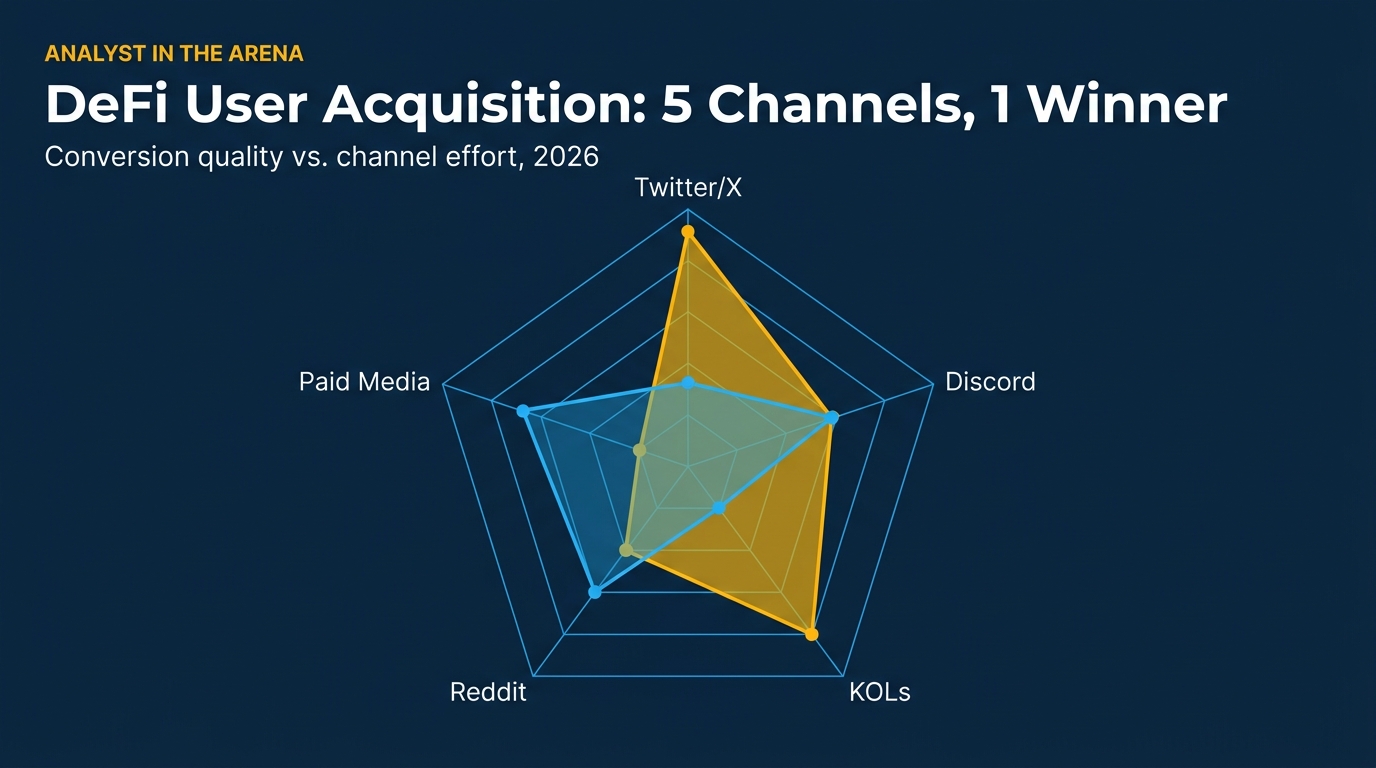
DeFi User Acquisition: The Channels That Actually Work in 2026
Most DeFi growth teams are running channels on instinct, not evidence.
They post on Twitter because that's where crypto people are. They run Discord because every protocol has one. They pay KOLs for a launch spike because it worked for someone else's TGE. Then they sit in front of Dune dashboards three months later trying to explain why none of it stuck.
The honest answer: nobody has systematically mapped what each channel actually produces in decentralized environments. Not reach, not impressions. Conversion. New wallets connected. TVL that compounds. Users who come back after the incentive ends.
After analyzing the growth patterns of protocols that achieved sustained traction, including Hyperliquid, Aave, Uniswap, and several smaller-cap launches, five channels show up in every team's stack. But they don't all produce the same outcome. Conflating them is where most teams bleed budget.
This article gives you the honest breakdown: what each channel actually does, what it costs in time and money, and a decision matrix for mapping channel to goal.
If you want context on the broader strategy behind channel selection, the Web3 Growth Marketer's Playbook covers the full GTM framework these decisions sit inside.
Why DeFi Channel Confusion Is Getting More Expensive
The cost of misallocated growth spend was tolerable in 2021 and 2022. Liquidity mining masked bad distribution. High overall market participation made weak channels look functional.
That environment is gone. In 2026, protocol teams face compressed emission budgets, a more skeptical user base, and leadership that demands attribution before increasing spend. Getting the channel mix wrong doesn't just slow growth. It burns credibility internally and depletes the budget window for experiments that would work.
Key Insight
The five major DeFi acquisition channels each serve a different conversion job. Mixing up which channel does which job is the most common and most expensive growth mistake in Web3.
The 5 DeFi User Acquisition Channels: Honest Verdicts
1. Twitter/X: Reach and Narrative, Not Conversion
Twitter/X is where DeFi lives culturally. Analysts post threads. Protocols announce upgrades. Narratives form and collapse in 48-hour cycles. For reach and credibility signaling, there's no substitute.
But reach isn't acquisition.
The attribution problem on X is fundamental. When a user connects their wallet and deposits, you can't trace that action back to a specific tweet or thread with any confidence. Most teams use rough proxies: Discord joins correlating with a thread spike, or a wallet cohort analysis showing an uptick in new addresses after a campaign. Neither is clean.
X works best as a narrative credibility layer. If your protocol isn't active on X, sophisticated DeFi users assume it's either dead or a rug. The minimum viable presence isn't optional. But treating X as a primary acquisition channel misunderstands what the channel produces. Putting budget behind promoted posts, running aggressive follow campaigns, or measuring growth by follower count are all misdirected.
The second limitation is algorithm dependency. Organic reach on X has compressed significantly since 2023. Distribution now tilts toward accounts with premium subscriptions, high engagement rates, and post velocity. Smaller protocol accounts compete against both CT influencers and the native noise of a very loud feed.
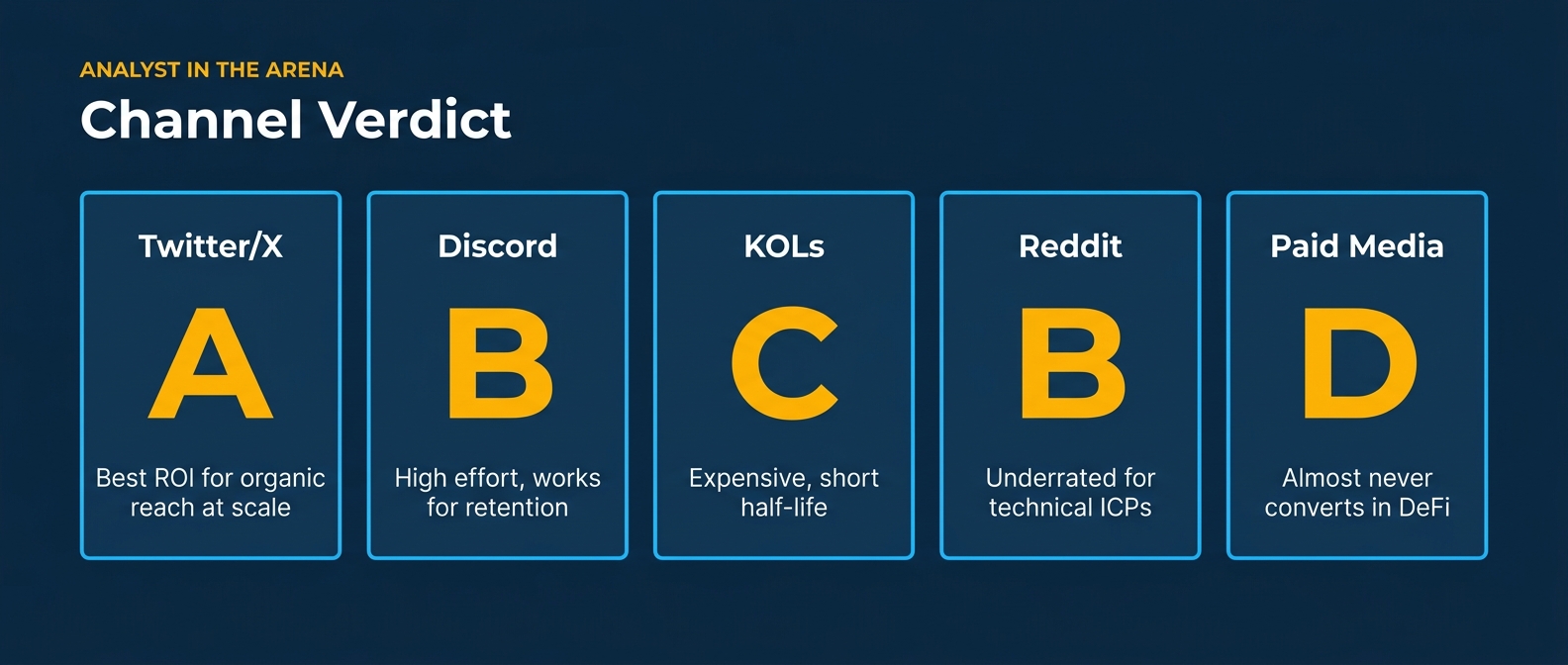
Verdict: Essential for narrative and community credibility. Not a reliable primary acquisition channel. Track engagement rates and thread saves, not follower count.
2. Discord: Community Depth, Not Acquisition
Discord has been called the "community hub" of Web3 for years. It's accurate. But that framing hides the distribution problem.
Discord requires a user to already believe in your protocol enough to seek it out, join, and stay active. That means Discord converts existing believers, not new users. It's a retention and engagement tool. The decision to join a Discord usually happens after discovery, not before.
For cold acquisition, Discord is largely useless. A new user who has never heard of your protocol will not stumble into your server. Discord doesn't have organic discoverability for protocols at the level Twitter or Reddit does. There's no feed, no algorithm surfacing your server to relevant audiences.
The saturation problem compounds this. DeFi users belong to dozens of servers. Notification fatigue is real. Even active community members often mute server channels after the first week.
Warning
High Discord member counts are often a vanity metric. Track weekly active members and the ratio of lurkers to contributors, not total joins. A 10,000-member server with 200 weekly actives is a dead channel masking as a live community.
Where Discord genuinely creates value is in converting warm leads. Users who found you on X or Reddit become protocol advocates. Power users who become vocal community members, who test new features, who report bugs, and who evangelize in other communities. That's not acquisition. That's activation and retention.
Verdict: Do not count Discord as an acquisition channel. Build it as a retention and activation layer after you have a user base worth retaining.
3. KOL / Influencer Marketing: High Variance, Short Shelf Life
KOL marketing works for TGE spikes. That's not a compliment. It's a description of the ceiling.
The pattern across documented launches is consistent. A KOL with a large, engaged CT audience posts about your token. Volume spikes. New wallets appear. Governance forum traffic increases. Fourteen to thirty days later, most of those wallets are empty or sold. The users who came because an influencer told them to come leave when the influencer moves to the next sponsored protocol.
The attribution problem here is even worse than on X. KOLs rarely provide verifiable data on wallet-level conversion. They share impressions, views, and engagement rates. None of those numbers tell you whether the user who clicked the referral link connected a wallet and deposited anything.
Hyperliquid's launch is the cleanest counterexample in recent memory. No VC. No KOL campaign. No paid influencer distribution. The protocol grew primarily through community word-of-mouth, organic trader discussion on X, and a points program that rewarded real usage rather than promotional activity. By the time Hyperliquid became one of the highest-volume DEXs, it had done so without a single paid content creator post.
That's a difficult distribution model to replicate. It requires genuine product-market fit and a trading experience compelling enough to generate organic advocacy. But it shows that KOL spend is a variable most protocols can reduce, not a fixed cost of distribution.
Verdict: Useful for TGE narrative amplification with carefully selected, niche-specific accounts. Not a sustained acquisition channel. Set a hard ceiling on KOL spend (typically under 15% of growth budget) and track post-TGE wallet retention rates for KOL-referred cohorts.
4. Reddit: Underrated, Long-Tail, and Underused
Reddit is the most underrated DeFi acquisition channel in 2026. Most protocol teams ignore it or treat it as an afterthought.
That's a mistake.
Subreddits like r/defi, r/ethfinance, r/CryptoCurrency, and r/0xPolygon serve a specific type of user: someone actively researching before they make a decision. The Reddit DeFi audience includes a disproportionate share of users who read long threads, verify claims, compare protocols, and convert after due diligence. That's a different behavioral profile from the user who acts on a tweet in 30 seconds.
The acquisition dynamic on Reddit is also fundamentally different from X. A well-written technical post in r/ethfinance can generate organic discussion for days. It gets indexed by Google. Users find it weeks or months later through search. The long-tail reach of Reddit content compounds in a way that Twitter threads don't. X threads decay in 48 hours. Reddit posts stay discoverable.
The acquisition path is also more traceable. A protocol that posts a transparent thread on r/defi explaining its mechanism design, fee structure, and competitive positioning generates discussion that self-selects for interested users. You can track referral traffic to your landing page. You can monitor wallet connections from Reddit UTM sources.
Organic Reddit requires genuine contribution. Promotional posts get flagged and downvoted. The communities are good at detecting marketing masquerading as information. The formats that work are technical explainers, honest AMAs with founders who take hard questions, and data-backed protocol comparisons.
Verdict: Underused by most protocol teams. Prioritize r/defi and r/ethfinance over r/CryptoCurrency for DeFi-specific protocols. Budget 10–15% of content production capacity here. Measure Google-indexed referral traffic and wallet connection events from Reddit UTM parameters.
5. Paid Media (LinkedIn, X Promoted, Reddit Ads): Predictable but Narrow
Paid distribution is the most predictable DeFi acquisition channel. It's also the most misused.
The narrow truth about paid media in Web3: it converts specific ICPs in specific contexts. For protocol teams trying to reach institutional operators, DeFi infrastructure buyers, and Web3-native growth marketers, LinkedIn paid campaigns can produce qualified leads that organic channels miss. A LinkedIn sponsored post targeting crypto and DeFi-adjacent job titles at Web3 companies can reach a large pool of relevant professionals. Audience size varies significantly by targeting configuration and region.
X promoted posts work similarly for retargeting. Users who engaged with organic content and then saw a paid reminder convert at higher rates than cold audiences. Cold audience paid reach on X is expensive and noisy.
Reddit ads sit in the middle. They convert better than X promoted posts for targeted subreddit audiences (r/defi, r/ethfinance) but require creative that matches the community's skepticism toward advertising.
The universal failure mode for DeFi paid media is running retail-targeted campaigns to audiences who don't convert on landing pages. A DeFi protocol running paid ads at broad cryptocurrency audiences typically sees high CTR and negligible wallet connections. The audience isn't the problem. The conversion path is. Most DeFi landing pages are not built for cold paid acquisition. They assume too much prior knowledge and don't resolve the basic trust questions a new user needs answered before connecting a wallet.
Verdict: Effective for reaching institutional operators and growth professionals (LinkedIn), not for retail acquisition at scale. Only run paid media when the landing page has been validated against cold audience conversion. Budget depends on ICP targeting precision. Narrow audiences with higher CPMs outperform broad audiences with lower CPMs in DeFi.
The Channel-to-Goal Decision Matrix
| Channel | New User Acquisition | Community Retention | Narrative Credibility | Institutional Awareness |
|---|---|---|---|---|
| Twitter/X | Weak. Hard to attribute. | Moderate. Reply culture builds familiarity. | Strong. The default credibility layer. | Moderate. Depends on account tier. |
| Discord | Very weak. No discoverability. | Strong. Depth of engagement for warm users. | Weak. Closed ecosystem, no indexing. | Weak. Not where institutional players look. |
| KOL / Influencer | Moderate for TGE only. Decays fast. | Very weak. Referred users don't stay. | Moderate. Short shelf life. | Weak. Institutional players are skeptical of KOL signals. |
| Strong for research-oriented users. | Moderate. Upvoted posts stay visible. | Strong. Skeptical audience means earned credibility. | Weak. Not the platform institutional teams use. | |
| Paid (LinkedIn/X/Reddit) | Strong for targeted ICPs with validated landing page. | Weak. Not a retention tool. | Moderate. Paid reach looks paid. | Strong on LinkedIn. Best institutional reach channel. |
What Real Protocol Data Actually Shows
Three protocols illustrate how channel selection maps to outcomes.
Hyperliquid built to over $3B in cumulative volume (per on-chain activity visible on public Dune dashboards) without a paid KOL campaign or venture capital distribution. The growth engine was a points program that rewarded real trading volume, combined with genuine product differentiation. X organic drove awareness. The protocol's existing users became its acquisition channel. They posted their PnL, explained the mechanism, and brought in peer traders. This model required product excellence as a precondition. Teams that try to replicate it without the product fit will fail.
Aave built its institutional awareness through a combination of governance participation, technical documentation quality, and consistent X presence from core contributors. The Aave community became a credibility signal. The depth of governance discussion, the quality of Snapshot proposals, and the engagement of addresses with known institutional affiliations sent a signal that Aave was a serious protocol. Discord retained the existing community. It didn't acquire new institutional capital. That came from the credibility layer built on X and through governance transparency.
Uniswap grew through protocol integrations and developer ecosystem reach as much as direct consumer acquisition. The DeFi aggregators, including 1inch and ParaSwap, routed liquidity through Uniswap pools, which brought users who never directly visited Uniswap's interface. That's a distribution channel most growth teams don't model: third-party integration as acquisition. For infrastructure protocols, this can outperform every direct channel combined.
Best Practice
For DeFi infrastructure protocols, third-party integrations and aggregator routing often drive more wallet connections than any owned channel. Map your integration partners before mapping your content channels.
The Takeaway Framework: Mapping Channels to Protocol Stage
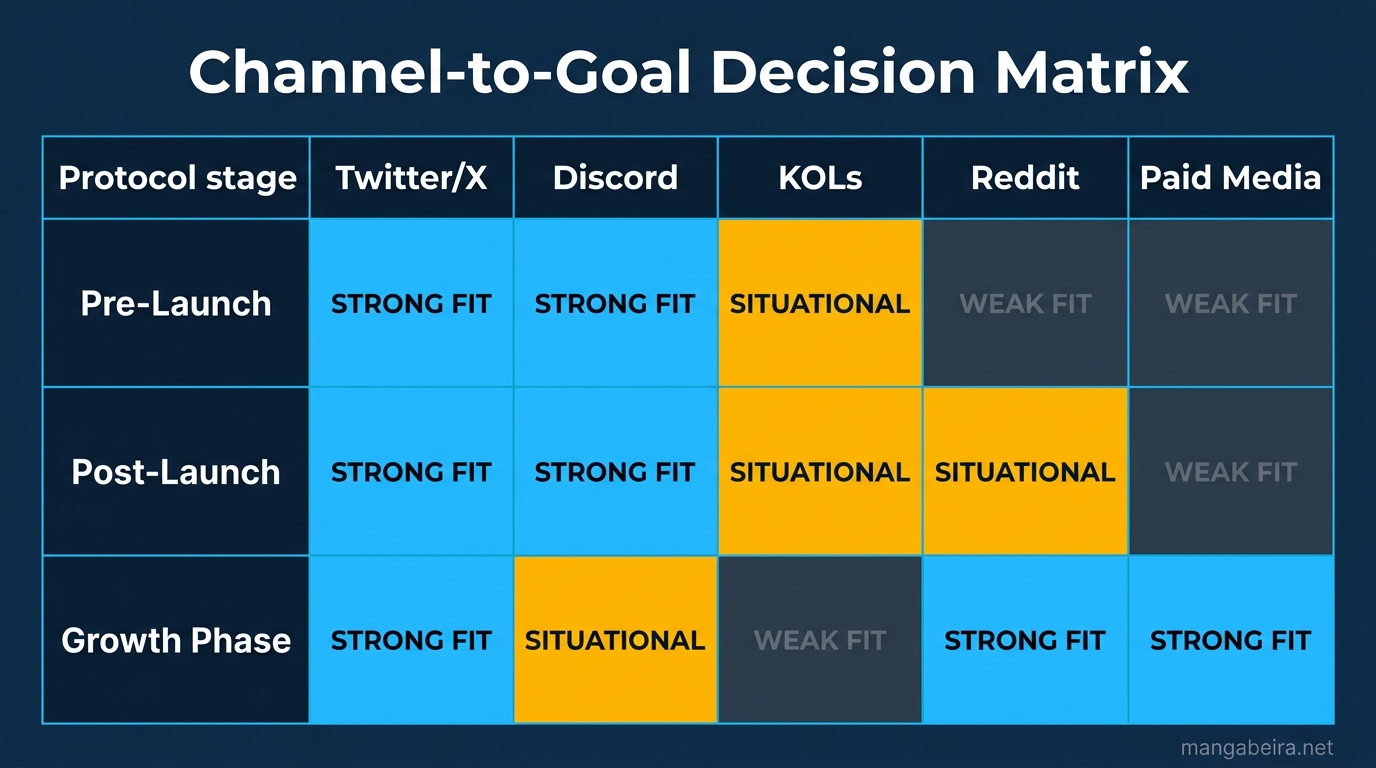
Channel selection should change as your protocol matures. The stack that works pre-TGE is different from the one that works six months post-launch.
The DeFi Go-to-Market Checklist covers the full pre-launch sequence. The section below maps channel decisions to each stage.
Channel-Stage Allocation: Pre-TGE (0–3 months before launch)
X organic
Establish narrative credibility with technical threads and founder presence. Minimum 3 posts per week from at least one core team member.
Post a technical explainer in r/defi and r/ethfinance explaining the mechanism. Answer every question in the thread. This builds discoverable trust that X posts don't.
Discord
Open only when you have 200+ users who are actually invested. An empty Discord signals weakness, not community.
KOL (if budget allows)
Select 2–3 niche-specific accounts with verifiable audience quality, not just follower counts. Define retention KPIs before signing. Track 30-day wallet activity for referred cohorts.
Channel-Stage Allocation: Post-TGE (0–6 months after launch)
X organic
Shift from mechanism education to data storytelling. Post on-chain metrics, TVL milestones, and usage patterns. Let the protocol prove itself in public.
Discord
Activate for governance discussions, product feedback, and power user programs. Stop treating it as an acquisition channel.
Run monthly AMAs. Post protocol performance data. Let the skeptical audience validate your numbers. Their endorsement carries weight that any owned channel can't replicate.
Paid (LinkedIn)
If your ICP is institutional operators or protocol researchers, test LinkedIn campaigns targeting Web3-adjacent job titles. Start with a $2,000–5,000 test budget and measure wallet connection rates, not CTR.
Integrations
Map every aggregator, wallet, and portfolio tracker that your target user touches. Prioritize integration partnerships over additional content spend.
Web3 Growth Audit · Channel Attribution
Which channels are actually driving wallets for your protocol?
A scoped audit maps your current channel mix against on-chain cohort behavior. You'll know exactly where your distribution is working and where it's leaking before you spend another dollar.
Start Your Growth Audit →Frequently Asked Questions
What is the most effective DeFi user acquisition channel in 2026?
There's no single answer. It depends on your goal. Reddit is the strongest for attributable, research-stage acquisition. Google-indexed, long-tail, it converts skeptical users who verify before they act. Paid LinkedIn is best for institutional operators and Web3-native growth professionals. Twitter/X is essential for narrative credibility but has weak direct attribution. KOLs produce TGE spikes only. Discord is a retention tool, not an acquisition channel. The most effective stack combines X for credibility, Reddit for research-stage acquisition, and paid LinkedIn for institutional targeting.
How do DeFi protocols measure user acquisition attribution without cookies?
On-chain attribution uses a combination of UTM parameters on landing pages, referral tracking via smart contract interaction paths, and wallet cohort analysis on Dune. The cleanest signal is first wallet connection by source. Reddit UTM parameters in the landing page URL, for example, can tie a wallet connection event to an organic Reddit referral. KOL attribution is harder because most KOL posts don't use tracked links. Treat any KOL attribution claim without a verifiable referral mechanism as unverifiable.
Should DeFi protocols spend on KOL marketing?
Selectively and with a hard ceiling. KOL spend makes sense for TGE narrative amplification when the selected accounts have demonstrably engaged audiences in your protocol's vertical, not just large follower counts. The failure mode is selecting accounts by follower size rather than audience quality. After TGE, KOL spend rarely sustains. Track 30-day and 90-day wallet retention rates for KOL-referred cohorts. If that cohort sells within 14 days at higher rates than organic cohorts, you paid for speculation, not users.
Is Discord still worth building for DeFi protocols in 2026?
Yes, but not as an acquisition channel. Build Discord as a retention and activation tool for users already committed enough to seek out community. Track weekly active members as your primary health metric. A very low ratio of active-to-total members (under roughly 10–15% is a common warning sign) signals a retention problem, not an acquisition one. More Discord marketing won't fix it. Focus Discord resources on governance discussion quality, power user programs, and feedback loops that improve the product.
When does paid advertising make sense for DeFi user acquisition?
When two conditions are met: you have a validated landing page that converts cold audiences, and your target ICP is reachable through the platform's targeting options. LinkedIn paid works for institutional operators and Web3-native growth professionals. It's a poor fit for retail DeFi users. Reddit ads work for subreddit-targeted campaigns in communities where your protocol is already discussed organically. X promoted posts work best for retargeting existing organic engagers, not cold acquisition. Don't run paid media until you've tested organic conversion on the same landing page.
What Comes Next
The protocols that compound in 2026 are the ones that stop measuring channel success by vanity metrics. Follower counts, Discord members, KOL impressions. They start measuring by wallet-level cohort behavior.
That requires building attribution infrastructure before running campaigns, not after. It requires honest internal alignment on what each channel is actually for. And it requires the discipline to stop spending on channels that look busy but convert nobody.
The growth operators who figure this out early will have a significant advantage in the next cycle. The question is whether your team is willing to cut the channels that feel culturally mandatory.
For more on the underlying strategy, the 12 Mistakes DeFi Token Founders Make covers the distribution errors that show up most often in post-mortem analyses.
Web3 Growth Audit · Distribution Strategy
Stop guessing which channels are worth your budget.
The Web3 Growth Audit gives you a data-grounded assessment of where your distribution is working and where it's leaking. Scoped, async, results in 48 hours.
Request Your Audit →References
- Dune Analytics, Hyperliquid on-chain volume public dashboards
- Snapshot, Aave governance activity and proposal records
- DefiLlama, Uniswap liquidity routing and TVL data
- Reddit community data: r/defi, r/ethfinance public post archives