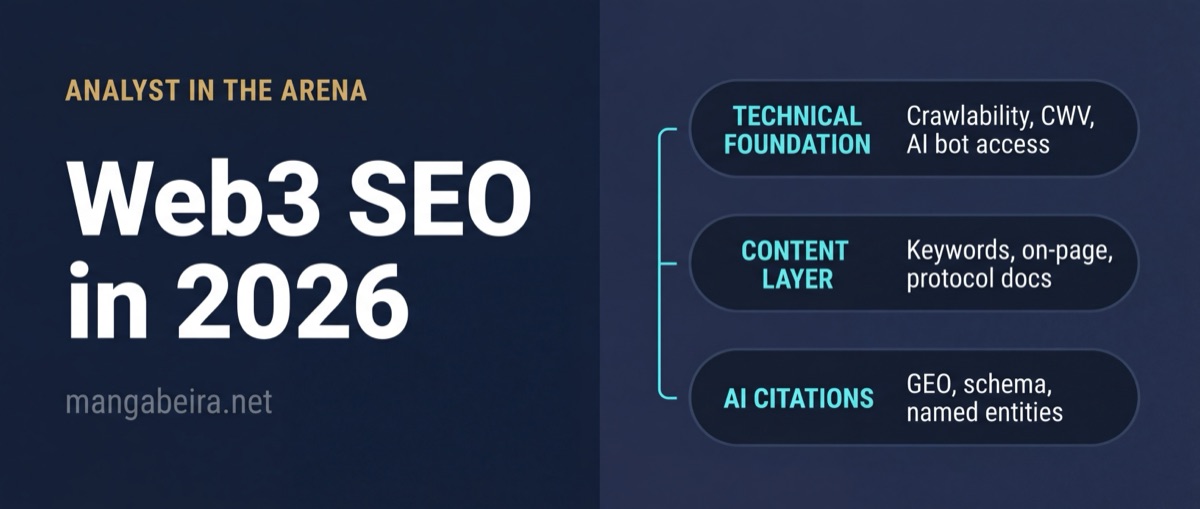
Web3 SEO is the practice of optimizing blockchain protocols, dApps, and token-related content to rank on traditional search engines and get cited in AI-generated answers.
I track this page's own citation record. As of September 2026, it ties for the single most-cited URL across an eight-prompt Perplexity test battery I ran on web3 SEO queries. That's not a brag. It's the baseline I'm sharpening in this rewrite, not a cold start.
Most protocol teams either skip SEO entirely or copy a Web2 playbook that breaks on contact with wallet-gated content and pseudonymous teams. Neither works.
What follows is the version built from inside the problem. It covers keyword research for zero-volume protocol terms, technical fixes for React dApps, and the honest link economics.
It also includes a per-vertical query pattern table. And it includes two pieces of executable code, a DuneSQL wallet-attribution query and a GA4 event schema, that nothing else in this category publishes.
I checked the top ranking pages for "web3 seo," "seo for web3," and "crypto seo" before writing this rewrite. Ten of thirteen are agency or consultant properties. Two are platform aggregators, Medium and dev.to.
None are protocol-owned, and none are SaaS tool blogs. There's no strong-domain incumbent sitting on this category. It's winnable on content quality alone.
This guide covers what Web3 SEO actually is and why Google treats crypto differently. It maps your real indexable surface across marketing site, docs, dApp, and forum.
It then walks through keyword and vertical strategy, technical fixes, and link building. It closes with GEO and AI citation measurement, on-chain attribution, cost and timeline, common mistakes, and a stage-by-stage action plan.
Key Takeaways
- Web3 SEO differs from standard SEO on three axes: trust (pseudonymous teams lack conventional E-E-A-T), technical stack (React SPAs and wallet gates block crawlers), and search intent (protocol queries mix research, price speculation, and technical evaluation).
- Nobody in the current top 13 ranking pages for "web3 seo" publishes an executable on-chain attribution recipe. A named GA4 event schema plus a copyable DuneSQL query is the single most linkable asset available in this category right now.
- Multi-surface architecture, marketing site, docs, dApp, governance forum, GitHub, is the highest-frequency real question a protocol growth lead asks. Almost nobody publishes a straight answer to it.
- On-chain identity (ENS, wallet address, sameAs links) is a verification-consistency signal, not a Google ranking factor. Treat any claim otherwise as marketing, not evidence.
- For your own brand and ticker queries, the actual top result is often CoinGecko, CoinMarketCap, or DefiLlama, not your own site. Reclaiming that SERP has a specific playbook, covered below.
In this article
What Is Web3 SEO?
Web3 SEO is the practice of optimizing blockchain protocols, dApps, and token-related content to rank on traditional search engines and get cited in AI-generated answers. It applies standard optimization frameworks to the unique trust, technical, and keyword challenges of on-chain projects.
That one sentence is already doing work. It's the definition this page has carried since 2025, and it's part of why Perplexity keeps citing this URL. I'm not replacing it. I'm sharpening what surrounds it.
Three things separate Web3 SEO from the standard version. First, the trust environment: anonymous or pseudonymous teams lack the conventional E-E-A-T signals Google's quality raters look for, especially on anything touching financial instruments.
Second, the technical stack. React SPAs with wallet-connect entry gates often return near-empty pages to crawlers. Third, the search intent. Protocol queries blend research, price speculation, and technical evaluation in ways standard keyword frameworks were never built to sort.
You'll also see this called "crypto SEO." The two terms overlap but aren't identical. Crypto SEO leans toward exchange and token-sale content. Web3 SEO covers how DeFi protocols, DePIN networks, wallets, and RWA platforms build search visibility, a different content surface with different trust requirements.
The opportunity is wider than most teams realize once they look past their own blog. A DeFi lending protocol explaining liquidation mechanics. A DePIN network publishing node coverage maps and hardware setup guides.
An RWA platform writing about the legal structure behind tokenized treasuries. A stablecoin team documenting peg stability data with real numbers attached. These are the content surfaces that rank, persist, and compound across every Web3 vertical. A one-time ad buy doesn't do that, and neither does a single launch-week press release.
The satellite ring around this page goes deeper on each front. See DeFi protocol SEO by protocol type, getting cited accurately by AI engines, and the technical stack that breaks silently. Also see making a wallet-gated dApp findable, turning on-chain proof into crawlable E-E-A-T, and taking the whole thing multilingual.
Web3 SEO vs Traditional SEO: What Actually Changes
Standard SEO playbooks assume verified identities, static HTML, and conversion events that leave first-party data trails. Web3 projects break all three assumptions at once.
| Factor | Traditional SEO | Web3 SEO |
|---|---|---|
| Trust signals | Author bylines, brand history, named credentials | On-chain reputation, audit reports, CMC/CoinGecko listings, security track record |
| Content format | Blog posts, landing pages, case studies | Whitepapers, tokenomics pages, protocol docs, Dune dashboards |
| Link building | Guest posts, digital PR, directory listings | Protocol directories, audit backlinks, Dune citations, crypto media |
| Analytics | GA4, GSC, first-party conversion data | GA4 plus Dune on-chain attribution, wallet connect events |
| Technical stack risk | Low. Most CMS platforms render server-side by default. | High. React SPAs and wallet-connect gates frequently block crawlers. |
| Brand SERP | Your own domain usually ranks #1 for your brand name | CoinGecko, CMC, or DefiLlama often outrank your own site for your ticker |
Why Google Treats Crypto Differently: YMYL, E-E-A-T, and the Trust Bar
Google's quality rater guidelines weight Experience, Expertise, Authoritativeness, and Trustworthiness heavily for YMYL content, "Your Money or Your Life." Anything touching financial instruments qualifies. Most Web3 content does.
A pseudonymous team with no author page, no verifiable track record, and no named contributors starts at a structural disadvantage on this axis.
That doesn't make ranking impossible. It means substituting institutional authority for personal credentials: published security audits, GitHub commit history, governance participation, and citations from credible third parties. The protocol's track record stands in for the founder's resume.
The pseudonymous-team mechanics nobody actually solves
Most Web3 SEO content names this problem and stops. Here's what to actually do about it.
Use an entity, not a person, as the author when the team is pseudonymous. Structure Organization schema around the protocol itself, with sameAs links to your audited GitHub repo, your CMC and CoinGecko listings, and your governance forum. Google's entity graph can verify a consistent organization even when it can't verify an individual.
Let the audit trail do the E-E-A-T work. A security audit from a named firm like CertiK or Hacken, published prominently and linked directly, functions as third-party validation. That's the strongest pattern available: independent verification beats self-published claims, every time.
Stack governance participation as a trust signal. Public voting history on Snapshot or Tally, tied to a consistent address, is auditable by anyone. It's not a Google ranking factor by itself, but it's the kind of consistent, verifiable activity that supports the institutional-authority case.
Compound Finance's documentation is a useful reference here. Its risk parameters page ranks for technical queries like "Compound Finance collateral factor." Not because anyone at Compound has a personal author byline.
It ranks because the page is structured HTML with clear headings, backed by a protocol with a long, verifiable on-chain and audit history. The institutional trail carries the weight a personal bio would carry elsewhere.
A worked example: my own on-chain identity, honestly framed
I want to show what this looks like in practice, so here's my own setup. My ENS name, mangabeira.eth, resolves to 0xc2268753E724bcE4A20B413ADD6359abF14D5154.
It's cross-linked via web3.bio to mangabeira.net, my GitHub, and my X profile. I also hold the equivalent mangabeira.lens name on Lens Protocol, pointing at the same address and the same site.
I do not have an EAS (Ethereum Attestation Service) attestation yet. I checked EASScan directly before writing this section and confirmed there's nothing there. I looked into building one myself and decided against it: EAS's own documentation is explicit that an attestation's value comes from the attester's reputation, not the subject's. A self-issued attestation about myself would just be a self-published claim wearing cryptographic packaging, the exact pattern this whole section warns against.
I do have one real credential, unrelated to any of the wallet setup: a Marketing Engineering certification from Profound University, completed September 2026, with a public diploma record I don't control the wording of. That's the honest bar for schema.org's hasCredential property: verification that lives somewhere other than my own site. Here's the full schema, both pieces:
{
  "@context": "https://schema.org",
  "@type": "Person",
  "name": "Gabriel Mangabeira",
  "url": "https://mangabeira.net",
  "sameAs": [
    "https://x.com/manga82",
    "https://github.com/gmangabeira",
    "https://web3.bio/mangabeira.eth"
  ],
  "identifier": [
    {
      "@type": "PropertyValue",
      "propertyID": "ens_domain",
      "value": "mangabeira.eth"
    },
    {
      "@type": "PropertyValue",
      "propertyID": "ethereum_address",
      "value": "0xc2268753E724bcE4A20B413ADD6359abF14D5154"
    }
  ],
  "hasCredential": [
    {
      "@type": "EducationalOccupationalCredential",
      "name": "Marketing Engineering",
      "recognizedBy": { "@type": "Organization", "name": "Profound University" },
      "url": "https://university.tryprofound.com/diplomas/344379c2-41f7-4829-a136-1d38e90837fe"
    }
  ]
}
Notice what hasCredential points to, and what it doesn't. It points to the Profound diploma, verifiable on Profound's own site, not mine. It does not point to the ENS name or the wallet address. Those stay in identifier, a secondary anchor alongside my name and URL, not a credential. Mixing the two, treating a wallet address as if it were a credential, is the same category error the retracted "85% Knowledge Panel" claim made below.
Watch Out For
A developer once built an ENS-plus-schema.org integration and publicly claimed it produced an "85% Knowledge Panel probability." He later retracted the number, stating it had no empirical grounding. On-chain reputation is not a confirmed Google ranking factor, and no evidence shows it touches Google's entity-verification graph at all. Treat this section as a verification-consistency play for AI answer engines, never as an SEO lever.
The honest pitch: a verifiable, tamper-evident claim is a real trust signal in a world where text is nearly free to generate. That holds whether or not any algorithm currently rewards it. That's a defensible position. "This will improve your rankings" is not. Read the full mechanics in the on-chain trust signals satellite.
Your Real SEO Surface: Marketing Site, Docs, dApp, Forum, GitHub
Ask any protocol growth lead what their actual indexable surface is, and most can't answer cleanly. A typical protocol spans a marketing site, a docs subdomain, a client-rendered dApp, a governance forum, and a GitHub org. Nearly every Web3 SEO guide names this sprawl and moves on without solving it. Here's the policy I run.
This matters because Google allocates a crawl budget per site. A fragmented surface spreads that budget thin across domains Google treats as separate entities.
A large-site case study on internal linking found that revised internal linking took a site from 40 percent to 70 percent Googlebot crawl coverage. Pages that get more internal links pointing at them get prioritized for crawling.
A protocol that consolidates its surface, and links to its important pages from its highest-traffic pages, gets more content actually crawled.
| Surface | Subdomain or subfolder | Index policy |
|---|---|---|
| Marketing site | Root domain | Fully indexed, SSR or SSG required |
| Docs | Subfolder (/docs), not docs.protocol.xyz | Fully indexed. Consolidates authority on the root domain instead of splitting it. |
| dApp (app.protocol.xyz) | Subdomain, kept separate | Noindex wallet-gated views. Index only static, pre-connect landing states if they carry real content. |
| Governance forum | Subdomain (gov.protocol.xyz) or hosted (Discourse/Commonwealth) | Index if self-hosted with canonical tags. Third-party hosted forums rarely pass equity back. |
| GitHub org | github.com/protocol (external) | Already indexed by Google directly. Ensure the README links back to the root domain, dofollow. |
The single highest-leverage move here: consolidate docs onto the root domain as a subfolder instead of a separate subdomain. Subdomains are treated as distinct entities for most authority signals.
A protocol running docs.protocol.xyz and blog.protocol.xyz is building two weak domains instead of one strong one. Move to protocol.xyz/docs and protocol.xyz/blog, and the inbound links your docs earn start flowing to the whole site.
Canonical rule for the dApp: if a route requires a wallet connection to render any content, noindex it explicitly. A blank or auth-gated page that does get indexed just accumulates thin-content signal against the domain.
Keep the dApp's static entry states (a landing page, a stats dashboard that doesn't require connection) indexable, and gate the rest. This is covered in more depth in the seo-for-dapps satellite and the web3-technical-seo satellite.
Keyword Research When Your Protocol Terms Have Zero Volume
Crypto keyword tools return low volumes for most Web3-specific terms. The temptation is to dismiss these queries as too small to build a strategy around. That's the wrong frame.
A founder searching "Aave vs Compound" is actively comparing risk parameters and choosing where to deploy capital. Low volume by consumer standards, high conversion value by any standard.
Here's the process, step by step:
- Start with GSC, not a keyword tool. Pull Search Console data sorted by impressions. Filter for positions 5 to 20. These are pages Google is already evaluating for relevant queries, where you haven't earned a click yet. This is the fastest path to ranking movement.
- Map the comparison queries first. "Aave vs Compound"-style queries define a protocol's positioning in search. A well-structured comparison page, with current DefiLlama TVL data for both sides, ranks for the query and builds credibility at the same time.
- Use DefiLlama category pages as a keyword signal. If your protocol appears in the "lending" or "liquid staking" category, those category terms are mid-funnel targets. DefiLlama's own protocol pages surface for terms like "[protocol] TVL" because the page has explicit data structure. Your docs and blog can compete for the same terms with protocol-specific context.
- Separate "price prediction" from research queries. These attract speculators, not protocol users, and generate traffic that bounces before a wallet connect. Map them separately if you serve them at all.
- Use the trust-query pattern. "Is [protocol] safe," "is [token] a rug," and "[protocol] hack" carry real, if unglamorous, search volume. A page that answers these honestly, with your audit history and incident record if any, ranks precisely because almost nobody wants to write it.
- Pull CoinGecko category terms. Standardized labels like "real-world assets" or "decentralized derivatives" map directly to search queries and typically carry lower competition than protocol-level branded terms.
- Include British spelling variants. "Web3 search engine optimisation" carries measurable GSC impressions from non-US audiences. Include the variant once in body copy for a global reach bump.
One caveat on tooling: most mainstream keyword tools, Ahrefs and Semrush included, undercount Web3-specific search volume. Their data sources skew toward broader consumer search patterns.
A "0" volume reading in a standard tool doesn't mean zero searchers. It usually means the tool's sample didn't catch this specific niche. Treat GSC's own impression data as more reliable than any third-party tool's volume estimate for protocol-specific terms.
Query Patterns by Vertical: DeFi, CEX/DEX, Wallets, Stablecoins, DePIN, RWA
Every Web3 SEO guide I've read treats "Web3" as one audience with one query pattern. It isn't.
A DeFi protocol, a CEX, a wallet, a stablecoin issuer, a DePIN network, and an RWA platform each face different query shapes. Each faces a different SERP incumbent and a different trust signal that actually moves the needle.
This is the most defensible original section in this whole piece. Satellite coverage for the deepest one lives at DeFi protocol SEO.
Treating these six verticals with one undifferentiated playbook is why so much Web3 content underperforms. A DePIN team writing "best practices" content aimed at token speculators misses the hardware-buyer and node-operator audience that actually converts.
A stablecoin issuer publishing generic DeFi content misses the peg-risk and reserve-transparency queries that dominate its actual search demand. The table below is the starting map. Each vertical deserves its own keyword universe built from it, not a single shared list.
| Vertical | Dominant query pattern | Typical SERP incumbent | Decisive trust signal |
|---|---|---|---|
| DeFi protocols | Comparison and metric queries ("[protocol] vs [protocol]," "[protocol] TVL") | DefiLlama, aggregator protocol pages | Published security audit, TVL freshness |
| CEX/DEX | "Is [exchange] safe," fee comparison, listing queries | CoinGecko exchange rankings, review aggregators | Proof of reserves, regulatory licensing pages |
| Wallets | "[Wallet] vs [wallet]," supported chains, recovery guides | App store listings, review sites | Open-source audit status, self-custody clarity |
| Stablecoins | Mechanism and peg-risk queries ("USDC vs DAI," "is [stablecoin] backed") | Issuer transparency pages, aggregator peg trackers | Reserve attestations, redemption track record |
| DePIN | Geographic, hardware, and operator queries ("how to run a [network] node") | Network coverage-map dashboards, hardware review forums | Real coverage-map data, operator payout history |
| RWA | Asset-class and compliance queries ("tokenized treasury yield," "RWA token regulation") | Legal/compliance content, institutional research firms | Legal structure disclosure, custodian and audit chain |
Winning Your Own Brand SERP Back from CoinGecko, CMC, and DefiLlama
Search your own protocol name right now. There's a real chance the top result isn't your site. It's a CoinGecko listing, a CoinMarketCap page, or a DefiLlama profile.
Not one of the 13 pages I reviewed while building this rewrite mentions this problem, let alone offers a fix. That makes it the most uncontested section in this entire guide.
This happens because aggregator pages carry more raw domain authority than most young protocol sites, and they're built with explicit data structure Google rewards. The fix isn't fighting the aggregator. It's making your own site the more complete, more current answer.
| Aggregator | Why it outranks you | Reclaim tactic |
|---|---|---|
| CoinGecko | High domain authority, structured price/TVL data | Complete the listing fully, link to your own docs and tokenomics from it, then out-publish it with fresher context it doesn't carry |
| CoinMarketCap | Same pattern, plus branded-query dominance from price-check traffic | Same as CoinGecko. Keep the CMC description current every time your messaging changes |
| DefiLlama | TVL-focused searchers land here first, especially for comparison queries | Build your own TVL page with the same live data (see the on-chain attribution section) plus mechanism explanation DefiLlama doesn't provide |
| Exchange listing pages | High-DA exchange domains rank for "[token] price" and similar | Don't compete on price pages. Own the mechanism and comparison queries the exchange page can't answer |
The realistic goal isn't outranking CoinGecko for "[token] price." It's owning the queries the aggregator can't answer: mechanism, roadmap, governance, and comparison. Those are exactly the pages your own site should be structured to win.
Technical SEO for dApps: Rendering, Core Web Vitals, and Wallet-Gated Content
Most protocols lose the most ground here, and most of it is fixable without a rebuild.
JavaScript rendering. If your dApp is a React SPA served entirely client-side, Google has to render it before indexing. That happens in a queue with delays that can run days.
If the homepage entry point is a wallet-connect modal, Googlebot often gets empty content on the first pass. The fix is SSR or SSG for all marketing and content pages, even while the dApp itself stays client-side.
Next.js handles this with hybrid rendering. The dApp keeps its architecture, and the landing pages, docs, and blog get static generation.
I've audited protocol sites where the homepage returned under 500 bytes of content to crawlers. The entire page was client-side rendered behind a wallet auth flow. That's not a minor gap.
It means Google effectively saw a blank page where a human visitor saw a full marketing site. The fix isn't always a full framework migration either.
A single-page-site failure mode is a more severe version of the same problem. That's when the entire domain is one route with everything loaded via JavaScript. Check whether your site has real, separately-routable URLs for docs, blog, and each content section, not just anchor links within one page.
Core Web Vitals for dApps
| Metric | Target | Common Web3 cause when it fails |
|---|---|---|
| LCP (Largest Contentful Paint) | Under 2.5 seconds | Heavy JS bundles, unoptimized wallet-connect libraries loaded on every page |
| CLS (Cumulative Layout Shift) | Under 0.1 | Dynamic price/TVL widgets loading without reserved space |
| INP (Interaction to Next Paint) | Under 200ms | Wallet interaction handlers running on the main thread |
robots.txt configuration. A pattern I see constantly in protocol audits: a robots.txt copied from a Web2 SaaS template that blocks staging paths and internal routes. Sometimes it also blocks /whitepaper, /docs, or /token by accident. Audit your robots.txt against your actual public site structure before assuming everything is indexable.
Test rendering directly rather than assuming it works. Google Search Console's URL Inspection tool shows exactly what Googlebot sees when it renders a given page, including a screenshot of the rendered DOM.
Run this on your homepage, your docs index, and your tokenomics page specifically. If the screenshot shows a blank page or a wallet-connect modal with nothing behind it, that's the page failing at the exact point that matters.
It's a five-minute check. It catches a problem most teams only discover months later in a GSC coverage report.
AI crawler access. Google is one crawler. Perplexity, ChatGPT, and Gemini send their own bots: PerplexityBot, GPTBot, ClaudeBot. If a template-inherited robots.txt blocks these, your protocol won't get cited in AI-generated answers for your category, regardless of how good the content is. Check this explicitly.
Wallet-gated content. Noindex any route that requires a wallet connection to render meaningful content, per the canonical rule in the SEO surface section above. The SSR-vs-CSR decision tree for each route type is in the seo-for-dapps satellite.
Schema Markup for Web3 Projects
Schema is one of the cheapest AEO wins in this category, and most of the top-ranking pages in this SERP still get it wrong.
Eight of thirteen competitor pages I reviewed show a visible FAQ block. Eleven of thirteen don't emit FAQPage schema at all. Most pages with a visible FAQ still fail to mark it up.
| Schema type | What it does | Web3-specific note |
|---|---|---|
| Article | Marks up blog and docs pages | Use on protocol docs and blog, never on the wallet-gated app views |
| Organization | Establishes the protocol as an entity | sameAs to CMC, CoinGecko, GitHub, and governance forum, all four if they exist |
| Person | Establishes a named author or contributor | Only for named team members. Use Organization, not Person, when the team is pseudonymous |
| FAQPage | Marks up FAQ content for direct extraction | Verify it actually renders. A visible FAQ with no matching schema is the single most common gap in this category |
| BreadcrumbList | Site hierarchy signal | Useful once docs are consolidated onto the root domain as subfolders |
| HowTo | Step-by-step process markup | Fits node-operator setup guides and staking walkthroughs well |
Validate every schema block against Google's Rich Results Test before publishing. A block that fails to render is worse than no block at all, because it signals a technical gap without earning any of the benefit.
Test after every deploy, not just at launch. A CMS migration or a template change can silently strip schema without breaking the visible page, and nobody notices until a citation rate quietly drops months later.
On-Page SEO for Protocol Pages, Docs, and Blog
On-page SEO for Web3 means optimizing pages that don't exist in a standard Web2 stack. For a DeFi protocol, that's the whitepaper, the tokenomics page, and the TGE landing page. For DePIN, it's node coverage maps and hardware guides. For RWA, it's asset-class explainers and legal structure pages.
Whitepaper SEO. Publishing a whitepaper as a PDF alone is an indexing penalty you're choosing. Google indexes PDFs poorly compared to HTML, and can't follow internal anchor structure inside one.
An HTML version, structured with H2s for mechanics, tokenomics, security, and governance, becomes a high-authority page. It ranks for technical queries and earns inbound links from researchers.
Tokenomics page structure. These pages consistently rank for "[token] tokenomics" and "[token] vesting schedule" queries from due-diligence researchers.
The common mistake: rendering the whole allocation breakdown as a JavaScript chart with no static text fallback. If the chart breaks or fails to render, the crawlable content is gone entirely.
Each allocation category and vesting term should exist as plain HTML text, with any chart layered visually on top.
TGE and token launch pages. A live, indexed page targeting "[protocol] token launch" and "[token] airdrop eligibility" accumulates impressions before launch if it goes up early. Most teams build this two weeks out. Building it three months out captures the search intent spike that hits on launch day itself.
Two related satellites go deeper here: tokenomics page structure and the full pre-launch SEO checklist.
Programmatic SEO for Token, Chain, and Pair Pages
Only two of thirteen competitor pages I reviewed cover programmatic SEO for Web3 at all, and neither goes past a paragraph. It's a real lever for any protocol that spans multiple chains, multiple pairs, or multiple assets.
The pattern: build a template that generates a page per token, per chain, or per trading pair. Populate it from the same data source that feeds your app.
A DEX aggregator with 400 supported pairs can programmatically generate 400 pages, each targeting "[token A] to [token B] swap" or "[token] price on [chain]." The pair-specific data pulls live from the same API the app already calls.
Three rules keep this from becoming thin-content spam Google discounts. First, each page needs genuinely distinct data, not a templated shell with the token name swapped in. Second, cap the template at data your app actually surfaces, don't invent fields to fill space.
Third, noindex any generated page below a minimum data threshold. A pair with near-zero volume doesn't deserve an indexed page. Multi-chain protocols and DEX aggregators are the clearest fit for this pattern. A single-chain lending protocol with five markets has less to gain from it.
Building Authority Without Guest Posting: The Honest Link Economics
Traditional link building, guest posts and link exchanges, doesn't map well to how Web3 protocols earn authority. The crypto ecosystem produces high-authority link sources naturally, as byproducts of normal protocol operations. Most teams aren't collecting them systematically.
| Link source | Authority impact | Effort |
|---|---|---|
| Protocol directory listings (CMC, CoinGecko, DefiLlama) | High. Among the highest-DA sources available to any Web3 project | Low. One-time setup, ongoing description freshness |
| Security audit publication | High. Trusted third-party backlink plus an institutional E-E-A-T signal | Low if the audit already exists. Just publish and link it prominently |
| Dune dashboard citations | Medium to high, compounds over time as researchers cite the dashboard | Medium. Build once, keep current |
| Crypto media coverage (CoinDesk, Decrypt, The Block) | High, plus branded query volume | Medium to high. Requires a genuine data-led story, not a press release |
| GitHub repository references | Compounds organically with ecosystem adoption | Low, mostly earned passively if the repo is genuinely useful |
| Podcast appearances | Medium. Single link plus an audience that may search for you afterward | Medium. Earned media, one appearance at a time |
The most durable authority signal for a DeFi protocol isn't a guest post on a blockchain blog. It's a complete CMC listing, a published security audit, a public Dune dashboard, and an active GitHub repo, together.
These are the sources researchers cite, journalists link to, and AI engines treat as authoritative when forming answers about your category. None of it is content built for link acquisition. It's the artifacts your protocol already produces, structured to pass authority instead of sitting unused.
On cost: I don't have a verified, sourced figure for the premium crypto links carry over standard SaaS links. One agency in this space has published a claim: crypto tier-1 placements run $5,000 to $15,000, three to five times a comparable SaaS link.
I can't independently verify that number, so I'm flagging it as a published industry claim, not a fact I'm asserting. Budget conservatively and negotiate per placement rather than anchoring to any single figure you read.
A data-led pitch beats a press release every time with crypto media specifically. Instead of announcing a launch, pitch a journalist a finding your own Dune dashboard surfaces. A shift in DEX volume share, a TVL inflection point, something your on-chain data shows that isn't visible from outside your protocol.
Journalists at outlets like CoinDesk and The Block cite original data because it makes their own coverage more credible. A press release competes with a hundred other press releases that week. A genuine data finding usually doesn't.
GEO: Getting Cited in AI Overviews, ChatGPT, and Perplexity
GEO, Generative Engine Optimization, is the practice of structuring content to get cited inside AI-generated answers, not just ranked below them. For Web3 queries, this is becoming more urgent than traditional ranking. Informational queries increasingly trigger an AI Overview before the first organic result even loads.
When a searcher gets their answer directly from Google's synthesized response, the click never happens. Ranking page one no longer guarantees visibility. The real question isn't "where do we rank." It's "are we cited inside the answer."
Four things drive AI Overview and AI-chat citation for protocol content:
Direct definitions at the top of relevant sections. AI engines extract from sections that directly answer a question. Open every major H2 with a 40 to 60 word direct answer, then expand. This page follows that structure deliberately, and it's part of why it already gets cited.
Structured data. FAQPage, Article, and Organization schema with verifiable sameAs links give AI systems named-entity clarity about what your protocol is.
E-E-A-T signals for pseudonymous teams. Covered in full above: audits, GitHub history, and institutional proxies substitute for personal credentials.
Named entity density. Content referencing Aave, Uniswap, Compound, Dune, DefiLlama, and CoinGecko by name signals domain-specific expertise in a way generic crypto content doesn't. Build this deliberately as evidence, not as keyword stuffing.
Accuracy, not just presence. Getting cited is only half the equation. A live test I ran in August 2026 checked what major AI models said about protocol TVL against the on-chain numbers at query time.
Pendle's TVL was overstated by 244 to 320 percent across the models tested. Lido's was overstated by 80 to 96 percent.
A user who checks the real number and finds it three times lower loses trust in both the model and the protocol. The protocol did nothing wrong except fail to control the narrative.
The fix isn't more content. It's numbers that update themselves. Embed a live TVL widget pulling from DefiLlama or your own subgraph instead of a static figure. Timestamp every numeric claim explicitly, "as of [date]," so both crawlers and readers can judge freshness.
Freshness matters beyond accuracy. Every top-cited page I checked while researching this rewrite carries a visible, recent update stamp, most within the last four months of when I checked.
A blog post about your fee structure can sit unchanged for two years without hurting you. A page that AI engines pull numeric claims from can't. If a page carries a figure that changes over time, TVL, APY, holder count, treat its update cadence as SEO maintenance, not an afterthought.
Measuring AI Citations: A Prompt Set and a Share-of-Voice Baseline
Every guide in this category says "get cited by ChatGPT." Almost none give a method for measuring whether it's actually happening. Here's the method I used to produce the citation claim in this article's opening paragraph, so you can run it yourself.
Build an eight-to-twenty prompt battery. Mix definitional prompts ("what is web3 seo") with vertical-specific ones ("how do I do SEO for a DeFi protocol"). Add an edge-case prompt on a topic with thin competitive supply, like hreflang for crypto sites. Keep the exact wording fixed so results are comparable over time.
Run the battery through an API that returns structured citations. Perplexity's API returns explicit url_citation annotations per response, not just prose you have to parse. That's a reliable signal for how that specific engine surfaces sources, though it's one engine, not a cross-engine consensus.
Tally by domain and by exact URL. Count distinct citation instances per prompt, then roll up by domain and by specific page. A domain can appear more than once per prompt if it has multiple ranked pages on the topic.
Re-run monthly. Citation share moves with content freshness and competitor publishing activity. A single snapshot tells you where you stand today. A monthly cadence tells you whether you're gaining or losing ground.
When I ran this exact process in September 2026 across eight Web3 SEO prompts, this page tied for the single most-cited URL. It appeared on the definitional prompt, the DeFi-protocol prompt, the best-practices prompt, and the technical-SEO prompt.
That's a verifiable, repeatable result, not an unsourced claim. Run the same eight prompts yourself and you can check it.
On-Chain Attribution: From Session to Wallet Connect
This is the section nobody else in this category has built. Every competing guide has a heading that says "on-chain conversion tracking." Zero contain an actual query or event schema, or a method for joining a session to a wallet address. Here's both pieces, ready to adapt.
Organic Search Session
Landing Page Visit
Wallet Connect
GA4 event, hashed address
Dune Join
On-Chain Wallet Activity
Step 1: instrument the wallet connect as a GA4 custom event
Fire this event on wallet connection, with the raw address hashed, never sent as plain text:
{
  "name": "wallet_connect",
  "params": {
    "wallet_provider": "metamask",
    "wallet_address_hash": "sha256_hashed_address",
    "chain_id": "1",
    "connect_source": "docs_page",
    "utm_source": "{{utm_source}}",
    "utm_campaign": "{{utm_campaign}}"
  }
}
This bridges the web analytics layer with the first on-chain action. You won't get full attribution from GA4 alone, but you'll see which organic queries and landing pages produce wallet connects at the highest rate. For most protocols, this is the most useful attribution signal available without a custom Dune pipeline.
Step 2: join connects to on-chain activity in Dune
The query below assumes you're exporting your GA4 wallet-connect events into a table Dune can query. A common pattern is a scheduled export to a warehouse, then a Dune data source pointed at it. It joins that connect log to on-chain transactions against your protocol's contract:
-- Wallet attribution: join marketing-site wallet connects to on-chain activity
-- Assumes a `wallet_connects` table populated from your GA4 export
-- (wallet_address, utm_source, utm_campaign, connect_timestamp)

with connects as (
  select
    wallet_address,
    utm_source,
    utm_campaign,
    connect_timestamp
  from dune.your_project.dataset_wallet_connects
),

first_tx as (
  select
    "from" as wallet_address,
    min(block_time) as first_tx_time
  from ethereum.transactions
  where "to" = 0xYOUR_PROTOCOL_CONTRACT
  group by 1
)

select
  c.utm_source,
  c.utm_campaign,
  count(distinct c.wallet_address) as wallets_connected,
  count(distinct t.wallet_address) as wallets_transacted,
  round(100.0 * count(distinct t.wallet_address) / count(distinct c.wallet_address), 1) as connect_to_tx_rate_pct
from connects c
left join first_tx t
  on c.wallet_address = t.wallet_address
  and t.first_tx_time >= c.connect_timestamp
group by 1, 2
order by wallets_connected desc
The output is a connect-to-transaction rate broken down by UTM source and campaign, the exact chain that justifies content investment to a board.
This needs a data engineer and some server-side export work to stand up. It's achievable for any protocol with a technical team. It's the only reliable way to see whether organic traffic actually converts into on-chain activity, not just page views.
Hash the wallet address before it ever reaches GA4. Google's own terms prohibit sending personally identifiable data. A raw Ethereum address tied to an identifiable session arguably crosses that line, even though it's public on-chain data.
A one-way hash (SHA-256 is fine) keeps the event usable for attribution. It also keeps the raw address out of a third-party platform you don't fully control. Do the actual wallet-to-transaction join inside Dune, against your own exported data, not inside GA4 itself.
I built the full version of this as an open-source kit rather than keep it as a one-off snippet: capture script, event receiver, a five-query Dune SQL pack, and alert runners for Telegram, Discord, and Slack. It is forkable and MIT-licensed. github.com/gmangabeira/onchain-attribution-kit.
What Web3 SEO Costs and How Long It Takes
| Task | Typical timeline |
|---|---|
| Technical fixes (crawling, robots.txt, Core Web Vitals) | 2 to 4 weeks once Google recrawls |
| Protocol directory listings (CMC, CoinGecko) | 2 to 8 weeks for review and indexing |
| Content targeting new keyword clusters | 3 to 6 months to page one, depending on domain authority and competition |
| AI Overview / AI-chat citations | Can appear within days on newly indexed content if the format matches what the engine extracts |
Costs vary widely by scope and whether you're hiring an agency, a solo consultant, or building in-house. I'm not going to publish a specific dollar range here. I don't have verified market data to back one, and an invented number would fail the standard I'm holding this article to.
What I can say with confidence: technical fixes and directory listings are the cheapest, fastest wins available. They should happen before any paid content or link-building spend.
When evaluating a quote, agency or solo consultant, ask what specifically gets fixed in the first 30 days. Ask how you'll know it worked.
A vendor who can't name a concrete, checkable output in the first month is selling a retainer, not a diagnosis. The fastest wins in this category are cheap and fast precisely because they don't require new content, just fixing what's already broken.
The 10 Mistakes That Burn Web3 SEO Budget
| # | Mistake | Why it burns budget |
|---|---|---|
| 1 | Whitepaper as PDF-only | Google can't crawl anchor structure inside a PDF. You lose a high-authority page for free |
| 2 | docs. and blog. as separate subdomains | Divides crawl budget and inbound authority across two separate domains that never combine into one |
| 3 | Tokenomics rendered as JS chart only, no text fallback | If the chart fails to render, the crawlable content disappears entirely |
| 4 | Inherited robots.txt blocking /docs or /whitepaper | Crawlers can't access content that's disallowed, no matter how good it is |
| 5 | Blocking AI crawlers by accident | GPTBot, ClaudeBot, and PerplexityBot blocked means zero AI citation, regardless of content quality |
| 6 | Chasing branded query spikes during price volatility | Looks like SEO progress in GSC. It's price panic, not search equity |
| 7 | Doing all content work inside Discord and Telegram | Real depth, zero indexable equity. The two efforts don't compound together |
| 8 | Static TVL or price figures in blog content | Ages out of accuracy within weeks and gets propagated forward by every model that scrapes it |
| 9 | Ignoring the aggregator brand-SERP problem | CoinGecko or CMC keeps outranking your own site for your own ticker, indefinitely, if nobody addresses it |
| 10 | Building an llms.txt file and expecting it to drive citations | Log analysis of 137,000 domains found 97 percent of llms.txt files got zero requests in a full month. It's a coding-agent courtesy file, not an AEO tactic |
Multi-Region and Jurisdiction-Gated Content
Crypto audiences are global and jurisdictionally fragmented, and almost nobody in this category writes about it.
Hreflang is the tag that tells Google which language and regional version of a page to serve which audience. It gets mentioned exactly once across the 13 pages I reviewed for this rewrite, as a bare word with no explanation.
If your protocol serves distinct regions with distinct compliance requirements, gate content by jurisdiction deliberately rather than geo-blocking silently.
A page invisible in one region for legal reasons should still be indexable where it's legal to show it. Correct hreflang tags should point between the regional variants. Silent geo-blocking without hreflang confuses crawlers into thinking the content simply doesn't exist anywhere.
This site runs a live example of the pattern. The same article exists in English, Brazilian Portuguese, and Spanish. Each has its own translated slug, not a machine-translated copy of the English URL, cross-referenced with hreflang tags.
A protocol with meaningful LATAM or European user bases faces the same decision, and almost none make it deliberately. Most either publish English-only and lose the non-English searcher, or auto-translate without hreflang and end up with duplicate-content signals working against them.
The full mechanics of running this across three languages, the translated-slug and canonical-tag pattern I use on this site, are in the international SEO satellite.
Web3 SEO Action Plan by Stage
Pre-launch
3-6mo before TGE
- SSR/SSG site live
- Audit scheduled early
- Organization schema + sameAs
Launch week
- Publish audit report
- Submit URLs to GSC
- Fix blank/wallet-modal pages
Post-launch
months 1-3
- Comparison content + Dune dashboard
- GSC positions 5-20 sweep
- Scope programmatic (if multi-chain)
Growth
months 3-12
- Media pitches from Dune data
- Brand-SERP reclaim check
- Publish programmatic pages
Scale
- Audit impressions-no-click pages
- hreflang if non-English share
- Ecosystem content
SEO priorities shift as a protocol matures, and the fastest path is not the same for every team. Self-identify by stage first. Past pre-launch, also self-identify by team structure or chain footprint where it changes the concrete path. Each path below assumes the trust and technical foundations covered earlier in this guide.
Pre-launch (3 to 6 months before TGE)
Confirm your team identity model first. It changes one step in an otherwise identical path.
If your team is pseudonymous or anonymous →
- Get the marketing site live on the root domain with SSR or SSG, and consolidate docs onto a subfolder (
protocol.xyz/docs) instead of a separate subdomain. - Configure robots.txt to allow all crawlers, including GPTBot, ClaudeBot, and PerplexityBot. Submit your sitemap to GSC immediately.
- Structure Organization schema around the protocol entity, not a person, with
sameAslinks to your GitHub repo, your CMC and CoinGecko listings, and your governance forum. Google's entity graph can verify a consistent organization even when it can't verify an individual. - Publish the whitepaper as HTML alongside the PDF, and build the tokenomics page with plain HTML text for every allocation category, never a JS-only chart.
- Schedule your security audit now, not after launch. It's the first institutional-authority substitute a credential-light team needs, and audit firms book out weeks in advance.
- Start the CMC and CoinGecko listing process early. Both require review periods that run weeks.
If your team is named or public →
Run the same six steps. Two adjustments: Organization schema still anchors the protocol, but Person schema is safe to add for named contributors with real, verifiable credentials. And the audit still matters just as much. A named team doesn't exempt YMYL content from scrutiny, it just gives you one more trust signal to stack alongside the audit, not a substitute for it.
Launch week
Same path regardless of team structure or chain footprint.
- Publish the audit report and link it prominently from your security page.
- Submit new URLs via GSC's manual indexing request.
- Monitor GSC for crawl errors on JS-rendered pages specifically, not just the aggregate coverage report.
- Run the URL Inspection tool on your homepage, docs index, and token launch page. If the rendered screenshot shows a blank page or a bare wallet-connect modal, fix that before anything else this week.
- Update your CMC and CoinGecko listings with live exchange data immediately.
Post-launch, months 1 to 3
Self-identify by chain footprint here. It determines whether one entire tactic applies to you yet.
If you're a single-chain, single-product protocol →
- Start producing comparison and "alternatives to" content built around your actual competitors.
- Publish your first public Dune dashboard with your protocol's name in the title.
- Run a GSC analysis: sort by impressions, filter for positions 5 to 20, and update those existing pages to target the query more directly. This is the fastest ranking win available at this stage.
| Query | Page | Position | Impressions |
|---|---|---|---|
| avici tokenomics | /publications/case-study-defi-avici | 6.2 | 43 |
| marketing analytics for defi growth teams | /publications/defi-growth-experiments-marketing-team | 7.6 | 27 |
| defilaunch | /publications/defi-launch-frameworks | 18.2 | 15 |
| hyperliquid team size | /publications/hyperliquid-analysis | 10.2 | 5 |
Live GSC query data for mangabeira.net, sorted by impressions, filtered to positions 5 to 20, 2026-06-08 to 2026-09-05. Highlighted row is the highest-impression query currently sitting in that band, the exact filter this stage of the plan tells you to run.
- Skip programmatic SEO for now. A single-chain protocol with a handful of markets doesn't have enough genuinely distinct data to avoid the thin-content pattern Google discounts.
If you're a multi-chain protocol, a multi-pair DEX, or an aggregator →
- Run the same first three steps: comparison content, a public Dune dashboard, and the GSC positions 5-to-20 sweep.
- Start scoping your programmatic page template now, even though you won't publish it until growth stage. Confirm which field, per token, per chain, or per pair, your app already surfaces, and build the template against that live data source, not a static dataset that goes stale.
- Set your noindex threshold now. Decide what minimum data volume, a pair, a market, a chain, a page needs before it's worth indexing. Deciding this before you generate hundreds of pages is what keeps the pattern from becoming the thin-content spam it can easily turn into.
Growth stage (3 to 12 months post-launch)
Self-identify by team structure again here. The tactics converge, but the sequencing and one lever differ.
If your team is pseudonymous or anonymous →
- Keep building the institutional-authority stack: re-run or update the audit after any material contract change, and keep governance participation (Snapshot or Tally voting history) tied to a consistent address.
- Target crypto media with data-driven pitches built from your Dune dashboard findings. A verifiable number a journalist can check beats a press release, and it doesn't require a named spokesperson to work.
- Run the brand-SERP check from earlier in this guide. If CoinGecko, CMC, or DefiLlama still outrank you for your own protocol name, this is the stage to fix it.
- Monitor AI Overview and AI-chat citations monthly using the prompt-battery method covered above.
- If you're multi-chain or multi-pair, publish the programmatic pages you scoped in months 1 to 3.
If your team is named or public →
Run the same five steps. The audit-and-governance stack still matters with named founders. You have one additional lever the pseudonymous path doesn't: pitch podcast appearances and named-byline commentary under your own credentials. A journalist or podcast host can verify a real person faster than a protocol entity, which shortens the outreach cycle without replacing the institutional signals above.
Scale stage
Self-identify by audience footprint. It decides whether international content is the next investment or a later one.
If a meaningful share of your activity is non-English →
- Audit the full content library against current GSC data. Find pages with impressions but near-zero clicks and run targeted updates first, before adding new content.
- Build out international content using the translated-slug and hreflang pattern covered in the multi-region section above, not machine-translated copies of the English URL.
- Gate any jurisdiction-specific content deliberately, with correct hreflang tags, rather than silent geo-blocking.
If your activity is English-only or single-market →
- Run the same GSC audit first: find impressions-but-no-clicks pages and fix those before writing anything new.
- Build ecosystem content covering adjacent protocols in your category. Category authority is what converts comparison searchers into evaluators of your specific product.
- Revisit the international question every two quarters. A market share you don't have today can appear once a protocol gets integrated into a chain, wallet, or exchange with a different regional user base.
Want a structured read on your protocol's full search presence?
The Web3 Growth Audit covers keyword gaps, technical crawl issues, content opportunities, link authority, and a 90-day plan matched to your protocol's stage and vertical. Fully async, fixed scope, no discovery call.
See the Web3 Growth AuditAgency vs In-House: When Each Makes Sense
| Factor | Agency | In-house hire | Async specialist |
|---|---|---|---|
| Cost structure | Monthly retainer, often junior-heavy delivery | Full salary plus benefits, sunk even during quiet periods | Fixed-scope, one-time or per-engagement |
| Speed to start | Slow. Onboarding, account management layers | Slowest. Hiring cycle, ramp-up time | Fast. Scoped and delivered async in days |
| Vertical depth | Varies widely, many agencies genericize crypto to one playbook | Depends entirely on who you hire | High, if the specialist works across multiple verticals already |
| Best fit | Large, funded teams needing ongoing execution capacity | Protocols with sustained, long-term content volume needs | Post-PMF teams needing a diagnosis and roadmap, not headcount |
There's no universally right answer here. A protocol with a large, sustained content operation benefits from an in-house hire who lives inside the roadmap daily. A team that needs a structured diagnosis, a prioritized plan, and judgment calls without adding headcount is better served by a scoped, async engagement.
The mistake I see most often: a team defaults to an agency retainer before doing the cheap, fast technical fixes covered earlier in this guide.
Paying for ongoing content while your robots.txt silently blocks your docs folder is spending on the wrong end of the problem. Fix what's broken first, whoever does it, then decide what ongoing capacity actually looks like.
Frequently Asked Questions
What is Web3 SEO?
Web3 SEO is the practice of optimizing blockchain protocols, dApps, and token-related content to rank on traditional search engines and get cited in AI-generated answers. It applies standard SEO frameworks to Web3-specific trust, technical, and keyword challenges.
How is Web3 SEO different from regular SEO?
Three axes: trust (pseudonymous teams lack conventional E-E-A-T) and technical stack (React SPAs and wallet gates often block crawlers). The third is search intent, since protocol queries mix research, price speculation, and technical evaluation together.
How long does Web3 SEO take to show results?
Technical fixes show results in 2 to 4 weeks once Google recrawls. Directory listings take 2 to 8 weeks for review. New keyword-cluster content typically takes 3 to 6 months to reach page one. AI citations can appear within days if the format matches what the engine extracts.
How much does Web3 SEO cost in 2026?
Costs vary widely by scope, agency versus in-house versus async specialist, and how much technical remediation is needed upfront. I don't have verified market-wide pricing data to publish a specific range here. Budget conservatively and scope by deliverable, not by retainer size.
Are crypto links more expensive than regular SEO links?
Some agencies in this space publish claims that crypto links cost several times a comparable SaaS link. I haven't independently verified a specific multiplier. Treat any number you see, including ones in this piece, as a directional industry claim, not a hard fact.
How do I measure Web3 SEO ROI?
Track GA4 wallet-connect events alongside GSC impressions and clicks by query category. For full attribution, join wallet-connect logs to on-chain transaction data in Dune, the query pattern is covered in the on-chain attribution section above.
Can you do SEO for a crypto project with no search volume?
Yes. Low reported volume on protocol-specific terms doesn't mean low value. A founder searching "[protocol] vs [protocol]" is actively evaluating where to deploy capital, regardless of what a keyword tool's volume estimate shows.
What keywords should a crypto project target first?
Start with GSC data at positions 5 to 20, these are your fastest wins. Then build comparison queries ("[protocol] vs [protocol]"), category terms from DefiLlama or CoinGecko, and trust queries ("is [protocol] safe").
Should crypto projects optimize for AI search (ChatGPT, Perplexity)?
Yes. Informational protocol queries increasingly trigger an AI-generated answer before any organic result loads. Structure content with direct 40 to 60 word definitions at the top of each section, and verify your robots.txt doesn't block GPTBot, ClaudeBot, or PerplexityBot.
Can new or small crypto projects rank against big exchanges?
Yes, on the queries exchanges don't compete for. Exchanges dominate price and listing queries. Small protocols win on mechanism, comparison, and trust queries that a large exchange's content team has no reason to write.
What's the role of on-chain data in Web3 SEO?
On-chain data doesn't feed Google directly, Google doesn't read the blockchain. But on-chain activity generates the press coverage, Dune citations, and community discussion on indexable platforms that do build search authority. The link is real but indirect.
What tools work best for Web3 keyword research?
Google Search Console for existing impressions, DefiLlama and CoinGecko category pages for topic mapping, and Dune dashboard query patterns for what your community actually tracks.
Can a crypto project build SEO without a blog?
Partially. Docs, a tokenomics page, and a whitepaper in HTML can rank on their own. But a blog is where comparison content, trust-query answers, and timely commentary live, and those are hard to substitute.
What are the most common Web3 SEO mistakes?
PDF-only whitepapers, splitting docs and blog onto separate subdomains, JS-only tokenomics charts with no text fallback, and accidentally blocking AI crawlers in robots.txt. The full list of 10 is above.
Should protocol docs live on a subdomain or a subfolder?
A subfolder on the root domain (protocol.xyz/docs), not a subdomain (docs.protocol.xyz). Subdomains split authority signals across two weaker domains. Subfolders consolidate them onto one.
How do I track wallet connects as an SEO conversion in GA4?
Fire a custom GA4 event on wallet connection, with the address hashed rather than sent as plain text, and UTM parameters attached. The full event schema is in the on-chain attribution section above.
How does a pseudonymous team satisfy E-E-A-T?
By substituting institutional authority for personal credentials: published security audits, GitHub commit history, governance participation, and citations from credible third parties. Structure Organization schema around the protocol entity rather than an individual.
Why does CoinGecko outrank my protocol for my own token name?
Aggregator pages carry high domain authority and explicit structured data Google rewards. The fix isn't competing on price queries, it's owning the mechanism, roadmap, and comparison queries the aggregator page can't answer.
How do I know if ChatGPT or Perplexity is citing my project?
Run a fixed battery of 8 to 20 prompts through an API that returns structured citations, like Perplexity's. Tally results by domain and URL monthly. The full method is in the measuring AI citations section above.
The protocols building search equity now pay a fraction of what late movers will pay. Late movers acquire equivalent users through paid channels and KOL deals later. That math holds in Web3 the same way it holds everywhere else. It takes longer to start and compounds indefinitely once it does.
Want a structured diagnosis of where your protocol's organic presence actually stands? The Web3 Growth Audit covers SEO as part of a full distribution system review.
Written by Gabriel Mangabeira, Web3 growth strategist at mangabeira.net. SERP analysis and AI citation testing conducted September 2026. GSC data from mangabeira.net trailing 12 months. Keyword volume data from YepAPI. On-chain identity verified via ENS and web3.bio, September 2026.