The market has been pricing TVL for five years. Billions parked across protocols treated as a scoreboard. Bigger number, stronger signal. More credibility. Better token performance.
In the first half of 2026, that logic started to crack publicly. On LinkedIn and Crypto Twitter, the narrative shift shows clearly: founders and operators are asking which protocols actually generate revenue per unit of capital deployed, not which ones attracted the most parked liquidity. The two are not the same thing.
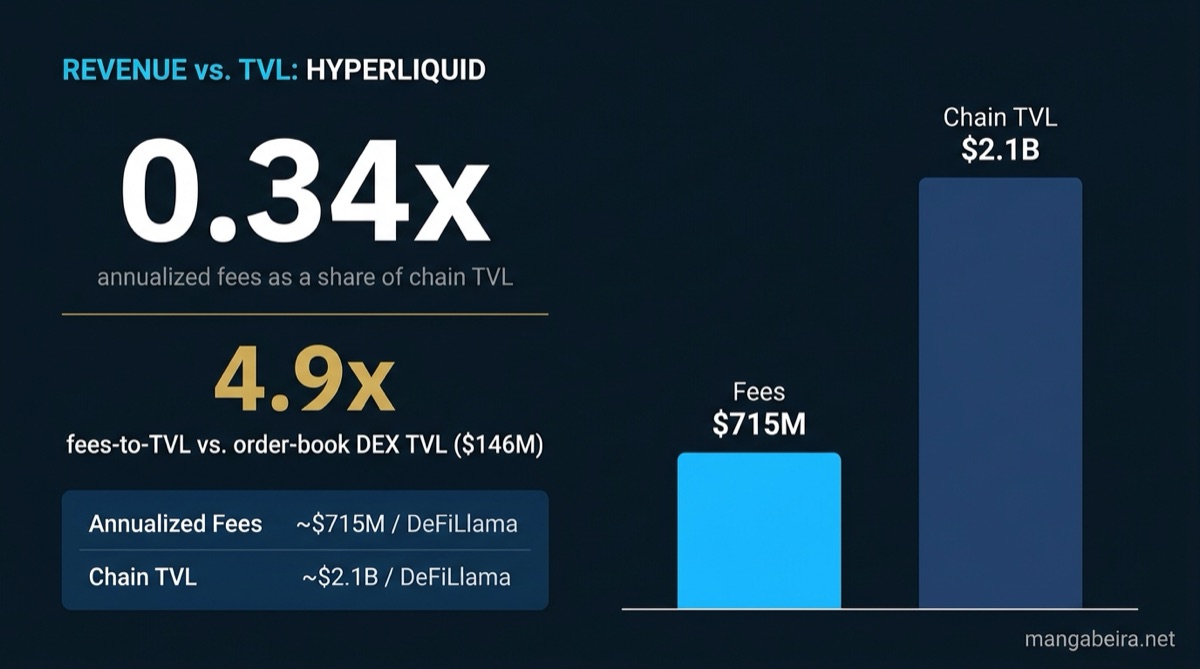
Hyperliquid is the cleanest proof of that gap. It generates roughly $715M in annualized fees on approximately $2.1B in chain TVL. That's a fees-to-TVL ratio of about 0.34x on chain TVL, and significantly higher when measured against its order-book DEX TVL of around $146M. Meanwhile, Canton Network runs roughly $1.9M per day in revenue on just ~$475,000 in TVL. Aave just announced a revenue-led 12-month plan anchored to $3.33T in cumulative deposits and GHO monetization.
Three data points, same signal. The metric that predicts protocol survival isn't how much capital you've attracted. It's how much revenue you generate from the capital you move.
This article covers why TVL became a trap, how Hyperliquid built a revenue flywheel without VC money, what the Canton and Aave patterns add to the picture, and a diagnostic framework builders can use to tell whether their own growth is revenue-led or TVL-rented.
The TVL Trap: Why the Metric Misleads
TVL made sense as a proxy metric in 2020 and 2021. DeFi was new, protocols needed a simple signal that capital trusted the smart contracts, and liquidity depth drove genuine utility. If nobody could swap $500K on your DEX without 5% slippage, the protocol wasn't useful yet.
The problem: TVL became an optimization target instead of a health signal. Protocols started designing around attracting TVL rather than generating value from it. High emissions, referral programs, yield incentives paid for with freshly minted tokens. The capital arrived because the yield was attractive. When the yield dried up, the capital left. The TVL chart looked like adoption. The on-chain behavior told a different story.
The core problem with TVL optimization
TVL measures where capital sits. Revenue measures what capital does. A protocol can have billions in TVL that generates almost nothing, while a competitor with a fraction of that TVL generates more fee revenue per day. Optimizing for the first metric doesn't build the second.
There's a second issue. Perp exchanges like Hyperliquid operate on margin. Traders don't need to park 1:1 collateral against their positions. A trader depositing $10,000 might control $50,000 in open interest. The collateral figure (TVL) dramatically understates the capital being put to work. This means measuring Hyperliquid's fee generation against its TVL base gives a ratio that already understates how efficiently the system uses deployed capital.
The market is finally pricing this differently. Analysts and founders are asking: what does this protocol earn per dollar of capital it processes? That question leads to very different conclusions than the TVL leaderboard.
Hyperliquid: The Revenue-Per-TVL Decoupling
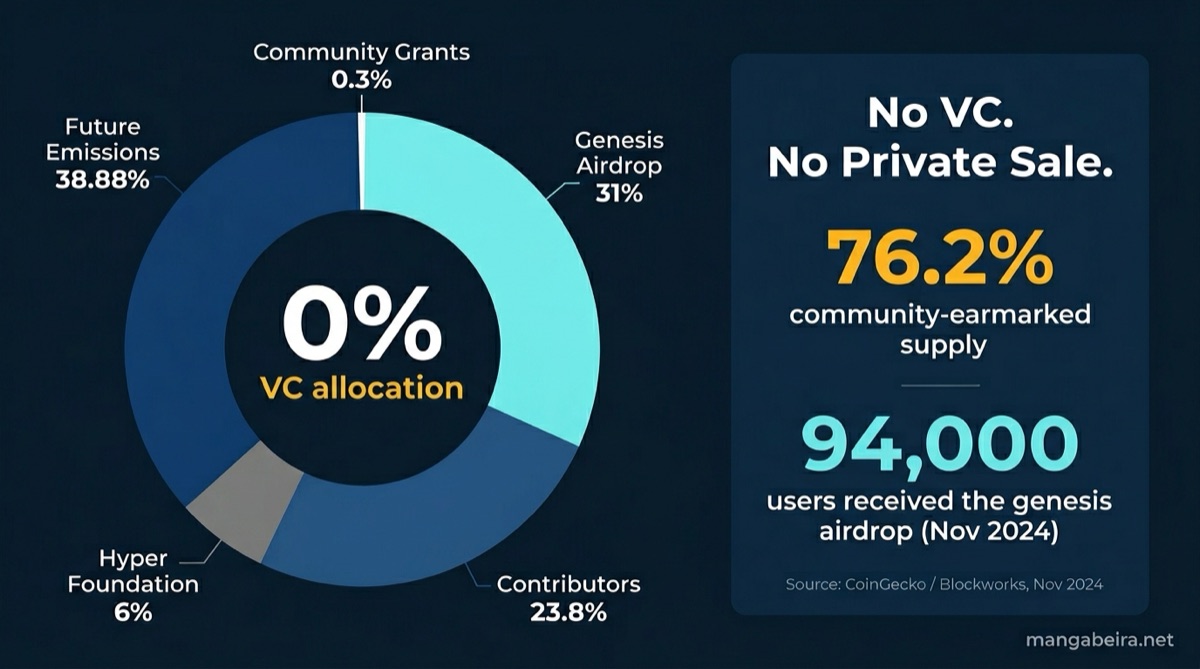
Hyperliquid launched its HYPE token on November 29, 2024. No VC backing. No private sale, per its public token distribution. It dropped 31% of total supply (310 million HYPE) to roughly 94,000 users in what was, at the time, the largest airdrop in crypto history. Day-one market cap was approximately $1.7B with an FDV around $5.1B.
By early 2026, HYPE was trading at $71.93 with a market cap of roughly $16B. The protocol had captured approximately 44% of perp DEX volume as of March 2026, up from 36.4% in January. Weekly derivatives volume exceeded $50B.
The key metric is fee generation. Hyperliquid produced approximately $1.9M in app fees in a single 24-hour window, with around $1.61M of that converting to revenue. Annualized, the protocol generates roughly $715M in fees. Against a chain TVL of approximately $2.1B, that ratio is striking. Against its order-book DEX TVL of around $146M, it's extraordinary.
The Assistance Fund: Where Fees Go
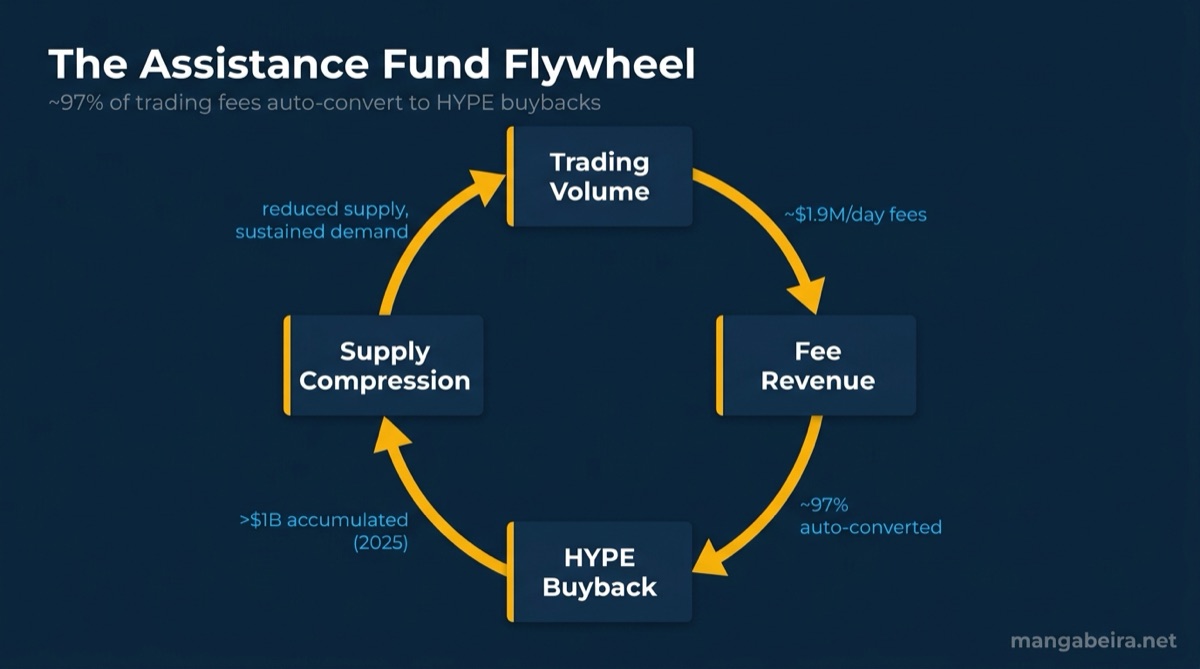
What Hyperliquid does with its fees is the other half of the story. Approximately 97% of trading fees auto-convert to HYPE buybacks, routed into a system address called the Assistance Fund. This address isn't controlled by the team. It accumulates HYPE over time, purchased at market prices from the open order book.
By late 2025, the Assistance Fund had accumulated more than $1B in HYPE (approximate figure; treat this as a late-2025 snapshot, not a real-time balance). The average purchase price was roughly $14 against a market price that had moved well above $40 at the time. A community proposal was floated to treat the address's holdings as effectively burned, given the non-controllable nature of the address.
This creates a flywheel the market hasn't seen at this scale without VC or foundation spending. Trading volume generates fees. Fees buy HYPE. Buybacks remove supply. Reduced supply supports token price. Higher token price attracts traders and liquidity. More trading generates more fees. The loop compounds without any emissions program, without any token printing, without incentivizing TVL that leaves the moment yields compress.
The structural difference
Emission-driven protocols rent capital with freshly printed tokens. Hyperliquid buys back tokens with earned revenue. One loop inflates supply over time. The other compresses it. The on-chain math is not equivalent, and the token chart reflects that difference over 12-18 month windows.
No VC, No Private Sale: What the Distribution Tells You
Token allocation signals a protocol's priorities more clearly than any whitepaper. Hyperliquid's breakdown: 38.88% future emissions, 31% genesis airdrop (distributed to real users, not investors), 23.8% current and future contributors, 6% Hyper Foundation (team, locked), 0.3% community grants.
That means roughly 76.2% of supply is community-earmarked. No VC allocation. No private round at a discount. The distribution model forced the protocol to earn its market cap through actual usage, not through pre-seeded liquidity from institutional holders looking for a 10x on their discounted entry.
This matters for builders evaluating their own distribution design. Protocols that allocate 20-40% to private investors and VCs at discounts create structural sell pressure the moment tokens unlock. The growth they report during the lockup period often reflects investor-driven liquidity deployment, not organic product-market fit. Hyperliquid had no such crutch.
Three Protocols, Same Signal
Hyperliquid isn't a one-protocol anomaly. Two other live data points from mid-2026 show the same pattern at different scales.
Canton Network: $475K TVL, $1.9M Per Day
Canton Network runs enterprise settlement flows for institutions including JPMorgan and the DTCC. Its chain TVL is approximately $475,000. Its daily revenue is approximately $1.9M, which annualizes to roughly $630M+. That's roughly $4,000 in daily revenue per dollar of TVL.
The explanation is structural. Settlement flows generate transaction fees based on the value of assets being settled, not the value of assets sitting idle on-chain. Canton's TVL is low because institutional participants don't leave capital parked. They move it, settle it, and take it off-chain. The revenue comes from movement, not from storage.
TVL as a retail-facing metric is simply the wrong lens for any protocol where the value is in throughput rather than in parked liquidity. Canton makes this visible at an extreme.
Aave: The Revenue-Led 12-Month Plan
On May 23, 2026, Stani Kulechov laid out Aave's 12-month growth plan with revenue explicitly as the organizing principle. The context: $3.33T in cumulative deposits, approximately $1T in cumulative borrows, roughly $75B in net deposits at present. The plan centers on monetizing GHO (Aave's native stablecoin) and building the Aave App as a distribution layer.
This matters because Aave is one of the few protocols with enough liquidity depth and protocol revenue to make the pivot credibly. The 12-month plan isn't speculative. It's anchored to a revenue base that already exists and a monetization path that connects product usage directly to protocol income.
The pattern across all three is consistent: the protocols building for 2026 and beyond are designing systems where usage generates fees and fees compound into the token or the treasury. The ones still optimizing for TVL are building a number that tells them nothing about survival.
| Protocol | TVL | Revenue (annualized est.) | Growth model |
|---|---|---|---|
| Hyperliquid | ~$2.1B | ~$715M | Fee buyback flywheel, no VC, usage-first distribution |
| Canton Network | ~$475K | ~$630M+ (est. from $1.9M/day) | Settlement throughput, institutional distribution, TVL irrelevant |
| Aave | ~$75B net deposits | Revenue-led plan anchored to $3.33T cumulative deposits | GHO monetization + Aave App as distribution layer |
Sources: DeFiLlama, CoinGecko, Blockworks, Aave governance forums. All figures as of mid-2026 snapshots. Canton revenue is approximated from the $1.9M/day public figure. Treat annualized estimates as directional, not audited.
What This Means for Builders
If you're pre-TGE or in the first 12 months post-launch, the Hyperliquid case study carries a specific implication: the distribution decision is upstream of everything else. Who holds your token at launch determines who you're building for and how sticky those holders are when the market cools.
Protocols that allocate heavily to VCs and seed investors are setting up for structural sell pressure the moment those investors can exit. Protocols that distribute to actual users are building a holder base with a different incentive structure. The airdrop-to-users model isn't charity. It's a retention mechanism built into the token economics.
For growth operators, the implication is simpler: stop measuring campaign success in TVL driven. Measure it in fees generated, in active users returning within 30 days, in on-chain transactions per wallet. If your campaign attracted $50M in TVL that left in 45 days, it didn't work. If it brought 2,000 wallets that each made at least three transactions over 90 days, you have a signal worth building on.
The strategic reframe
The question isn't "how do we attract more TVL?" The question is "how do we build a system where each dollar of user activity generates more protocol revenue than it cost to acquire that user?" Distribution systems, not campaigns. Revenue per user acquired, not liquidity deposited.
The tokenized RWA market crossing approximately $31.4B (roughly 5x since early 2025) reinforces this shift. Institutional capital is entering DeFi. Institutional capital doesn't park for yield. It settles. It moves. It processes. The protocols built for throughput will capture that flow. The ones built for TVL retention will see it pass through without generating much revenue at all.
For a breakdown of how distribution mechanics connect to growth loops, see the Web3 Growth Marketer's DeFi Playbook.
The Revenue-Led vs. TVL-Rented Diagnostic
The following framework is designed for founders and growth operators to run against their own protocol. It doesn't require on-chain analysis tools. It requires honest answers to direct questions about how your growth was built and what would happen if the incentives stopped tomorrow.
Work through each signal. Count your "revenue-led" answers. The ratio tells you where you actually sit.
Revenue-Led Growth Diagnostic
Check each item that currently applies to your protocol. More checks = stronger revenue-led foundation.
Fee Generation
Capital Behavior
Token Design
Distribution
Scoring guide: 9–11 checks indicates a revenue-led foundation. 5–8 suggests a mixed model with TVL-rented components worth auditing. Below 5 means your growth is primarily emissions-driven, and the Hyperliquid case study is a direct challenge to your current strategy.
The checklist won't tell you exactly what to fix. But it will tell you which layer to examine first. For most protocols, the answer is in the token design row: the connection between user activity and token value is either missing or relies on governance theatre rather than on-chain mechanics.
For a deeper look at how growth operators build sustainable acquisition systems, the same principles apply at the campaign level.
What I'm Watching Next
The revenue-per-capital narrative isn't fully priced in yet. Most protocols still report TVL as the primary health metric in their public dashboards and investor updates. The ones that pivot to revenue-first reporting in their governance forums and community updates in the next two quarters are signaling which direction they're building toward.
The Aave 12-month plan is worth tracking closely. GHO monetization as a distribution layer is a genuinely different bet than "lend more assets." If the revenue numbers from that plan become public in Q3 2026, they'll either validate or challenge the revenue-led thesis at a scale that makes Hyperliquid's perp DEX context look narrow.
Canton's institutional settlement data is also worth watching. Institutional DeFi growing into a $31B+ tokenized RWA market while running on minimal TVL and high throughput revenue is not a niche edge case. It's a preview of what large-scale DeFi usage actually looks like when it's not optimized for retail TVL metrics.
Ready to diagnose your protocol's growth gaps?
A structured Web3 Growth Audit across 6 dimensions: website, dApp, social, community, SEO, and PR.
Run the Growth Audit →Frequently Asked Questions
What does revenue-led growth mean in crypto?
Revenue-led growth means a protocol's expansion is driven by fees earned from user activity, not by emissions paid out to attract capital. A revenue-led protocol generates more protocol income as usage grows. A TVL-rented protocol generates the appearance of growth by paying out token incentives to attract liquidity that leaves when those incentives stop.
Why is Hyperliquid considered a revenue-led growth example?
Hyperliquid generates approximately $715M in annualized fees on around $2.1B in chain TVL. It routes roughly 97% of those fees into HYPE buybacks via the Assistance Fund, creating a compounding loop where usage generates revenue and revenue removes token supply. It did this with no VC funding and no private sale, per its public token distribution, which forced the protocol to earn market cap through actual usage rather than institutional liquidity support.
What is the difference between TVL and protocol revenue in DeFi?
TVL (total value locked) measures how much capital is sitting idle in a protocol's smart contracts. Protocol revenue measures how much fee income the protocol generates from user activity. The two can diverge significantly: Canton Network holds roughly $475,000 in TVL while generating approximately $1.9M per day in revenue, because its value comes from settlement throughput, not from parked capital. TVL is a liquidity signal. Revenue is a business signal.
How does the Hyperliquid Assistance Fund work?
The Assistance Fund is a system address on Hyperliquid that receives approximately 97% of trading fees and converts them into HYPE buybacks. The address is non-controllable, meaning no individual or entity can redirect the accumulated HYPE. By late 2025, the fund had accumulated more than $1B in HYPE (an approximate late-2025 figure). A community proposal suggested treating the address's holdings as effectively burned, given the lack of withdrawal capability.
How can I tell if my protocol's growth is revenue-led or TVL-rented?
The clearest test: cut your emissions by half and observe how much TVL stays. If the answer is "most of it would leave," your growth is emissions-rented. A revenue-led protocol retains users because the protocol generates utility they can't get elsewhere, not because the yield is temporarily attractive. The diagnostic checklist in this article covers the specific signals to check across fee generation, capital behavior, token design, and distribution mechanics.
Does Hyperliquid's model apply to protocols outside perp DEXes?
The core principles apply across DeFi categories: design token mechanics where usage generates revenue, route that revenue into supply compression or treasury accumulation rather than printing more tokens, and build your user base from actual product users rather than yield farmers. The specific implementation varies. A lending protocol can do this through interest spread and liquidation fees. A stablecoin protocol can do it through stability fees. The Hyperliquid perp DEX model is the most visible current example, but the structural logic isn't category-specific.
Related Reading
Web3 Growth Marketer's DeFi Playbook
Distribution systems, on-chain attribution, and the KPI frameworks that actually track protocol health. Growth OperationsThe Web3 Growth Operator Stack (2026)
Tools, frameworks, and measurement systems for operators building sustainable acquisition at protocol scale. SEOThe Definitive Guide to Web3 SEO
How protocols build organic search distribution that compounds over time instead of requiring constant campaign spend. Token LaunchLaunchpad Scorecard: Q1 2026 Rankings
Data-driven ranking of launchpad performance across post-TGE price retention, community activation, and distribution quality.Sources
Hyperliquid data: DeFiLlama "Hyperliquid Perps" fees dashboard (trailing annualized figure); DeFiLlama L1 overview (chain TVL, 24h app fees and revenue); CoinGecko (HYPE price, market cap, 24h volume, 2026-06-01 snapshot); Blockworks (genesis distribution, Nov 28 2024; HYPE Assistance Fund analysis, Dec 2025); Binance research recap (token distribution detail, Nov 29 2024); Yahoo Finance citing DeFiLlama (Aug 2025 revenue, Sep 2 2025); multiple aggregated reports (perp DEX volume share, March 2026).
Canton Network: Public revenue and TVL figures as cited in the June 1, 2026 DeFi narrative pulse. Annualized revenue figure derived from $1.9M/day. Treat as directional, not audited.
Aave: Stani Kulechov public governance communications, May 23, 2026. Cumulative deposit and borrow figures from Aave public data.
Tokenized RWA market: Aggregated market figure (~$31.4B) from multiple data providers, mid-2026. Cited as directional context, not a precise audit.
Honest caveats: Perp TVL understates capital in use because traders operate on margin, not 1:1 collateral. The 44% perp DEX volume share and the Assistance Fund accumulated balance are aggregated figures and late-2025 snapshots respectively. "No VC funding" is strongly evidenced by public token distribution data but is not from a legal disclosure. All DeFiLlama figures reflect trailing snapshot data, not real-time balances.