The founder handed you a date. Maybe it's 90 days out. Maybe it's 60. They said something like "build buzz," pointed at a Telegram group with 2,000 members, and walked back into their product meeting.
You are now responsible for a token launch.
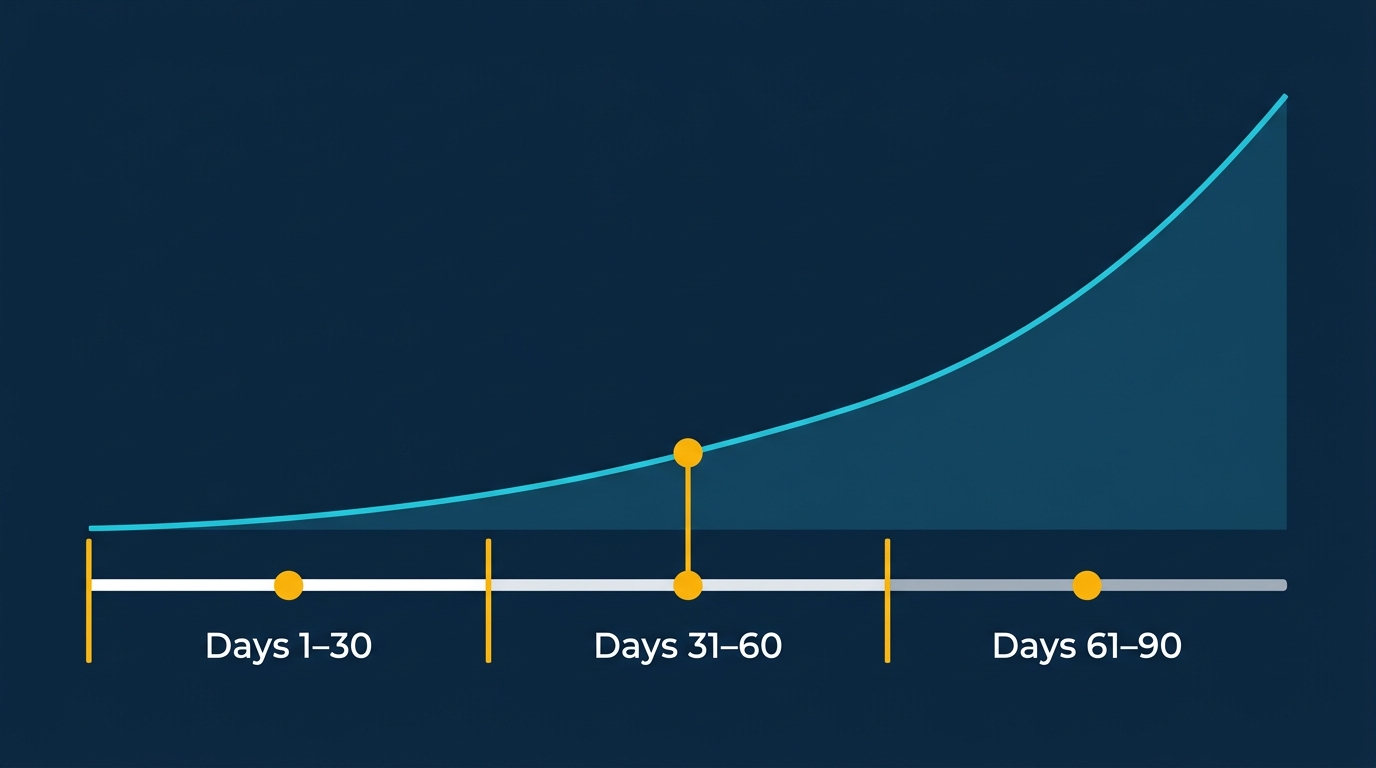
Pre-TGE demand gen is the process of building credible buyer interest before your token goes live, starting 90 days out, so that institutional allocators and sophisticated retail have already researched and formed conviction by the time the token trades publicly.
Most growth operators in this position do what feels logical: they scope out KOLs, draft a Twitter campaign, plan a community sprint for the two weeks before the token drops. That's not a demand gen system. That's a content schedule. And a content schedule doesn't move institutional capital. (The Web3 Growth Marketer's Playbook has a full breakdown of how these two things differ.)
The institutional allocation window for most TGEs closes well before launch day. Tier 1 DeFi funds, family offices with crypto mandates, and sophisticated wallets that actually move price are not making decisions the week of your token's listing. They made that call two months earlier, based on research they'd already done, conversations they'd already had, and narratives they'd already stress-tested.
By the time you're running Twitter Spaces to "create FOMO," the investors who matter have already decided.
This article covers the pre-TGE demand gen system that closes that gap. What to build, in what order, and how to measure whether it's actually working.
Why the 90-Day Window Is the Only Window That Matters for Pre-TGE Demand Gen
There's a pattern that shows up in every token launch post-mortem I've analyzed. The launch looks strong on day one, volume spikes, price moves, the team celebrates. Then something shifts around day 14 or day 30. Volume dries up. The only buyers left are retail chasing the chart, and there's no institutional floor to hold price when they exit.
The cause isn't bad tokenomics or poor listing timing. It's demand that was built too late, from the wrong audience, using the wrong signals. The 12 most common DeFi token launch mistakes almost all trace back to this same root.
Institutional participants don't respond to launch-week Twitter campaigns. They respond to credibility signals that have been accumulating for weeks. A post from a well-known DeFi analyst that went up 60 days before launch. A governance forum discussion that showed up in their research feed. A Discord AMA in a Tier 1 DeFi community that surfaced in their deal-flow review.
Hyperliquid is the clearest example of this working correctly. Before HYPE launched, the protocol had spent months building a community of actual traders using the product. The waitlist wasn't marketing theater. It was a real demand filter that created scarcity among people who were already product-qualified. By launch day, the "narrative" didn't need to be manufactured because it had already spread through the right channels organically.
Compare that to protocols that announce a TGE date and immediately start pushing influencer content. The traffic spike is real. The demand isn't.
Your job as the growth operator is to work backward from the 90-day window and build the signals that institutional and sophisticated retail buyers actually research before committing capital.
The Three Demand Signals That Move Institutional Capital Before Your TGE
Before getting into the week-by-week breakdown, you need to understand what you're actually building toward. Demand gen for a TGE isn't about follower counts or Discord member totals. Those are lag indicators. They measure awareness that may or may not convert.
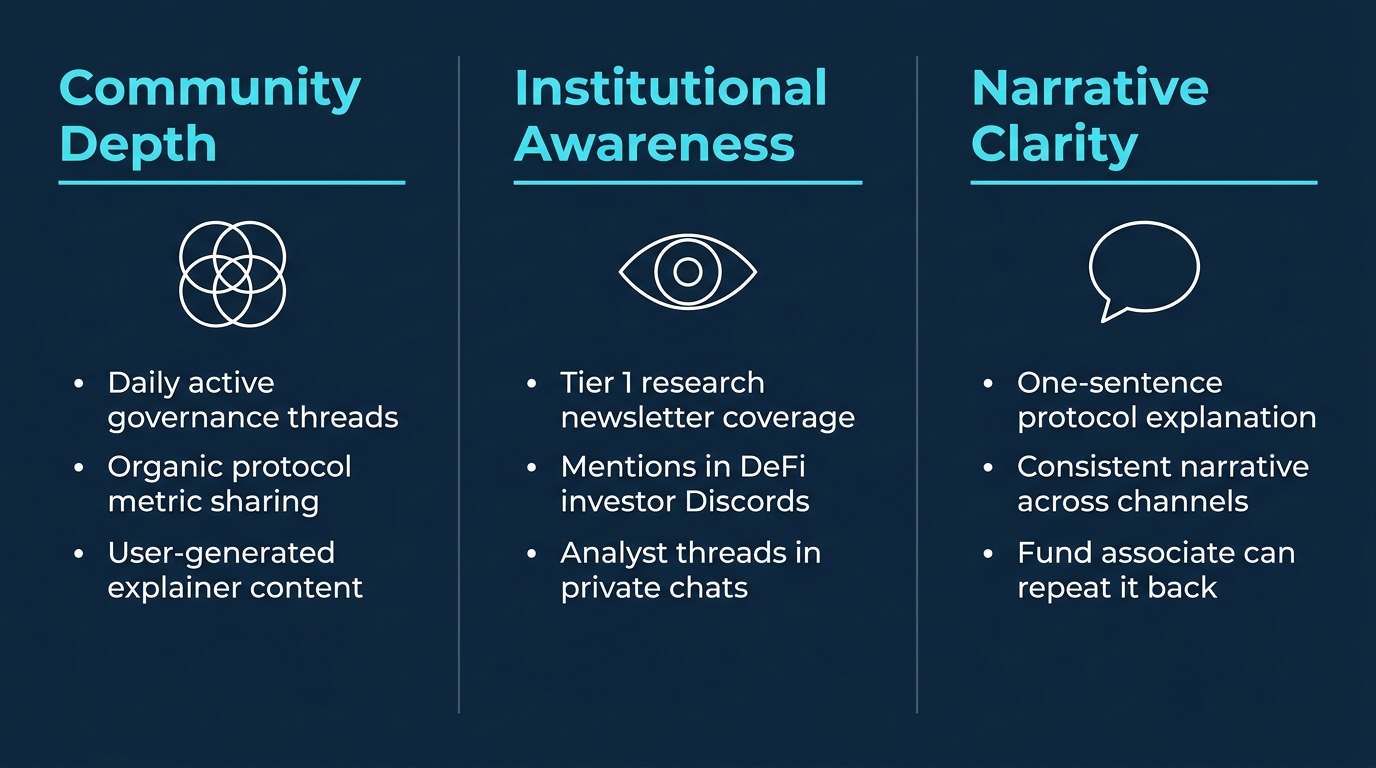
The three signals that matter are community depth, institutional awareness, and narrative clarity.
Community Depth
Community depth is different from community size. Size counts wallets in a Telegram group. Depth measures whether those wallets are paying attention, contributing, and staking their reputation on your protocol's success.
A 3,000-member Discord where 200 people actively participate in governance, share protocol data, and bring in new members through their own networks is worth more than a 30,000-member group where the admins are the only ones posting.
The depth signals that matter: daily active discussion threads with multiple contributors, organic sharing of your protocol's metrics by non-team members, and user-generated content that explains the product without prompting.
Ethena's pre-TGE community work is useful here. The protocol spent months cultivating a group of yield-focused DeFi participants who genuinely understood the USDe mechanics and were willing to defend them publicly. When critics raised questions about the yield sustainability, community members with actual positions and actual understanding pushed back with data. That's depth. It doesn't happen in two weeks.
Institutional Awareness
Institutional awareness means your protocol has surfaced in the research environments where allocation decisions actually get made. Not your Twitter following. Not your Discord server.
The research environments that matter: Tier 1 DeFi research newsletters (Delphi Digital, Blockworks Research, The Defiant), DeFi-native investor Discords and Telegrams that require referral to join, protocol-specific governance forums, and analyst Twitter threads shared in private group chats.
You cannot buy placement in most of these. You earn it through substantive contributions to on-chain data discussion, through citations from researchers who are already credible, and through analysis specific enough to be useful rather than promotional enough to be ignored.
Narrative Clarity
Narrative clarity is the simplest test: can someone who has never heard of your protocol explain it in one sentence after reading your publicly available content?
Most protocols fail this test. Their documentation explains the mechanism but not the value. Their website says "decentralized liquidity protocol" when it could say "the protocol that lets you hold yield without leaving ETH." They optimize for technical accuracy. They miss the narrative compression that actually spreads.
If your narrative requires three sentences to explain, a fund associate isn't going to include it in their deal-flow summary. The protocol gets skipped.
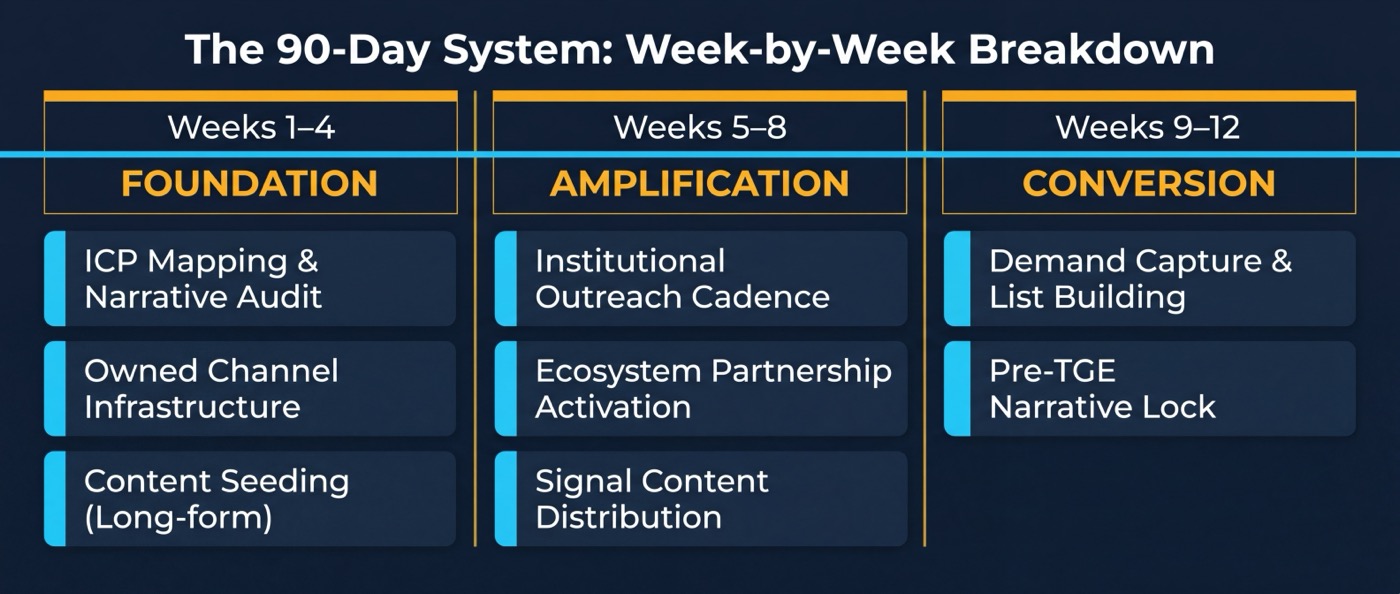
The 90-Day System: Week-by-Week Breakdown
Quick Navigation
Days 1–30: Narrative Foundation {#days-1-30}
The first 30 days are not about marketing. They're about making your protocol research-ready.
Everything in this phase is infrastructure. If you skip it and go straight to distribution, you'll generate traffic that lands on content that doesn't convert, which wastes your best leads at the moment when they're most interested. The pre-launch traction framework for DeFi protocols covers the foundation layer in detail.
What to build in days 1–30:
Your documentation needs to answer the questions that informed buyers actually ask. Not "how does the protocol work" in abstract terms, but "what is the yield source," "what are the smart contract risks," "what happens to token value when TVL grows." Review the DeFi forums for your protocol category and find the 10 most common skeptic questions. Build documentation that addresses each one directly.
Your positioning sentence needs to be locked before any outbound starts. Test it with people outside your team. If they can't repeat it back correctly after reading your homepage, it's not done.
Your on-chain narrative needs a data anchor. Find the single metric that best represents your protocol's core value proposition and make it publicly trackable. Publish a Dune dashboard. Link it from your documentation. Sophisticated buyers want to verify claims themselves. Give them the tools.
Analyst seeding starts here, but quietly. Identify five to eight people who write substantively about your protocol's category. Not KOLs with large followings. Researchers and analysts with credibility in your specific vertical. Share your documentation with them, answer their questions, and don't ask for anything in return yet. You're planting a research relationship, not buying a mention.
Key Insight
The goal of days 1–30 is not visibility. It's credibility infrastructure. Distribution without this foundation generates attention that doesn't convert.
Milestone check at day 30: Your positioning sentence is finalized. Documentation is live and covers the top skeptic questions. A Dune dashboard or equivalent public data source is linked from your site. Five or more researchers in your vertical have received your documentation and responded.
Days 31–60: Distribution Engine {#days-31-60}
With the foundation in place, days 31–60 are about building distribution reach in the right channels. The emphasis is on channels where institutional participants and sophisticated retail actually spend research time, not where retail volume lives.
Twitter/X presence for your protocol account. This is not about follower growth. It's about establishing a consistent voice in on-chain data discussion. Post your Dune dashboard updates. Share analysis of your own protocol metrics. Quote and engage with researchers in your vertical. The goal is to become a credible data source in your category, which builds organic research credibility faster than promotional content.
KOL seeding, done correctly. The standard approach is to pay large-following KOLs for promotional content two weeks before launch. This generates impressions and almost no allocation from serious buyers. The effective approach is to identify analysts with smaller but more credible followings in your specific vertical and give them early access to protocol mechanics or data. Let them form their own views. When they write about you because they find it genuinely interesting, the content carries weight that paid promotion doesn't.
Discord community structure. By day 60, your Discord needs to have functional governance discussion, a clear onboarding path for new members, and at least one dedicated channel for on-chain data that your team updates regularly. This structure signals to institutional researchers that the community is substantive, not just a support channel.
Tier 1 DeFi community presence. Identify three to five Telegram or Discord communities where serious DeFi participants and smaller funds discuss new protocols. Your goal isn't to promote in these channels. It's to become a participant who contributes useful data and earns the right to introduce your protocol when it's relevant. Cold promotion in these spaces gets ignored or banned. Patient participation gets noticed.
Warning
Days 31–60 is when most growth operators make the mistake of starting to measure vanity metrics. Follower growth, Discord member count, and Twitter impressions are all lagging indicators that don't predict launch demand. Track researcher engagements, inbound questions from non-community accounts, and organic mentions in DeFi research channels instead.
Milestone check at day 60: Your protocol has been mentioned by at least two credible researchers in your vertical without payment. Your Discord has daily active non-team contributors. Your Twitter is posting protocol data consistently and getting engagement from accounts outside your existing community.
Days 61–90: Demand Activation {#days-61-90}
This phase converts the credibility and distribution infrastructure you've built into actual allocation intent. The mechanics here only work if days 1–60 have been executed. Without the foundation, these tactics generate noise, not demand.
Waitlist mechanics. A well-designed waitlist does three things: it filters for high-intent participants, it creates genuine social signaling about demand (when real people talk about trying to get access), and it gives you a qualified list to activate at launch. Hyperliquid's pre-launch waitlist worked because the product was live, the waitlist was real, and the community talked about it organically.
A waitlist that's just an email collection form with no product behind it signals theater, not demand. The waitlist needs to be gated by something meaningful: proof of DeFi activity, a minimum portfolio threshold, a referral from an existing community member, or completion of a protocol-specific action.
Whitelist strategy. Your whitelist allocation should be structured to maximize on-chain credibility signals at launch. This means allocating to wallets with genuine DeFi history rather than new wallets or obviously sybilled addresses. On-chain researchers will look at your launch day wallet distribution. A launch where the first buyers have genuine DeFi track records reads differently than one dominated by new wallets.
Last-mile institutional outreach. At day 61, you should be able to identify the institutional participants who have been researching your protocol over the previous 60 days. These are the wallets and accounts that have engaged with your documentation, asked questions in your community, or been spotted in your analytics. Direct outreach to these participants is legitimate and effective, because you're reaching people who already have context, not cold pitching.
The outreach should be specific: "I noticed you've been exploring our governance forum discussions around yield mechanics. We're doing a small briefing for participants who have been following the protocol closely before launch. Would that be useful?" That's not spam. That's closing a relationship that has already been building.
Best Practice
The most effective last-mile move is a small, private briefing for 20–40 serious participants one to two weeks before launch. Not a Twitter Space. A closed-format call or written briefing with data, tokenomics analysis, and a Q&A. The participants who attend this become your most credible launch-week voices because they're informed, not incentivized.
What Investor-Ready Demand Gen Actually Looks Like
The signals that tell you your 90-day system is working are not the ones you'll find in your dashboard by default.
What you're tracking wrong: Discord member count, Twitter follower growth, impressions, total waitlist sign-ups, total whitelist applications.
What actually signals demand:
Inbound from non-community accounts. When DeFi researchers, analysts, or fund associates with no prior connection start reaching out to ask questions, your protocol has surfaced in their research flow organically. Track these inbound contacts separately. They're worth more than a thousand Discord joins.
Organic mentions in closed DeFi communities. This requires you to have presence in these communities so you can see it. When someone in a Tier 1 DeFi Discord mentions your protocol without being asked, that's a real signal. Screenshot it, date it, and track it.
Wallet engagement from credible DeFi addresses. Look at who's interacting with your smart contracts during any testnet or early access phase. Addresses with significant DeFi history signal real due diligence, not just airdrop farming.
Researcher coverage without payment. Track every time your protocol is mentioned in a research newsletter, analyst thread, or podcast without a paid arrangement. These mentions carry weight in fund decision-making in a way that paid KOL content doesn't.
The Pre-TGE Checklist Growth Operators Miss
This section covers the specific items that repeatedly surface in protocol post-mortems as missed or executed too late. Most of them have nothing to do with marketing tactics. The DeFi GTM Checklist covers the broader go-to-market setup that runs in parallel with the demand gen work here.
The 90-Day Pre-TGE Operator Checklist
Narrative Foundation (Days 1–30)
Distribution Engine (Days 31–60)
Demand Activation (Days 61–90)
The items that consistently get missed
Tokenomics documentation that answers investor questions. Most teams publish a tokenomics page that explains the mechanics but doesn't address the questions sophisticated buyers actually ask: what happens to token value when TVL grows, what is the sell pressure at each vesting cliff, and what is the protocol's plan when emissions slow. These questions come up in every serious due diligence process. If your documentation doesn't answer them, investors find the answers themselves in ways you can't control.
Narrative compression before outreach starts. Teams start distributing content before the one-sentence narrative is locked. This means different channels develop different narratives about what the protocol is. By launch, the market has four different mental models of your product, none of them compelling enough to drive allocation.
The on-chain data trail. Smart operators set up a Dune dashboard before any marketing starts. When researchers look you up, they find real data. When you share the dashboard in community channels, it signals transparency. Protocols that struggled to build demand for their TGEs frequently lacked this: there was no public data trail that sophisticated buyers could verify independently. The marketing claimed things the on-chain data couldn't confirm.
Tracking the right signals from day one. Most growth operators start measuring the wrong things immediately. Discord joins and Twitter followers are easy to track so they get tracked. Inbound from credible non-community accounts, organic mentions in Tier 1 community channels, and researcher engagements don't show up in standard dashboards. Build a manual tracking system for these on day one, because they're the signals that actually predict launch demand.
Web3 Growth Audit · Pre-TGE Strategy
Is your demand gen system actually building institutional interest, or just noise?
A scoped audit maps your current pre-TGE credibility signals against the patterns that move serious capital. You'll know exactly where your system is working — before the window closes.
Start Your Growth Audit →Frequently Asked Questions
What is pre-TGE demand gen and why does it matter for institutional buyers?
Pre-TGE demand gen is the process of building real buyer interest and credibility signals before your token goes live. It matters for institutional buyers because their allocation decisions are made weeks or months before launch day, based on research they conduct independently. By launch day, the window to influence serious capital has largely closed. Demand gen that starts two weeks before the TGE reaches retail participants, not institutional allocators.
How is a 90-day pre-TGE system different from a standard token launch marketing campaign?
A standard token launch campaign is typically promotional content, KOL partnerships, and community growth tactics run in the four to six weeks before launch. A 90-day demand gen system works backward from the institutional research cycle: it starts with credibility infrastructure, builds distribution reach in the channels where serious buyers do research, and then activates demand through relationships that have been building for months. The difference shows up in who is buying on launch day: retail chasing a Twitter trend versus qualified participants who have spent weeks researching the protocol.
What do startups usually miss in pre-TGE demand generation?
The most common gaps are tokenomics documentation that doesn't answer investor questions, narratives that aren't compressed to one clear sentence before distribution starts, and tracking the wrong metrics throughout the process. Teams measure Discord member count and Twitter followers because those numbers are easy to find, but they're not the signals that predict launch demand. Inbound from credible non-community researchers, organic mentions in Tier 1 DeFi channels, and engagement from wallets with real DeFi history are the leading indicators that almost never get tracked.
How do you build institutional awareness for a TGE without paid placements?
The most reliable path is contributing genuine analytical content to the on-chain data discussion in your protocol's vertical. Publish a Dune dashboard and update it regularly. Engage with researchers who write about your category by adding substantive data points to their threads, not by pitching your protocol. Over 30 to 60 days, this builds a research relationship where the analyst becomes genuinely familiar with your protocol before you ever ask for coverage. When they write about you, it carries weight because it's not paid.
When should a growth operator start the pre-TGE demand gen system if the TGE date is fixed?
Start as early as possible, with 90 days as the minimum effective window. If you have less than 90 days, compress the phases but don't skip the narrative foundation work. A well-positioned protocol with 60 days of credibility building will outperform a poorly-positioned protocol with 90 days of promotional content. If you have less than 30 days before launch, focus entirely on narrative clarity and last-mile institutional outreach with whatever relationships already exist. A two-week Twitter campaign with no foundation behind it won't move serious capital regardless of budget.
What the Data Tells You After 90 Days
By day 90, the demand gen system either works or it doesn't. The signals are readable before launch day.
A working system looks like this: multiple credible researchers have written about the protocol organically, inbound questions are coming in from non-community accounts, and your Discord has daily active non-team governance contributors. Your institutional outreach list has at least a dozen warm contacts who've been following the protocol for weeks. The waitlist has real DeFi wallets behind it. The launch-week narrative is already in the market.
A system that didn't work looks different: a large community built quickly through giveaways and raid events, high follower counts with low engagement from credible accounts, a whitelist dominated by addresses with no prior DeFi activity. The team feels the energy and mistakes it for demand. Launch day confirms the difference.
The growth operator's advantage is that you can read these signals before launch and adjust while there's still time. The patterns are visible. The question is whether you're tracking the right ones.
If you want a diagnostic on your protocol's demand gen stack against the patterns that predict launch performance, the Web3 Growth Audit covers this as part of a full protocol review. No calls. Send the brief and get a scoped response.