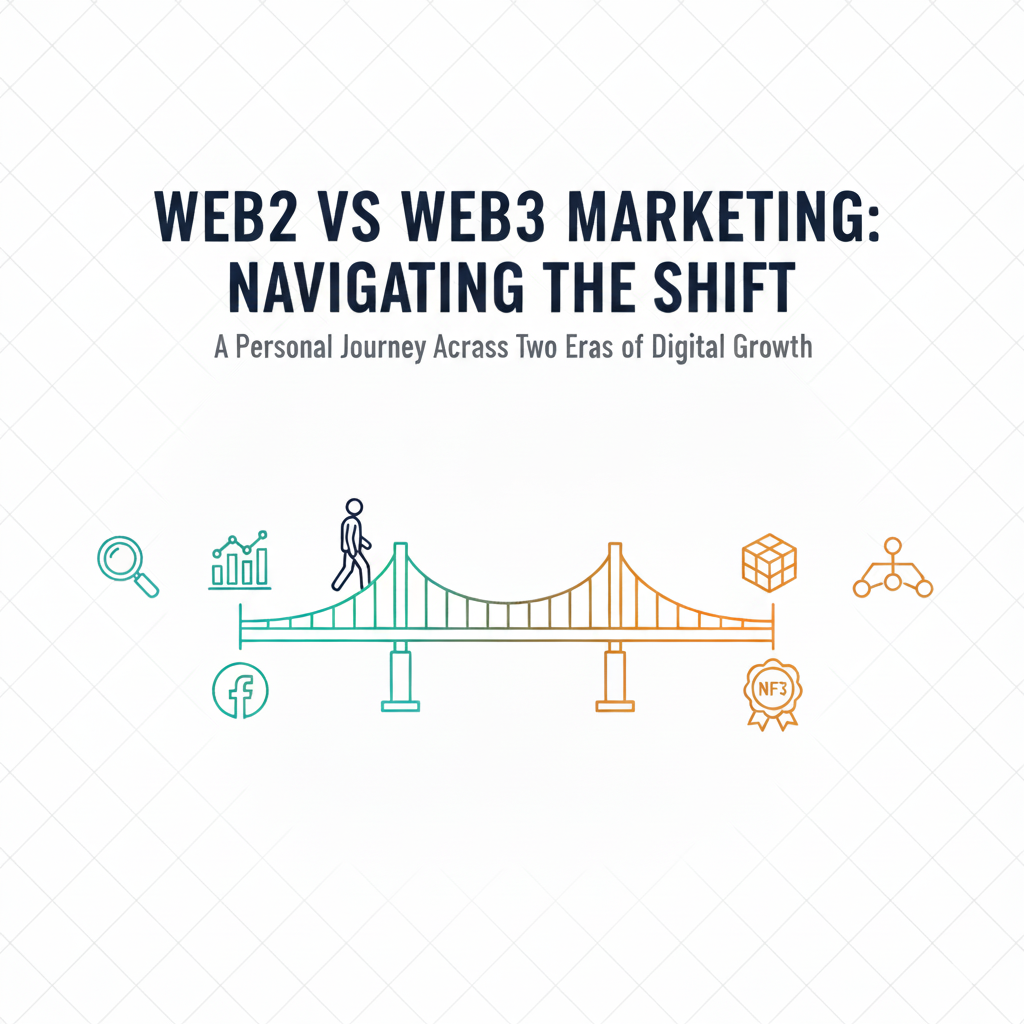
When I transitioned from professional swimming to marketing, I learned that discipline isn't about doing more. It's about doing what matters. In the pool, every stroke counts. In Web2 marketing, every click counted. But in Web3, every relationship matters more than any metric.
Marketing isn't dying. It's evolving from capturing attention to building ownership. And that changes everything.
The Fundamental Architecture: Two Different Worlds
Marketing is evolving from capturing attention to building ownership. Web2 optimized reach on centralized platforms; Web3 optimizes direct, verifiable relationships with stakeholders.
Web2: Platform Economy
- 📊 Centralized data (platforms own everything)
- 💰 Algorithmic distribution (pay to play)
- 🔒 Intermediary dependency (no direct access)
- 📉 Data extraction model (user is the product)
Web3: Ownership Economy
- 🔓 Decentralized data (users own wallets and identity)
- 🤝 Direct relationships (no intermediaries)
- ✅ Transparent verification (on-chain proof)
- 📈 Value co-creation (users become stakeholders)
For two decades, marketing meant renting attention on someone else's platform. Facebook "owned" your audience. Google controlled your visibility. You paid to reach people you couldn't truly have.
Web3 flips this. Instead of renting attention, you build relationships with stakeholders. Instead of paying platforms, you reward communities for contribution.
💡 Key Insight
82% of Web3 marketing professionals report positive ROI with community ownership models, with efficiency gains of 2x to 4x versus traditional campaigns.
Real Example: Starbucks Odyssey
← Traditional Rewards (Web2)
- • Earn "stars" for purchases
- • Locked in ecosystem
- • No transferability
- • Company sets the rules
→ Starbucks Odyssey (Web3)
- • Earn "journey stamps" (NFTs)
- • Real ownership
- • Tradeable on markets
- • Community-driven value
The result? Loyalty becomes tangible. Engagement becomes an asset. Customers become advocates because they own a piece of the story.
This isn't about swapping loyalty programs for tokens. The question is: what if customers could own the relationship with your brand?
The Philosophy Shift: Attention to Ownership
| Mindset | Web2 | Web3 |
|---|---|---|
| Goal | Extract value | Co-create value |
| User is... | Customer | Stakeholder |
| Success = | Conversion | Ownership |
| Time horizon | Quarterly | Long-term |
Web2 assumption: attention is scarce. Capture and monetize.
Web3 assumption: ownership is powerful. Distribute and nurture.
When you give real ownership (not points, but tradeable value), people don't just engage differently. They think differently. They become evangelists, strategists, and builders. Because now, the project is theirs too.
5 Principles Marketing Professionals Need to Learn
1. Transparency is non-negotiable
In Web2, we crafted narratives. In Web3, we prove narratives. Every claim can be verified on-chain. If you say "70% of tokens go to the community," anyone can check the blockchain.
Action: practice radical transparency. Share real numbers. Let the community verify.
2. Community is your distribution
The best Web3 projects don't have traditional marketing departments. They have communities that promote organically because they have economic alignment (tokens) and emotional alignment (shared mission).
📊 Web3 projects with active communities have 4x higher retention vs. traditional models
Action: ask "How can our community promote this?" before "How do we promote this?"
3. Incentive design beats campaign design
Instead of spending $100K on ads, some Web3 projects distribute $100K in tokens to early contributors who create content, report bugs, or participate in governance.
Traditional ads rent attention temporarily. Token incentives create long-term stakeholders.
Action: learn tokenomics basics. Reward contribution, not just consumption.
4. Data privacy is a feature
You might only know a wallet address, but you know exactly what it did on-chain: tokens held, protocols used, NFTs owned, DAOs joined.
Behavioral segmentation based on on-chain activity is more predictive than demographic segmentation.
Action: shift from demographics (who they are) to behavior (what they do on-chain).
5. Long-term thinking wins
Web2 optimizes for quarters. Web3 optimizes for decades.
You're not building a customer base. You're building an ecosystem that can outlive your company.
Action: track community health, holder retention, and network effects, not just acquisition.
The Hybrid Future: Best of Both Worlds
The smartest brands don't choose. They combine.
Use Web2 for:
- ✓ Education & awareness
- ✓ Mainstream reach
- ✓ Paid acquisition
- ✓ Content at scale
Use Web3 for:
- ✓ Deep engagement
- ✓ Long-term retention
- ✓ Transparent incentives
- ✓ Network effects
Nike's approach
Nike didn't abandon Instagram ads. They added .SWOOSH (their Web3 platform) for superfans. Web2 brings them in. Web3 keeps them invested.
Over 1 million AI agents are expected to be on blockchain networks by the end of 2025. Marketing to non-humans is coming faster than you think.
The AI Layer: AI bridges Web2 and Web3, enabling on-chain analytics, churn prediction, fraud detection, and privacy-respecting personalization.
What This Means for You
For Marketing Leaders
| 0-6 Months | 6-12 Months | 12-24 Months |
|---|---|---|
|
|
|
For Individual Professionals
Your current skills aren't obsolete. They're the foundation. Knowing how to craft messaging, analyze funnels, and build relationships is still 80% of the job.
Add to your toolkit:
- □ Basic blockchain literacy (wallets, smart contracts, DAOs)
- □ On-chain analytics (Dune, Nansen, Formo)
- □ Community management 2.0 (Discord, governance)
- □ AI fundamentals (segmentation, prediction, fraud detection)
When I made this transition, I felt like a beginner again. That discomfort was the point. Those who thrive aren't those who resist change. They're the ones who stay curious.
In Summary
| Web1 (1990s) | Information broadcasting |
| Web2 (2000s-2020s) | Engagement optimization |
| Web3 (2020s+) | Ownership alignment |
The shift from Web2 to Web3 isn't just technology. It's about rediscovering what marketing should have always been: creating genuine value for real people.
What stays the same:
- Know your audience deeply
- Communicate with clarity
- Build trust through consistency
- Create more value than you capture
What needs to change:
You don't optimize for ownership the way you optimized for attention. You can't measure Web3 value with Web2 metrics.
"The future belongs to marketers who respect what worked AND embrace what's emerging."
Start Here: Your First Steps
1. Live it firsthand
- • Download MetaMask
- • Join a DAO
- • Mint a free NFT
2. Follow the signal
- • The Defiant
- • Bankless
- • a16z crypto
3. Experiment
- • Token-gate content
- • Create community wallet
- • Launch small NFT
Frequently Asked Questions
1. What is the main difference between Web2 and Web3 marketing?
Web2 focuses on capturing attention through centralized platforms where companies own data. Web3 emphasizes community ownership, with users controlling data and becoming stakeholders through tokens.
2. How can traditional marketers transition to Web3?
Start by experiencing Web3 firsthand: create a wallet, join a DAO, and mint an NFT. Then build on-chain attribution, learn tokenomics basics, and run small experiments with token-gated content.
3. Do I need to abandon Web2 for Web3?
No. The most effective approach is hybrid: use Web2 for awareness and reach, while implementing Web3 principles for retention and community building. Brands like Nike and Starbucks successfully blend both.
Ready to Go Deeper?
Let's talk about how to apply these principles to your business.
Run the Growth Audit →Where This Applies
The Web3 Founder's Guide to DeFi Growth
Community ownership in practice: the tokenomics, liquidity, and community engines that turn this article's philosophy into a working growth system.
Read the Main Guide →How to Design Tokenomics That Drive Protocol Growth
Ownership isn't a slogan, it's a mechanism. This is the mechanism.
Design Your Tokenomics →The Web3 Growth Marketer's Playbook for Scaling DeFi Protocols
The channel-by-channel execution layer for a team that's already bought into ownership over attention.
Read the Playbook →Web3 SEO: Proven Strategies to Rank Your Project in 2026
Owned distribution, not rented reach: why search is the Web3-native channel Web2 playbooks miss.
Read the SEO Guide →