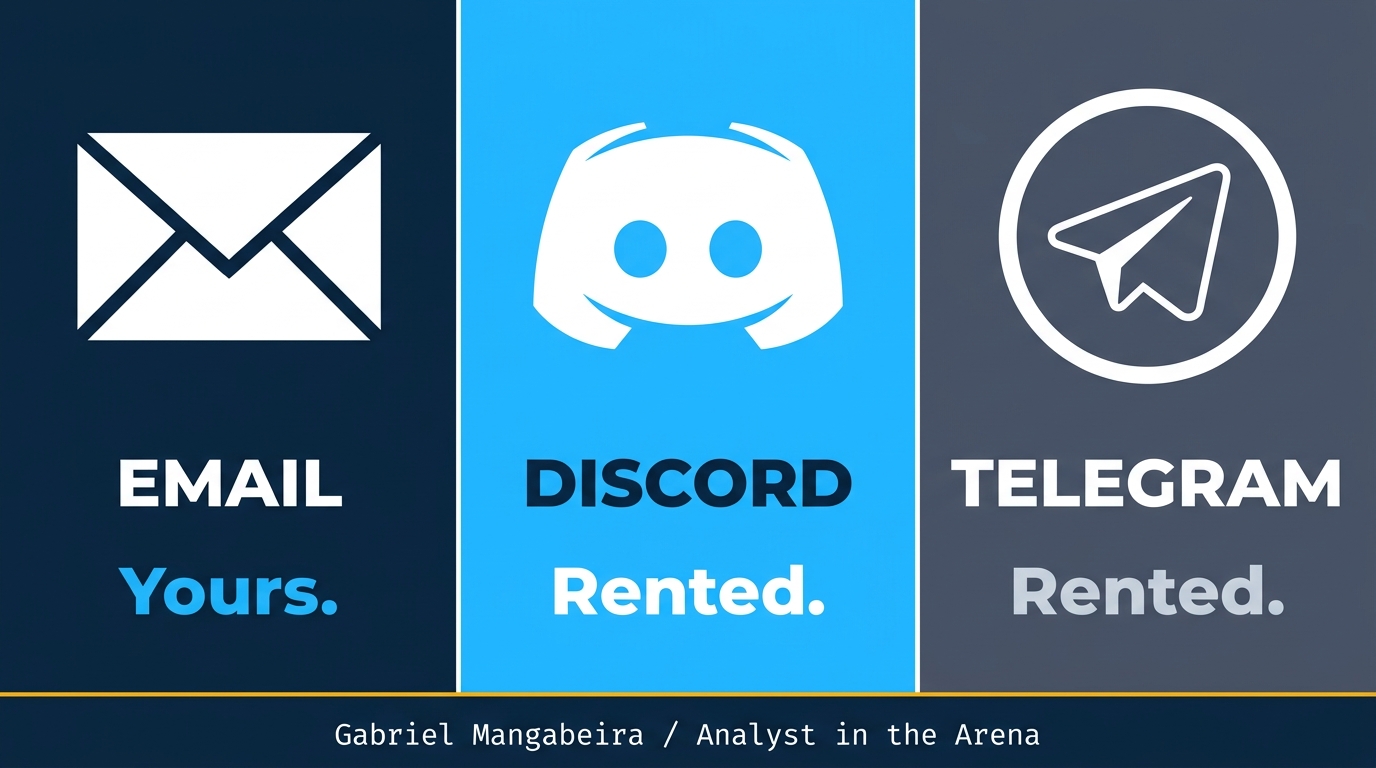
Web3 Email vs Discord vs Telegram: Channel Decision Framework
Most Web3 teams don't have a community channel problem. They have a sequencing problem.
The question I hear most often from post-launch growth operators is some version of: "Should we focus on email, Discord, or Telegram?" That's the wrong question. It treats channel selection as a one-time choice when it's actually a staged decision that shifts depending on where you are in the protocol lifecycle.
After analyzing growth patterns across DeFi, DePIN, and stablecoin protocols, three things become clear. Email, Discord, and Telegram each do a fundamentally different job. Teams that mix them up, or pick one and abandon the others, tend to hit the same retention wall around 90 days post-TGE. This article breaks down what each channel actually does, where it fails, and how to sequence them by stage.
The Wrong Question Most Web3 Teams Ask
The default debate goes like this: "Telegram is better for reach, but Discord is better for community. Which one should we be on?" Both statements are true. Neither helps you make a decision.
The framing assumes you're choosing between channels. You're not. You're choosing which job each channel is responsible for. A distribution tool, a community tool, and a retention tool look similar from the outside. They operate completely differently.
Web3 teams that treat these channels as interchangeable end up with fragmented communities that don't convert. Announcement feeds nobody reads. Email lists they never build until it's too late. The protocols that retain users at 90 days tend to have figured out the job separation early, not after the TGE.
The Job Each Channel Actually Does
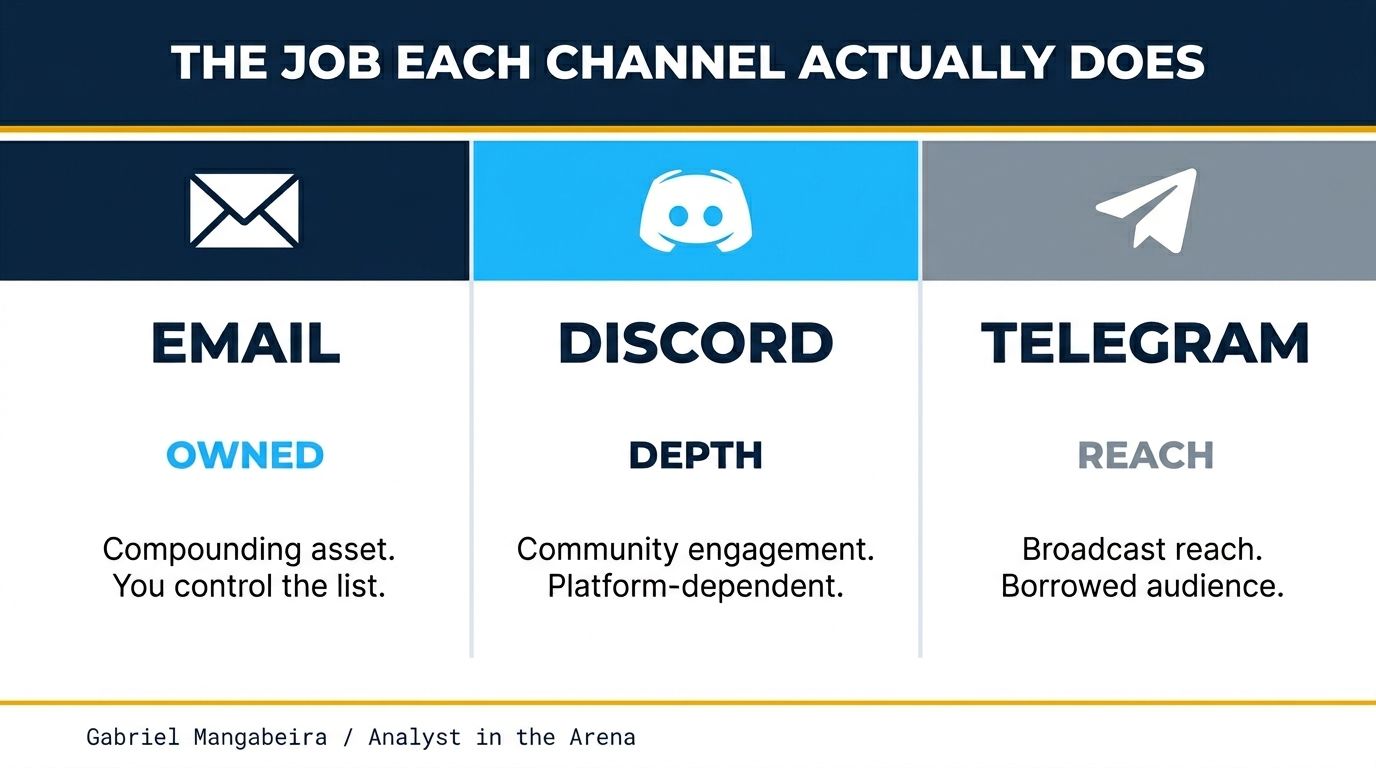
The best way to think about channel selection is through the lens of jobs to be done. Not features. Not user counts. What specific outcome does this channel produce that no other channel produces as well?
Here's how I map it across the three channels most Web3 teams are choosing between:
Email does retention and conversion. It's the only channel where you own the relationship outright. No algorithm. No ban risk. No feed noise. A subscriber who gave you their email address is signaling more intent than a Telegram follower who joined a group. Email is also the highest-converting channel in fintech adjacent verticals, where open rates run well above most social engagement rates. Web3 teams ignore this because it feels slow. That's the point: email builds durable audience, not spike traffic.
Discord does community depth. The server structure, the role system, the threaded conversations. Discord is optimized for people who want to go deep on a protocol. It rewards engagement. But it's also noisy, high-maintenance, and not ownable in any meaningful sense. Your Discord server exists on Discord's platform. If you get banned, your community disappears overnight. For teams with active contributors and core community members, Discord earns its complexity. For teams with thin communities, it just creates an empty channel that signals low activity to everyone who visits.
Telegram does reach and speed. Broadcast messages, one-way channels, fast mobile notifications. Telegram is the fastest way to push information to a large audience. It's where most Web3 announcements live. The problem is trust. Telegram carries a low trust signal in most verticals because it's also where scams, fake support bots, and pump-and-dump groups operate. It works as an announcement layer. It doesn't work as a community layer or a retention layer.
The Channel Decision Matrix
Scoring each channel across six dimensions makes the decision clearer.
| Dimension | Discord | Telegram | |
|---|---|---|---|
| Ownership | Full | None (platform risk) | None (platform risk) |
| Reach | Medium (list size) | Medium (community size) | High (broadcast) |
| Noise Level | Low | High | Medium |
| Conversion | High | Medium | Low |
| Longevity | High (compounding) | Medium (active upkeep) | Medium |
| Searchability | High (archives) | Low (buried in threads) | Low (linear scroll) |
Email wins on ownership, conversion, longevity, and searchability. Telegram wins on reach and speed. Discord wins on community depth. None of them wins across the board, which is why the right answer is always "all three, in the right sequence."
Email: Owned, Searchable, Highest Conversion. Why It Gets Ignored.
Web3 teams deprioritize email for two reasons. First, it's slower to build than a Telegram group. Second, it feels too Web2.
Both are true. Neither justifies ignoring it.
Email lists compound. A Telegram channel doesn't. If you stop posting to Telegram for 30 days, you've lost the relationship. If you stop emailing for 30 days and then send a quality update, most of your list reads it. That compounding behavior is what makes email the highest-retention channel in any digital marketing system, Web3 or otherwise.
Key Insight
Email is the only channel in the Web3 stack where a user's attention is fully yours. No algorithm controls who sees your message. No community moderator can ban your account. If someone is on your list, you have a direct line to them for as long as they stay subscribed.
The conversion data in fintech-adjacent verticals consistently shows email outperforming social channels for actions that require trust: purchases, signups, protocol upgrades, governance votes. Web3 isn't an exception to this pattern. It's a category where trust is harder to build, which makes owned channels more valuable, not less.
Discord: Community Depth, High Noise, Not Ownable After a Ban
Discord works when you have real contributors. Protocol core teams, governance participants, early LPs, power users. These are people who will engage with the depth that Discord enables. Channels for governance discussion, technical support, alpha sharing, and community calls all make sense at this layer.
The problem: Discord scales complexity faster than it scales community. As a server grows, noise increases. Moderation costs go up. Engagement-per-member drops. Most protocols hit a point where their Discord has tens of thousands of members and maybe a hundred active daily participants.
Warning
Discord is not ownable. If your account or server gets banned for any reason, including a false positive on their trust and safety systems, your community relationship is gone. Several Web3 protocols have lost access to their entire Discord community with no recourse. Email would have survived that.
Discord is the right tool for community depth. It is not the right tool for community retention, broadcast communication, or conversion. Keep its job narrow.
Telegram: Reach and Speed. Low Trust Signal. Announcement-Only.
Telegram channels are excellent for one thing: getting a message to a large number of people quickly. Updates, announcements, TGE dates, listing confirmations. This is Telegram's job in the Web3 stack.
The trust problem is real. Scam groups, fake support bots, and impersonation attacks are more common on Telegram than on any other channel. Sophisticated users know this. They treat Telegram announcements with more skepticism than they apply to email from a protocol they've subscribed to. That skepticism is earned and it's appropriate.
Telegram also has no searchability to speak of. A message sent six months ago is effectively gone. That's fine for time-sensitive announcements. It's a serious problem if you're trying to build a content archive or community knowledge base.
Use Telegram as a broadcast layer. Don't confuse broadcast reach with community depth or audience retention.
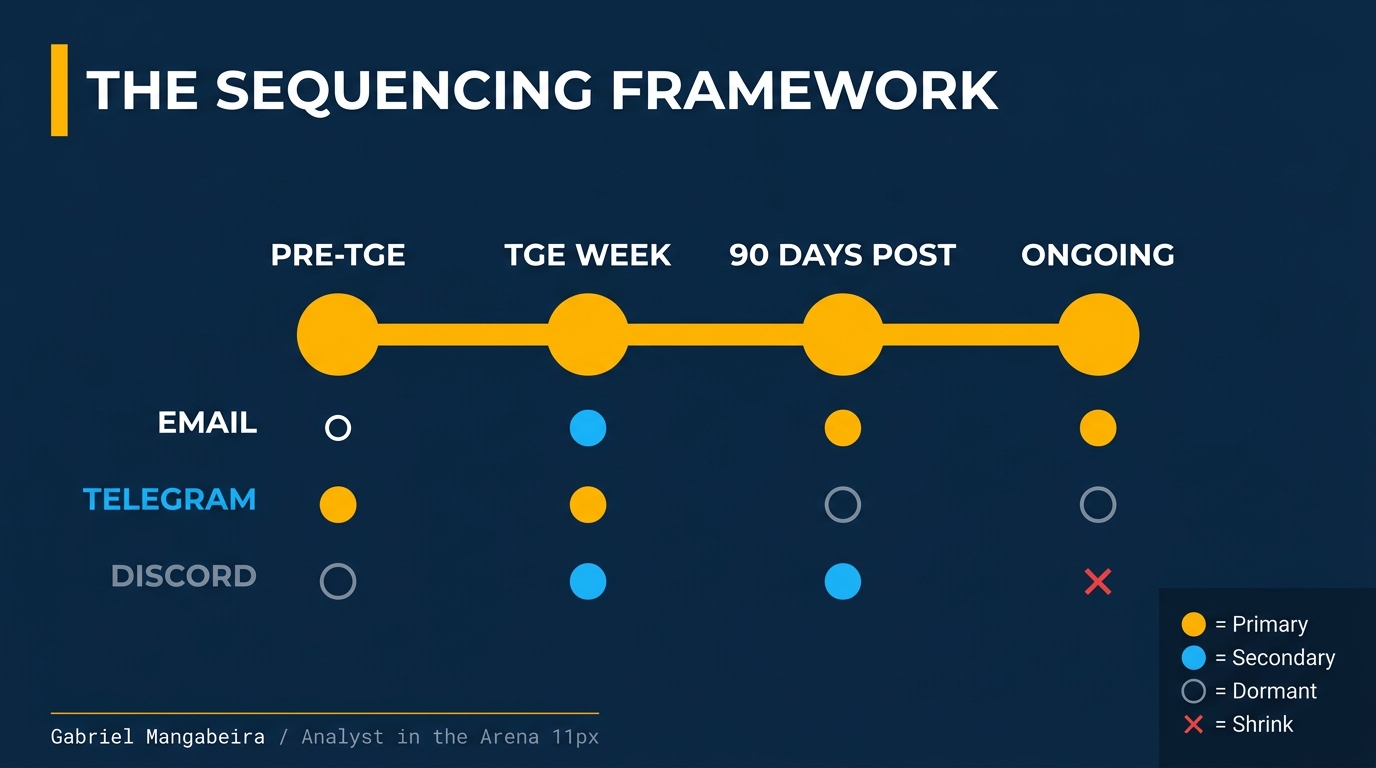
The Sequencing Framework: Pre-TGE vs. Post-TGE Channel Priorities
Channel strategy isn't static. The right priority at pre-launch is different from the right priority at TGE week, which is different again from 90 days post-launch. Here's how I map it:
Channel Sequencing by Stage
What Protocols Consistently Get Wrong
The same mistakes appear across protocols that struggle with community retention after TGE. They're not obscure. They're predictable.
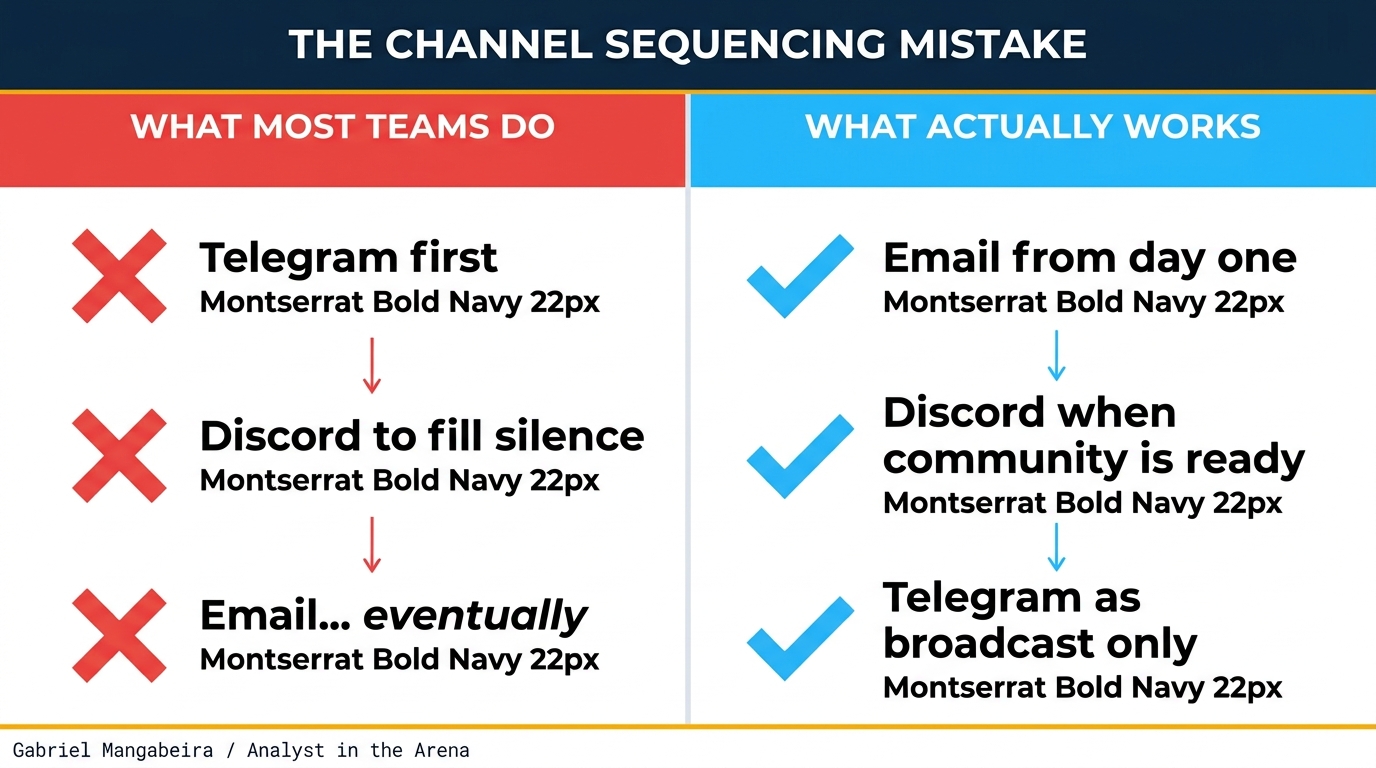
First: they build Telegram before email. A 50,000-person Telegram channel looks impressive. It converts poorly and can't be migrated if Telegram's platform changes. An email list of 5,000 engaged subscribers typically produces more protocol activity than a 50,000-person Telegram channel.
Second: they open Discord before they have anything for Discord to do. An empty Discord server with three channels and no daily activity signals low traction to every new visitor. It's better to launch Discord late with real activity than early with a ghost town.
Third: they treat all three channels as announcement feeds. Discord becomes a copy-paste of Telegram. Email becomes a copy-paste of Discord. When channels have no differentiated job, users pick one and ignore the rest. Usually they pick Telegram, which is the lowest-conversion option.
Critical
If you cross-post the same content to all three channels, you've eliminated the reason for your audience to be on more than one. Every channel needs a differentiated content job or it's just redundancy that costs you moderation time.
Fourth: they never ask for emails. Web3 teams are good at driving Discord joins and Telegram follows. They are genuinely bad at collecting email addresses. Every community action, including airdrop claims, governance votes, and protocol signups, is an opportunity to capture an email. Most teams miss it entirely.
Frequently Asked Questions
Does email marketing actually work for crypto protocols?
Yes. Email open rates in fintech and crypto communities consistently outperform most social engagement rates when the list is permission-based and the content is genuinely useful. The challenge isn't that email doesn't work in Web3. It's that most Web3 teams don't build lists until after the TGE, when the growth moment has already passed. Starting email capture at pre-launch dramatically changes what the channel can do for you at 90 days post-launch.
Should I choose Discord or Telegram for my Web3 community?
Both, with different jobs. Telegram handles speed and broadcast reach: announcements, updates, time-sensitive information. Discord handles community depth: governance discussions, contributor coordination, support, and onboarding. The mistake is treating them as substitutes. They're complements. Run Telegram as an announcement layer and Discord as a community layer, and neither channel competes with the other.
What's the biggest risk with Discord as the primary community channel?
Platform risk. You don't own your Discord community. If your server gets flagged, banned, or if Discord's moderation systems generate a false positive, you lose access to your entire community with no recourse. Several Web3 protocols have experienced exactly this. Email survives a Discord ban. A Telegram channel survives a Discord ban. Your Discord server does not. This is the strongest argument for building email alongside every other channel you operate.
When should a pre-TGE protocol start building its email list?
From the first day you have any public presence. The waitlist email is the most valuable asset most Web3 teams never collect. Every whitepaper download, every early access form, every "get notified on launch" signup should capture an email address. By TGE, a protocol with a well-built list has a retention tool ready to deploy immediately after the launch spike. A protocol that starts building its email list after TGE is trying to fill a bucket that already has a hole in it.
How do I know which channel is actually driving protocol activity?
Attribution in Web3 is genuinely difficult because most on-chain actions don't carry UTM parameters. The most reliable signal is comparative: run the same announcement across all three channels with unique links or coupon codes. Then measure which channel drives more on-chain actions per message sent. Over time, you'll see which channel your most active users actually use. Most protocols find that email drives higher-value actions even when Telegram has a larger audience, because email subscribers signal more intent by being there.