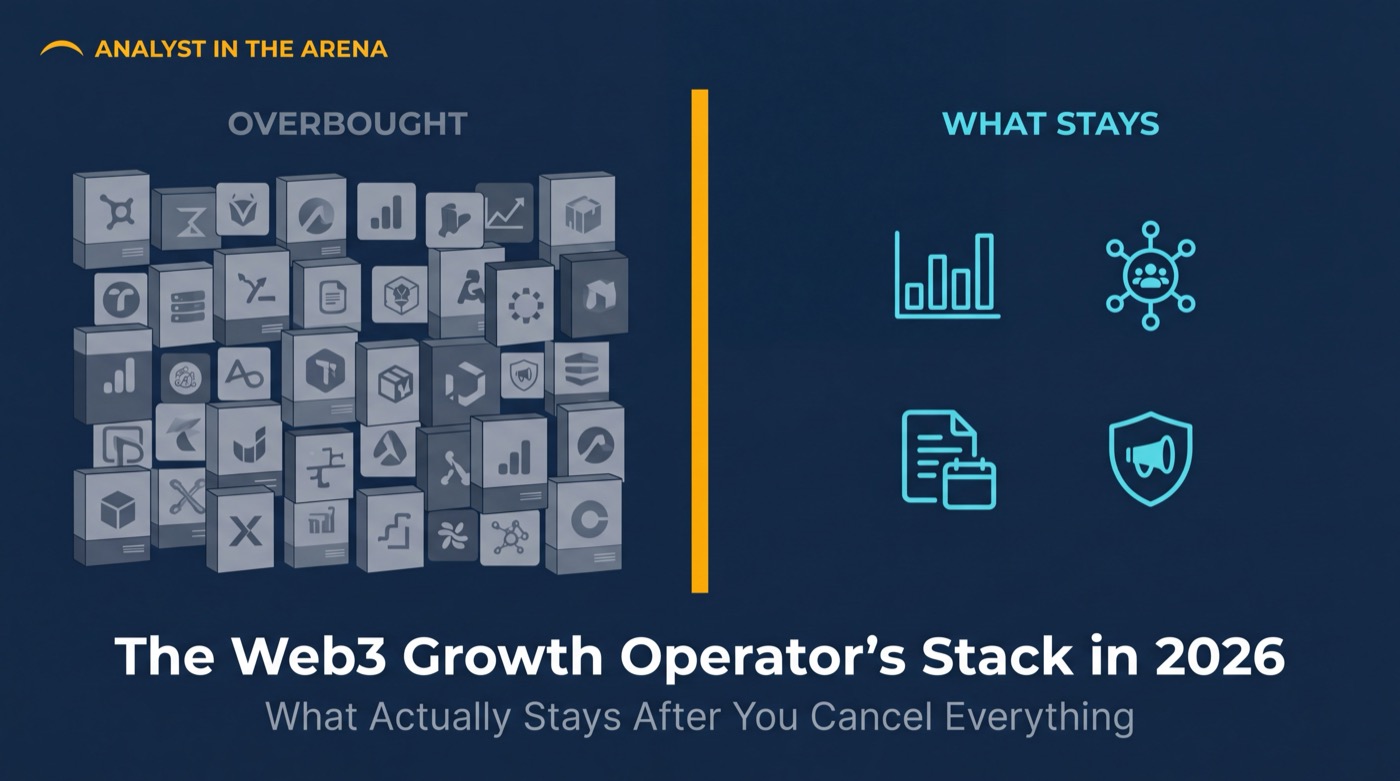
The Web3 Growth Operator's Stack in 2026: What Actually Stays After You Cancel Everything
A pattern has been showing up across Web3 marketing teams this year. Growth operators are cancelling subscriptions.
Not because the tools aren't good. Because there are too many of them, most of them overlap, and none of them talk to each other. One practitioner put it plainly on LinkedIn last week: "I cancelled 90% of my subscriptions."
That's not unusual anymore. Web3 growth roles attracted a wave of tool adoption between 2022 and 2024. On-chain analytics platforms, community intelligence tools, AI writing suites, attribution dashboards, social listening APIs. Every month brought a new category. Every month brought a new annual contract pitched as essential infrastructure.
Most of it wasn't.
The problem with tool sprawl isn't the cost. It's the cognitive overhead. When your growth stack has 12 tools, you spend more time maintaining the stack than running actual growth work. Data sits in silos. Reports require manual assembly. Workflows that should take 20 minutes take two hours.
This article breaks down what a minimal viable stack actually looks like for a Web3 growth operator in 2026. For each function, one primary tool, one acceptable alternative, and one category to avoid. The goal isn't to be prescriptive. It's to give you a framework for deciding what stays.
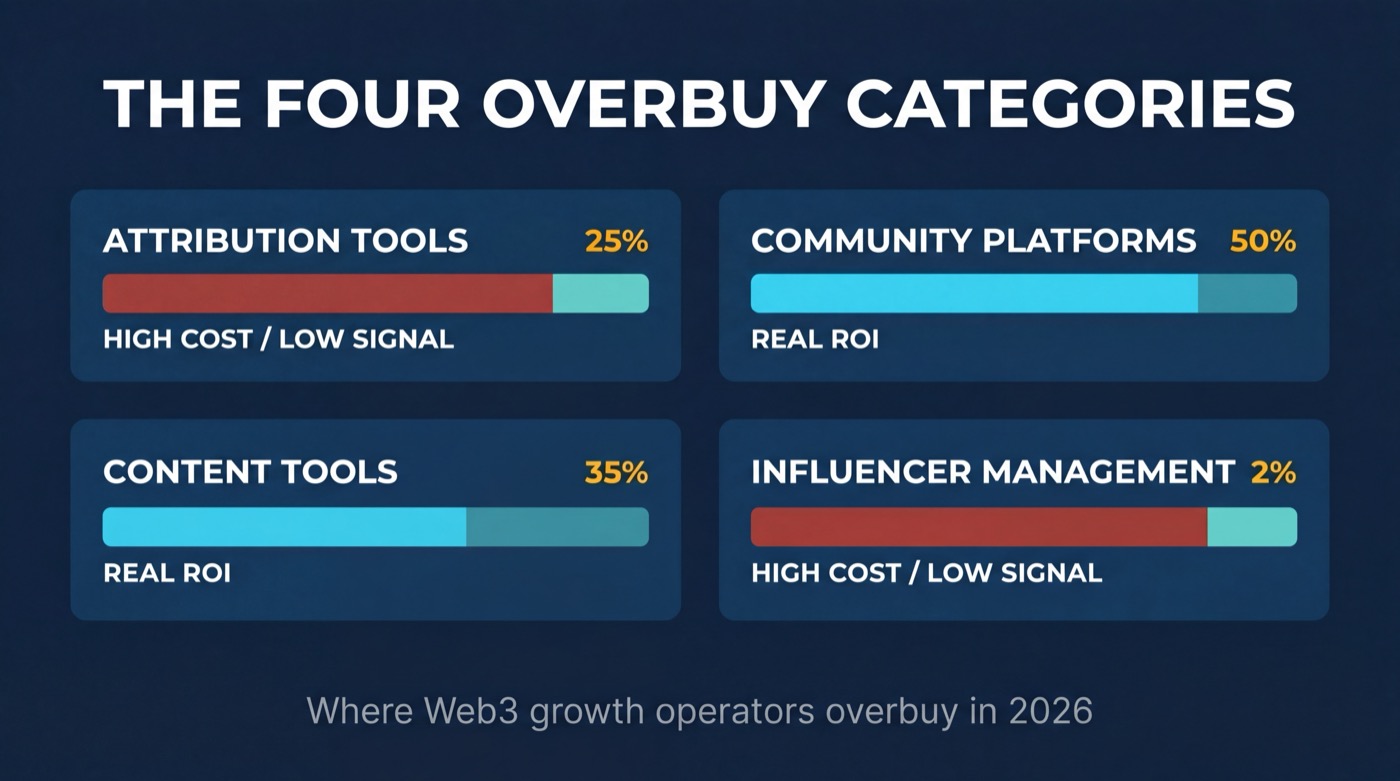
The Four Categories Where Growth Operators Overbuy
Key Insight
Most Web3 growth stacks aren't bloated because operators made bad decisions. They're bloated because the market created a new tool category every quarter and positioned each one as a gap-filler. The gaps were often imaginary.
Before building the minimal stack, it helps to understand where the bloat typically comes from. Four categories account for most of the redundancy.
Analytics Redundancy
The average Web3 growth operator at a DeFi protocol has access to Dune, Nansen, DefiLlama, Token Terminal, and sometimes a custom Looker or Metabase build. In most cases, three of those five answer the same questions.
Dune gives you raw on-chain data via SQL. DefiLlama aggregates TVL and protocol-level metrics. Token Terminal handles revenue and fee data. Nansen layers wallet intelligence on top of Dune's raw data. The overlap between these tools is significant, and paying for all of them usually means you're duplicating work without realising it.
Community Tool Overlap
Discord analytics tools, Telegram monitoring platforms, community health dashboards, sentiment trackers. These proliferated fast between 2023 and 2025. Many protocols ended up paying for two or three tools that measured roughly the same thing: message volume, member growth, and engagement rate. Very few of these tools connected community signals to on-chain behavior, which is the metric that actually matters.
AI Content Tool Churn
This one is the most acute right now. The AI content tool space saw significant consolidation pressure in 2025. A lot of "Web3-native" writing tools launched on the premise that a general-purpose LLM couldn't write good crypto content without protocol-specific training. Most of those tools underdelivered. Growth operators who bought them found that Claude or GPT-4 with a well-written system prompt outperformed the specialist tools at a fraction of the cost.
Attribution Infrastructure That Doesn't Work
This is the hardest category to talk about honestly. A number of platforms have raised significant funding on the promise of solving Web3 attribution: connecting ad spend or content performance to wallet-level conversions. The honest answer is that this problem isn't solved yet. Tools exist, but the methodology gaps are still significant. Protocols that paid for "Web3 attribution platforms" between 2023 and 2025 mostly ended up with dashboards that looked impressive and provided limited actionable signal.
The Minimal Viable Stack: What Actually Earns Its Seat
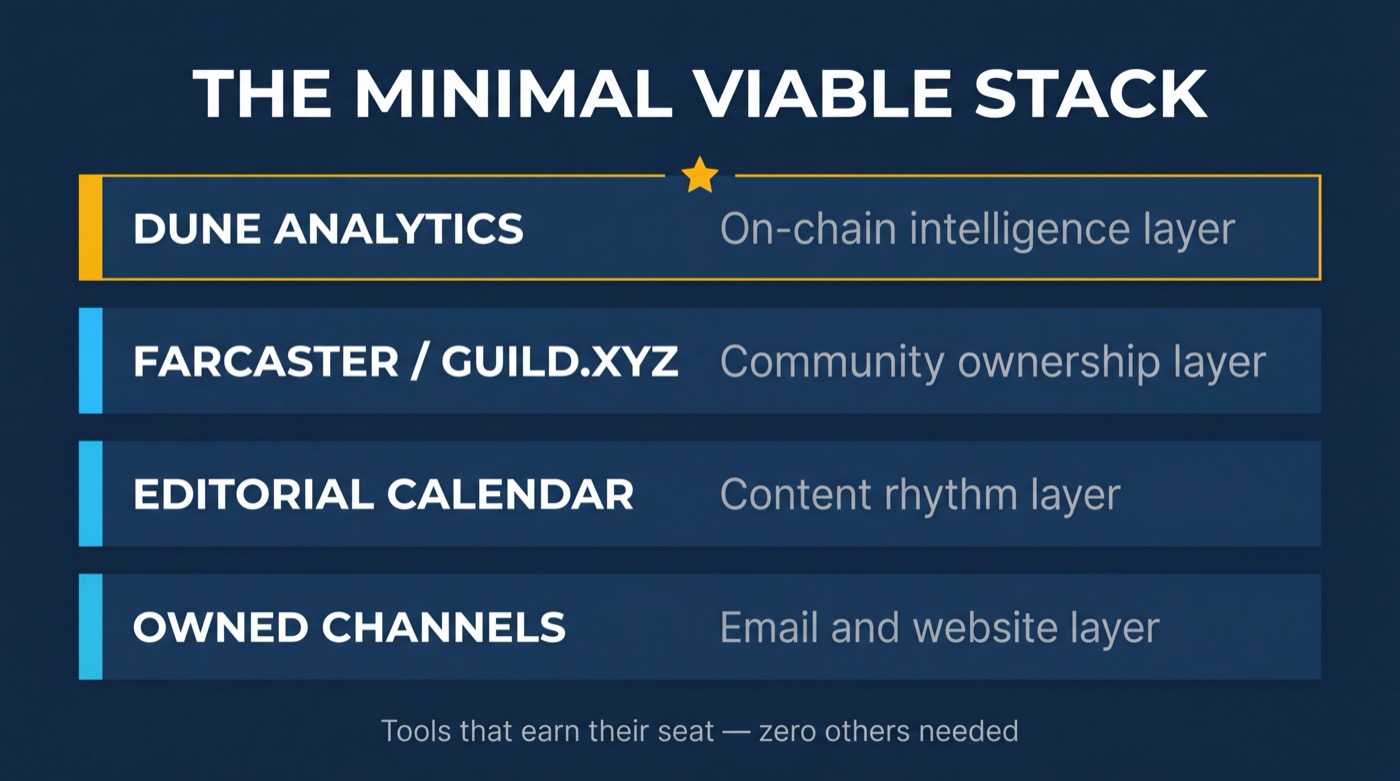
This is the stack that survives the audit. Organised by function. For each function: primary tool, acceptable alternative, and the category to stop buying into.
| Function | Primary | Alternative | Avoid |
|---|---|---|---|
| On-chain analytics | Dune (free tier) | Nansen (post-Series A) | Paid dashboards repackaging Dune data |
| Community intelligence | Manual + Discord/Telegram | One social listening tool | "AI community insights" with no methodology |
| Content production | Claude or GPT-4 + Buffer | Same LLM + native scheduling | Web3-specific AI content platforms |
| Attribution | UTMs + wallet cohort analysis | Nothing. The problem isn't solved. | Dedicated "Web3 attribution platforms" |
| Distribution | Buffer + LinkedIn + X | Native scheduling on 2 platforms | Tools that post to 15 channels at once |
On-Chain Analytics: Dune First
Dune's free tier covers most of what a growth operator at a protocol actually needs. You can query wallet cohorts, track TVL inflows, monitor token holder distribution, and build custom dashboards without paying anything.
The free tier's main constraint is query speed and private dashboard limits. For most growth teams, that's a reasonable tradeoff.
Nansen earns its cost when you're post-Series A, running campaigns that require wallet-level segmentation, or trying to track "smart money" movement relative to your protocol. Its address labels and transaction clustering are genuinely differentiated. For earlier-stage protocols or solo operators, the Dune free tier plus DefiLlama for protocol benchmarking is usually sufficient.
What to cut: Any paid dashboard product that markets itself as an analytics layer but is ultimately pulling from Dune or DefiLlama on the backend. You're paying for a UI wrapper on data you already have access to. Ask the vendor directly: where does your data come from? If the answer involves Dune or public RPC endpoints, you're paying for presentation, not insight.
Community Intelligence: Manual Is Underrated
The honest assessment of community analytics tools is that the signal quality is inconsistent. Message volume and member count are vanity metrics without context. Engagement rate matters, but most community tools measure it at the surface level, not in ways that connect to growth outcomes.
Manual monitoring inside Discord and Telegram covers most of what a growth operator needs. Add one social listening tool for tracking mentions and sentiment across X and Reddit.
The tools to avoid are the ones that promise "AI-generated community insights" without a clear methodology for how the AI classifies sentiment or extracts signal. Several tools in this category produce reports that look structured but are essentially pattern-matched summaries of Discord message volume. You can do the same thing faster by reading the actual channels yourself.
Watch Out
Community intelligence tools that can't explain their methodology in plain language are usually just aggregating message counts with a sentiment classifier bolted on. That's not intelligence. It's data formatting.
Content Production: One LLM, One Scheduling Tool
The AI content platform category had a rough 2025. Most platforms that launched with "Web3 personas" or "crypto-native content AI" couldn't demonstrate meaningful quality advantages over Claude or GPT-4 with a well-crafted system prompt. The general-purpose models improved faster than the specialist platforms could keep up with.
The minimal viable content setup is one LLM subscription plus a scheduling tool. Claude handles long-form strategy content and analysis well. GPT-4 handles structured output and templates well. Pick one, build a strong system prompt that encodes your protocol's voice and context, and stop paying for a proprietary platform on top.
Buffer handles scheduling across LinkedIn and X at a price point that makes sense for most teams. For protocols running light content operations, native scheduling on each platform eliminates the need for a scheduling tool entirely.
Attribution: The Honest Answer
Web3 attribution is not a solved problem. No platform has a clean methodology for connecting awareness-layer content to wallet-level conversions. The user journey is too fragmented, too pseudonymous. This is worth saying clearly because several platforms have raised significant funding on the promise of solving it, and the sales pitches are convincing.
The best available approach combines UTM parameters for off-chain traffic (articles, landing pages, newsletters) with on-chain wallet cohort analysis to understand where activated users came from. You can build wallet cohorts in Dune that segment users by first-touch wallet activity, then overlay your content publication dates to identify correlation patterns.
It's imperfect. But it's honest, it doesn't require a proprietary platform, and it surfaces actual patterns rather than dashboard theater. For more on why Web3 metrics mislead before you even reach attribution, see Why Your Web3 Marketing Metrics Are Lying to You.
Don't buy a dedicated Web3 attribution platform until someone demonstrates a genuinely differentiated methodology. Ask for a proof-of-concept with your own protocol's data before committing to a contract.
Distribution: Fewer Channels, Owned Audience
The growth operators who drove the most measurable traction in 2025 were running two or three channels well, not eight channels adequately. LinkedIn plus X plus one owned channel (newsletter or Discord) is the right footprint for most protocols.
Tools that post to 15 channels simultaneously create a false sense of reach. They also tend to produce formatting mismatches, since content optimised for LinkedIn doesn't translate cleanly to X, Telegram, or Farcaster. The cognitive tax of managing 15 channels is also significant, even with automation.
Cut the multi-channel automation tools. Focus the distribution budget on the two or three channels where your ICP actually spends time. The DeFi User Acquisition Channels breakdown covers which channels actually convert for DeFi protocols in 2026.
Web3 Growth Audit · Tool Stack
Not sure which tools in your stack are actually earning their seat?
A scoped audit reviews your current growth stack against on-chain cohort behavior and attribution quality. You'll know exactly what to keep, what to cut, and what to replace — before your next billing cycle.
Start Your Growth Audit →How to Audit Your Current Stack
The three questions below work as a simple audit framework for any tool in your current stack. Apply them once per quarter.
Stack Audit Checklist
A tool that fails two out of three of these questions should be cancelled at the next renewal date. A tool that fails all three should be cancelled immediately.
The exception is tools in active evaluation. Give a new tool 60 days with a defined test. If it hasn't changed a decision in 60 days, the answer is clear.
Where the Budget Goes When You Cancel
This part is straightforward. If you cancel three tools that collectively cost $600–$800 per month and redirect that budget, the highest-ROI destinations are:
Dune Pro if you're running frequent queries and hitting the free tier's speed limits. The upgrade adds private dashboards and faster execution times, which matters if you're running cohort analyses during active campaigns.
Nansen if your protocol is post-Series A and you're running wallet-level segmentation campaigns. Its address labeling database is genuinely useful for identifying which wallet segments are driving TVL or token holding. The cost is significant. The ROI is protocol-stage dependent.
Distribution spend on the channels you've already validated. More LinkedIn newsletter subscribers, more X reach, or a Beehiiv plan for a proper newsletter operation. All of these compound. Tool subscriptions don't.
Best Practice
Redirect cancelled tool budgets to owned audience growth first. A newsletter list of 2,000 engaged Web3 practitioners compounds in ways that a Looker license doesn't. Distribution assets outlast any analytics tool subscription.
FAQ
What is the minimum tool stack a Web3 growth operator actually needs?
For most growth operators, the minimum viable stack is: Dune (free tier) for on-chain analytics, one general-purpose LLM for content production, Buffer for scheduling, and native Discord or Telegram for community monitoring. That's four tools. Everything beyond that should earn its place by demonstrating a decision it changed in the last 90 days.
Is Nansen worth the cost?
It depends on your stack's current stage and how you'd actually use it. Nansen earns its cost when you're running wallet-level segmentation campaigns or tracking institutional wallet behavior relative to your protocol's TVL. For operators at earlier-stage protocols, the Dune free tier combined with DefiLlama covers most of the same ground at no cost. Ask one question before buying: can Nansen tell you something that would change your next campaign? If you can't name a specific use case, it's not the right time.
How do Web3 growth teams measure attribution without a dedicated platform?
Web3 attribution is not cleanly solvable yet. The best available approach is UTM parameters for off-chain content traffic, combined with on-chain wallet cohort analysis in Dune. Look at when new wallets first interacted with your protocol relative to content publication dates. It's correlation-based, not causal. But it's honest about its limitations, which is more than most "Web3 attribution platforms" are. Don't pay for a platform that presents correlation as causation.
Why did so many Web3-specific AI content tools underperform?
The core assumption was that general-purpose LLMs couldn't handle protocol-specific terminology without fine-tuning. That held in 2022. It didn't hold by 2024. Claude and GPT-4 improved faster than specialist platforms could iterate. A well-constructed system prompt encoding a protocol's voice and context typically outperformed the specialist tools. The platforms that survived added genuine workflow infrastructure on top of a good LLM. The ones that competed on output quality alone didn't.
How often should a Web3 growth operator audit its tool stack?
Once per quarter, at minimum. Run the three-question framework in this article against every active subscription at the start of Q2, Q3, and Q4. Annual renewals come fast in a market where tool adoption happens quickly and cancellation momentum stalls.
Closing
The Web3 Growth Marketer's Playbook covers the channel strategy that runs on top of this stack.
The Web3 growth operators who are running leaner stacks in 2026 aren't doing less. They're doing the same work with less friction. Fewer tools means fewer handoffs between platforms, less time spent assembling reports from disconnected data sources, and more time spent on the actual growth work.
The "I cancelled 90% of my subscriptions" moment is worth paying attention to. It's not tool fatigue. It's pattern recognition. Most of what the market sold as essential growth infrastructure between 2022 and 2024 was speculative tooling for a problem that hadn't been validated yet.
The stack that survived that culling is smaller, cheaper, and does more.
If you want a structured audit of your current growth stack alongside a review of your protocol's distribution mechanics, the Web3 Growth Audit covers both. Async. Scoped. No discovery call required.
Here's what a minimal viable stack actually looks like in 2026, and the three questions that tell you what stays.