
Picture the weekly growth call. Someone pulls up the slide. Discord is up 12% this month. Twitter impressions climbed 8%. GA4 is showing healthy session growth. The KOL campaign is live and the links are tracking clicks.
Then someone from the product side asks: "How many new wallets actually did anything on-chain this week?"
Silence. Someone pulls up a Dune dashboard. The numbers don't match the story on the slide. Nobody says it out loud, but everyone in the room knows: the two sets of numbers exist in completely separate universes.
I've seen this exact scenario play out across protocols in DeFi, DePIN, and wallet products. The growth team isn't incompetent. The metrics they're tracking are real. The problem is that those metrics were designed for a Web2 identity model that doesn't apply in Web3. And when the identity model breaks, the whole measurement stack breaks with it.
This article walks through exactly where the model breaks, what it costs you, and what to track instead.
The Web2 Identity Model and Where Web3 Breaks It
In Web2, identity is continuous. A user signs up with an email. That email anchors every action: login, session, purchase, return visit. Your analytics stack threads all of it together. GA4 knows who came from which ad, what they did, and whether they came back.
Web3 doesn't have that anchor. The wallet address is the closest equivalent, but most growth stacks aren't built to use it that way. Instead, growth teams in Web3 inherit a Web2 measurement playbook and try to apply it to a fundamentally different architecture.
Here's where it breaks, specifically.
Break 1: Discord Counts Members, Not Users
Discord membership numbers look like community health. They're not. A Discord server can grow by thousands of members in a week from a well-timed KOL post or a token launch announcement, while the actual number of wallets interacting with the protocol stays flat.
Discord has no native connection to on-chain activity. It doesn't know if those members ever connected a wallet, made a deposit, or touched the dApp. A server with 80,000 members and 200 monthly active wallets is not a growth success. It's a vanity metric wearing community clothing.
Break 2: Twitter/X Impressions End at the Wallet Connect Screen
Impressions are real. Clicks from Twitter to your site are real. But the thread ends at wallet connect. Standard UTM tracking, GA4, and most analytics setups have no way to follow what happens after a user clicks "Connect Wallet." The session continues in the browser, but from GA4's perspective, you're now tracking a new anonymous session with no memory of where that person came from.
The social reach signal is genuine. What it can't tell you is how much of that reach converted into on-chain action. Without that connection, you can't compare channels. You can't tell if the organic thread outperformed the paid KOL post. You're optimizing creative in the dark.
Break 3: GA4 Goes Blind at Wallet Connect
Critical
The moment a user does anything on-chain, GA4 loses the thread entirely. Blockchain transactions happen outside the browser event model that GA4 tracks. Every swap, deposit, stake, or governance vote is invisible to your standard analytics setup. This isn't a configuration problem, it's an architectural one.
If your primary product actions happen on-chain (and in most Web3 protocols, they do), then GA4 is tracking the path to your product, not the product itself. Sessions, bounce rate, and time-on-site tell you about the website. They tell you almost nothing about protocol usage.
Break 4: KOL Links Report Clicks That Die at MetaMask
KOL campaigns are expensive. A single mid-tier crypto influencer post can run $5,000 to $30,000. The standard measurement setup returns: clicks on the link, page visits from the link, maybe a click-to-wallet-connect conversion rate if you've instrumented that step.
What it almost never returns is verified on-chain conversion. Did any of the wallets that came from that KOL post actually transact? Did they deposit? Did they stake? Without cross-referencing wallet cohort data against campaign timing windows, you're paying for reach with no proof of conversion.
What This Costs You
Bad data doesn't just produce inaccurate reports. It produces misallocated budgets.
When Discord growth is the most visible metric in your weekly review, you fund the things that grow Discord: airdrops, giveaways, hype campaigns, and KOL blasts that target followers rather than active DeFi users. The channels that actually produce wallets (targeted content for practitioners, protocol integrations, incentive design) tend to show up weakly in the standard dashboard and get underfunded.
You end up with a growth team that's good at the metrics it's being asked to hit. And those metrics have a weak or nonexistent relationship to the actions that drive protocol revenue.
The Metrics That Actually Track Web3 Growth
The fix isn't about finding better analytics tools. It's about anchoring your measurement system to the right identity unit: the wallet address.
Here's what a corrected Web3 growth stack tracks.
| Web2 Metric (Broken for Web3) | Web3 Equivalent (What to Track Instead) |
|---|---|
| Discord member count | New wallets with at least one on-chain activation event |
| Twitter/X impressions | Wallet connect rate from social traffic (requires instrumentation) |
| GA4 sessions / returning users | Return wallet rate: wallets that transacted again within 30 days |
| KOL click-through rate | Wallet cohort activity in the 7 days post-campaign (via Dune) |
| Page views / sessions per campaign | Protocol revenue per active wallet |
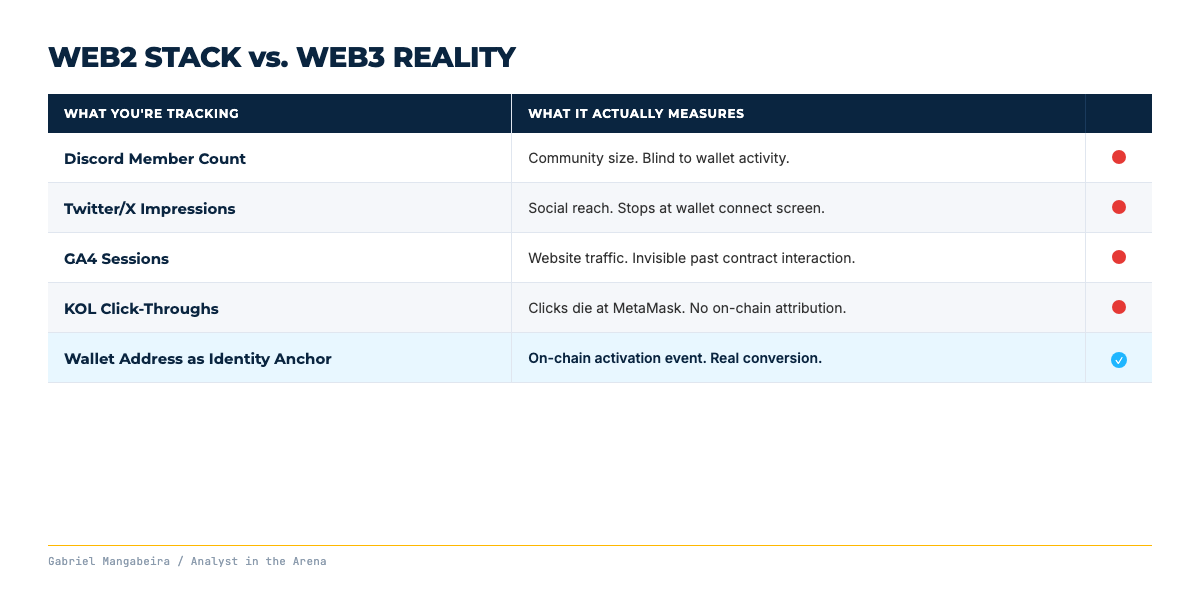
Let's break down each one.
Wallet address as identity anchor. Replace email and cookie with wallet address as your primary user identifier. Every meaningful action in your protocol maps to an address. From there you can track activation, retention, and revenue at the user level without relying on browser session continuity.
On-chain activation events as your conversion signal. Define your protocol's first meaningful action: first deposit, first borrow, first stake, first governance vote. That's your activation event. Track the number of new wallets that hit that event each week. That's a real acquisition number. Everything upstream is funnel metrics.
Return wallet rate. This is your retention signal. Take the wallets that were active in a given week. Check how many of them transacted again within 30 days. Protocols with real product-market fit tend to show strong return wallet rates. Protocols running on emissions or airdrop incentives tend to show a sharp drop-off when the incentive ends. The return wallet rate exposes which type of engagement you actually have.
Protocol revenue per active wallet. This is the one number that connects growth activity to business outcome. You can calculate it from on-chain data: total protocol fees generated divided by the number of unique wallets that transacted in that period. It tells you whether you're growing a productive user base or just inflating wallet counts.
Campaign timing windows cross-referenced with Dune wallet cohorts. This is the closest thing to KOL attribution available without a full-stack tracking implementation. You run a KOL campaign on a given date. You pull new wallet activations on your protocol for the 48-72 hours after. You compare that window to baseline activation rates from the prior two weeks. It's not perfect, but it gives you a directional signal on whether the campaign drove real behavior.
Key Insight
The wallet address is the identity layer your analytics stack is missing. It's not a perfect user identifier, one person can hold multiple wallets, but it's far more connected to actual protocol behavior than a Discord username or a browser session. Build your measurement system around it.
The Wallet Cohort Approach (Without a Full-Stack Dev)
You don't need a custom data pipeline to start thinking in wallet cohorts. Dune Analytics has public queries for most major protocols. You can fork them and adapt them to your needs.
The basic workflow: build a query that shows new wallet addresses that interacted with your protocol each day or week. Filter for wallets that hit your activation event (not just connected, but actually transacted). Track that cohort over the following 30 days. Do they come back? Do they transact more or less frequently over time?
For campaign attribution, layer in your campaign timing. Mark the dates of KOL posts, token drops, partnership announcements, or content campaigns. Look at whether new wallet activations spiked in the following 48-72 hours. Over time, this becomes a directional model for which external channels actually drive protocol usage.
This approach is accessible to a growth operator who knows Dune basics and has access to the protocol's contract addresses. It doesn't require a data engineer or a custom event tracking infrastructure to start generating usable signal.
The deeper framework for building a full attribution system across channels is covered in the DeFi attribution guide on mangabeira.net. If you're past the basics and want to build something more systematic, that's the right starting point.
A Concrete Example: TVL vs. Borrowing Demand
Protocols that have moved toward more sophisticated measurement show a useful contrast. Aave's public data on DefiLlama and Token Terminal surfaces not just TVL but active borrowers, borrow volume, and protocol revenue. These are the metrics that reveal whether the protocol is generating real economic activity or just holding deposits from yield farmers who will leave when rates drop.
Protocols that still report TVL as their primary growth metric are, in most cases, still stuck in the Web2 dashboard problem. TVL measures capital in the pool. It doesn't measure wallets actively using the protocol. A billion dollars in TVL with 400 active borrowers is a different business than a billion dollars in TVL with 40,000 active borrowers. The standard growth deck doesn't always surface that difference.
The question to ask of any growth metric is: does this number go up when users are extracting value from the protocol, or does it go up for other reasons? If it can go up for other reasons, it shouldn't be your headline KPI.
The Real Problem Isn't the Growth Team
Growth operators running Web3 protocols aren't bad at their jobs. Most of the people I've seen in these roles are rigorous, data-literate, and genuinely want accurate measurement.
The problem is the measurement model they inherited. It was built for a Web2 environment where identity is continuous, browser sessions persist, and every meaningful user action happens inside a trackable digital surface. Web3 broke those assumptions. The wallet is the user. On-chain transactions are the product actions. And most standard analytics stacks have no way to observe either one.
The fix requires a deliberate choice to build around the wallet as the identity unit, to define on-chain activation as the conversion signal, and to cross-reference campaign timing against wallet cohort data rather than click counts.
That's not a minor adjustment to the dashboard. It's a different way of thinking about what growth means in a protocol context. And it's the shift that separates teams who know how their protocol is actually growing from teams who know how their marketing looks.
If your team is presenting that exact slide right now and the on-chain question still doesn't have a clean answer, that's a reasonable place to start a Web3 growth audit.
Frequently Asked Questions
Why don't standard analytics tools work for Web3 protocols?
Standard tools like GA4 are built around continuous session and identity tracking using cookies, email addresses, and browser state. Web3 protocols execute their core product actions on-chain, outside the browser event model that these tools observe. The moment a user interacts with a smart contract, GA4 loses visibility. This is an architectural mismatch, not a configuration problem.
What is a web3 growth operator's most important metric?
Protocol revenue per active wallet. It's the one number that connects growth activity to a real business outcome. New wallet activations tell you acquisition. Return wallet rate tells you retention. But protocol revenue per active wallet tells you whether the users you're acquiring are actually using the product in a way that sustains the protocol. Everything else is upstream of that signal.
How do you attribute a KOL campaign to on-chain results without custom tracking?
The practical approach is the campaign timing window method. Record your campaign launch date. Pull new wallet activations on your protocol for the 48-72 hours following the post. Compare that window to your baseline activation rate for the prior two to three weeks. A meaningful spike above baseline in the campaign window is directional evidence that the campaign drove real behavior. It's not statistically precise, but it's far more useful than click counts alone.
What is return wallet rate and how do you calculate it?
Return wallet rate is the percentage of wallets that were active in a given period and then transacted again within the next 30 days. To calculate it, take the set of unique wallets that interacted with your protocol in week one. Check how many of those same wallets executed at least one transaction in weeks two through four. Protocols with genuine product-market fit typically show return wallet rates above 25% at 30 days. Protocols running on incentive-driven activity tend to show sharp drop-offs when the incentive ends.
Does this apply to non-DeFi Web3 projects like wallets or DePIN networks?
Yes. The core problem applies to any Web3 project where the meaningful product actions happen on-chain. For wallet products, the activation event might be the first outbound transaction from a newly created wallet. For DePIN networks, it could be the first node registration or the first rewards claim. The specific events change depending on the protocol. The measurement logic is the same: define the on-chain action that signals a real user, track wallet cohorts around that event, and measure return rates from there.
References
- DefiLlama, Protocol TVL and fee data
- Token Terminal, Protocol revenue and active user data
- Dune Analytics, On-chain query environment
- DeFi Attribution Framework for Growth Marketers, mangabeira.net
- Web3 Growth Marketers DeFi Playbook, mangabeira.net
Ready to diagnose your protocol's growth gaps?
A structured Web3 Growth Audit across 6 dimensions: website, dApp, social, community, SEO, and PR. Delivered in 72 hours.
Run the Growth Audit →