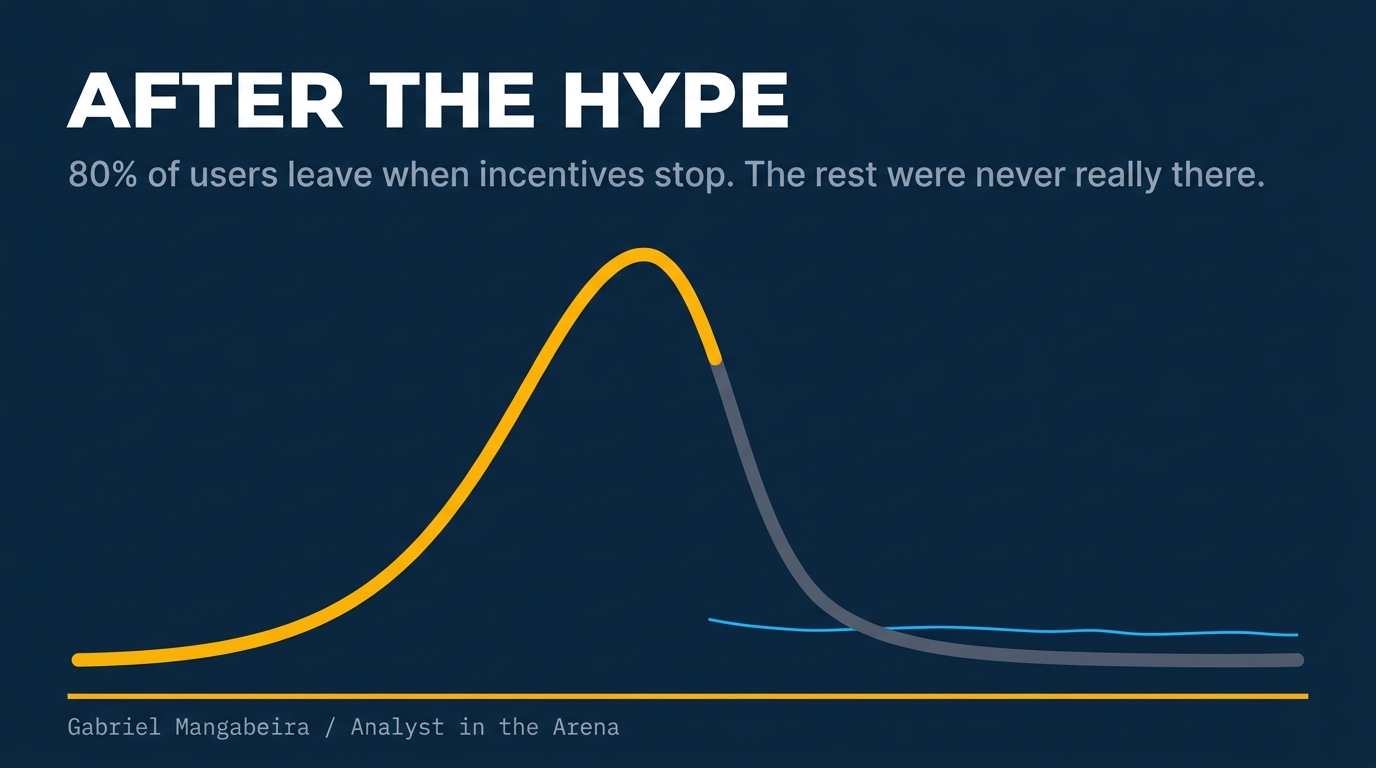
The emissions chart bent. Slowly at first, then all at once.
A protocol that had 50,000 daily active wallets during incentive season. Three months after the emission curve flattened: 4,200. The team called it a bear market. Pointed to macro conditions, competitor noise, token price. But the data told a different story. Non-incentivized usage sat at roughly 4,200 the entire time. The incentives didn't grow the user base. They temporarily inflated a number that was always 4,200 underneath.
This pattern has played out across dozens of protocols in the past two years. It's the central argument in what practitioners on Crypto Twitter are calling the Retention Era: the idea that post-2021 emissions-driven TVL was never real growth. It was rented behavior.
This article breaks down why that happens, how to tell the difference between a retention problem and a design problem, and what growth operators can do about it right now.
The Farm-and-Leave Cohort: Who You Actually Attracted
Before you can fix retention, you need to be honest about what you built.
When a protocol launches with aggressive incentives, it attracts a specific cohort. Airdrop hunters. Liquidity farmers. Points chasers. These are not users in any meaningful sense. They are incentive arbitrageurs. Their decision to interact with your protocol is a financial calculation, not a product decision. They came because the yield math worked. They'll leave the moment the math changes, or the moment another protocol offers better math.
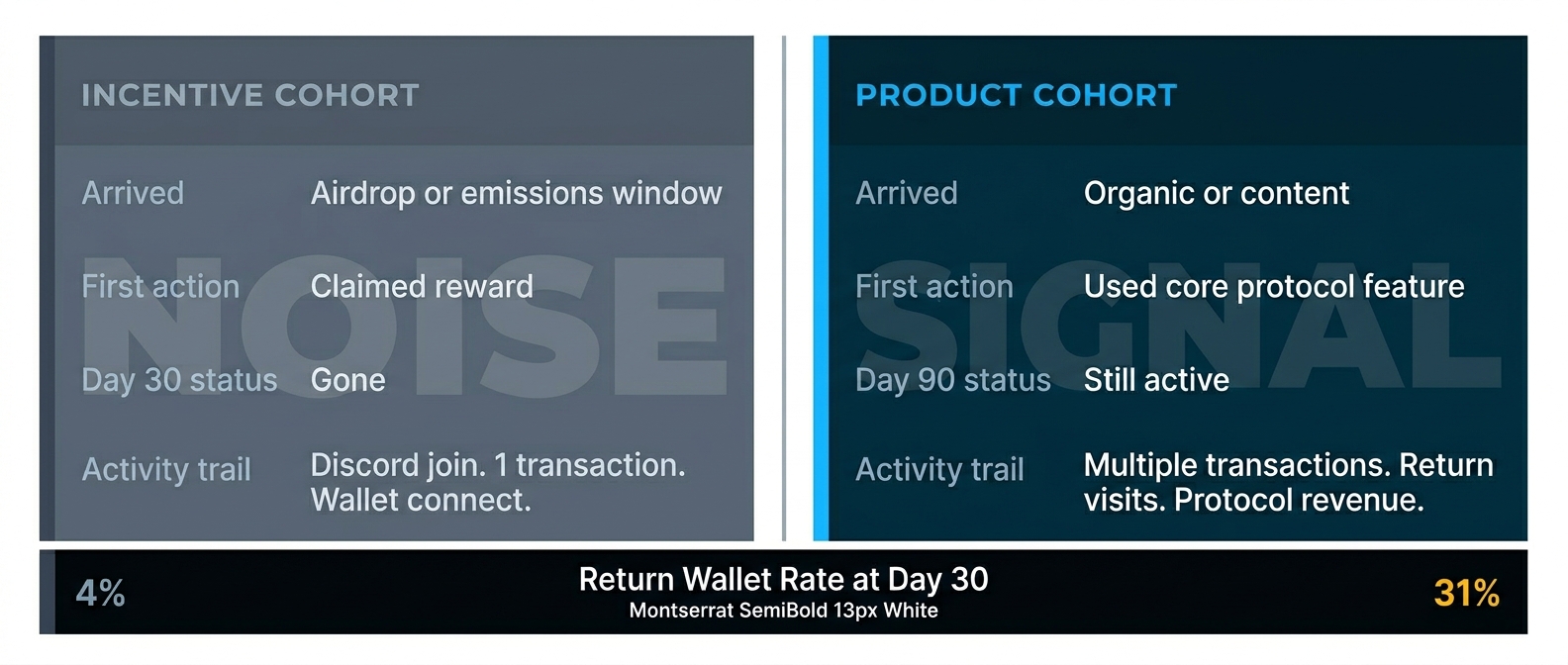
This cohort is not disloyal. They never claimed loyalty. You invited them in with an incentive, and they responded to the incentive. Blaming them for leaving is like blaming a shopper for using a coupon and never coming back. The incentive attracted exactly the behavior it was designed to attract.
The problem isn't the farm-and-leave cohort. The problem is building a protocol that can only be measured while they're present.
"If your retention curve looks like your emissions curve, you don't have a retention problem. You have a design problem."
Design Failure vs. Execution Failure
Critical
Treating high post-incentive churn as a marketing problem is the most expensive mistake in Web3 growth. Re-engagement campaigns, Discord activations, and community sprints cannot fix a protocol that was designed to attract people who were never going to stay. Diagnosing this correctly. design failure vs. execution failure. is the first job of any growth operator working with declining retention metrics.
Most teams reach for execution fixes when they see churn spike after incentives taper. Better re-engagement emails. Loyalty NFTs. Discord events. Token buybacks to prop up price. Some of these moves produce short-term bumps. None of them address the underlying cause.
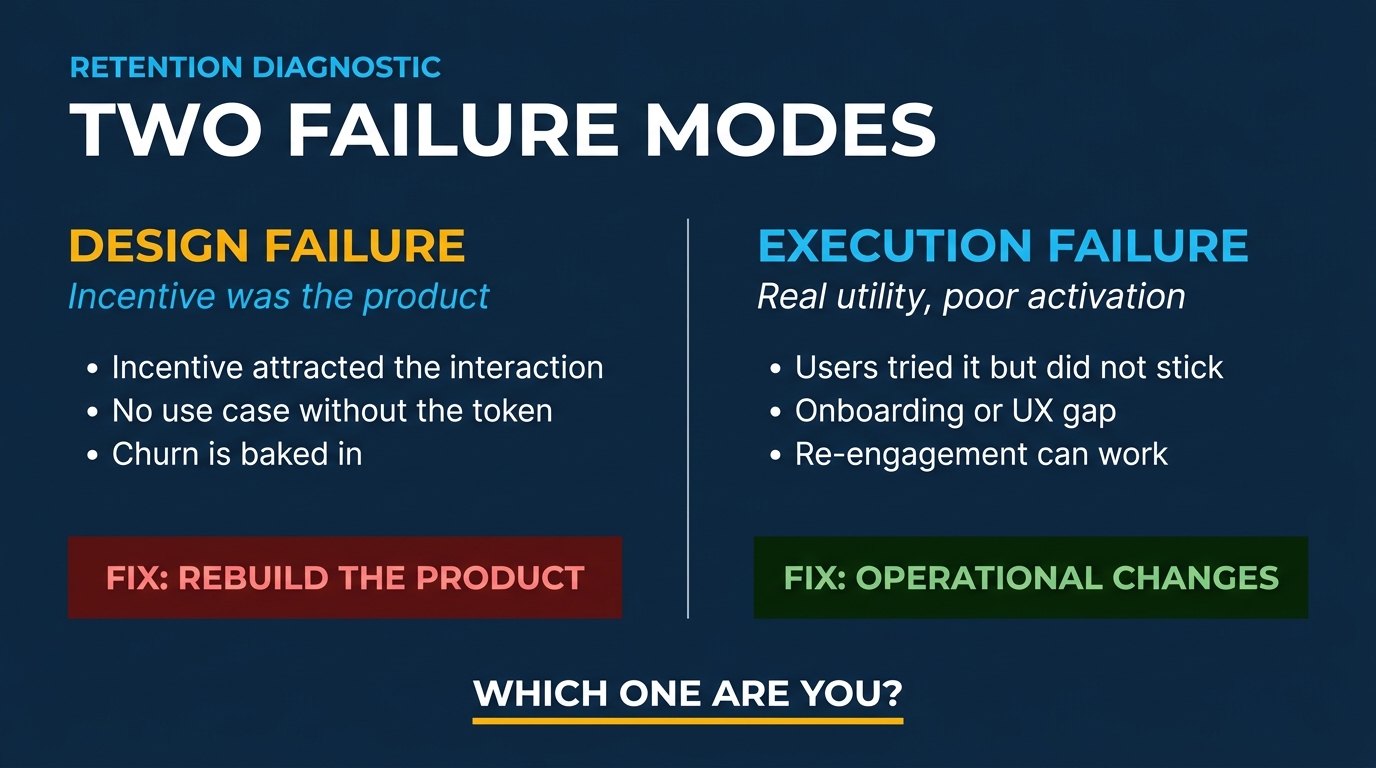
Here's the distinction that matters:
An execution failure is when your product has genuine value for a real user, but your marketing, onboarding, or communication didn't convert or retain them. The fix is operational: better activation flows, clearer messaging, improved UX, more targeted outreach.
A design failure is when the incentive structure itself trained users to leave. The protocol attracted people who wanted the incentive, not the protocol. When the incentive changes, they go. There is no marketing fix for this. The product never solved a real problem for those users. Re-engagement campaigns are noise to someone whose relationship with your protocol was always transactional.
The brutal test: remove all token incentives from your protocol tomorrow. Who's still there in 30 days? That number is your actual user base. Everything above it was rented.
Most teams never run this test, even hypothetically. They should run it every quarter.
What Retention-Designed Protocols Look Like
The protocols winning the Retention Era didn't get lucky. They made a specific design decision: build real utility before incentivizing adoption.

Best Practice
Aave has maintained meaningful borrowing activity across multiple market cycles because it solves a real problem. accessing liquidity against collateral. that exists independent of token price or emissions. When AAVE token emissions decreased, core protocol utilization held because the demand was never incentive-driven. Users came to borrow and lend, not to farm AAVE. That's the product-first design decision that separates protocols with real retention from those with inflated metrics.
Pendle is another example worth studying. The protocol built a yield trading mechanism that creates genuine utility for yield-sensitive capital. The product works for a specific type of user (someone who wants to trade future yield or lock in fixed rates) regardless of Pendle's own token incentives. That product-native utility is what creates the retention floor. It's not that Pendle doesn't use incentives. It's that the core use case doesn't collapse when they do.
SkyEcosystem follows a similar logic in the stablecoin layer. When a stablecoin protocol's primary use case is holding and transacting with a stable asset, the retention driver is product reliability and ecosystem reach, not farming yield on the governance token.
What these protocols share is sequencing. They built product-market fit before using incentives to scale adoption. They didn't use incentives to find PMF. The incentive was acceleration, not discovery.
The contrast is protocols where the incentive was the product. There was no borrowing use case, no yield trading utility, no stablecoin function independent of the emissions. The token was the product, and when the token stopped rewarding, there was nothing left to retain users with.
Web3 Growth Audit · Retention Diagnostic
Want a structured diagnosis of your protocol's real retention floor?
Most teams discover their actual retention 90 days too late. A focused audit names design failure versus execution failure and gives you the next move for each.
Schedule a Free Strategy Call →The 5-Question Retention Audit
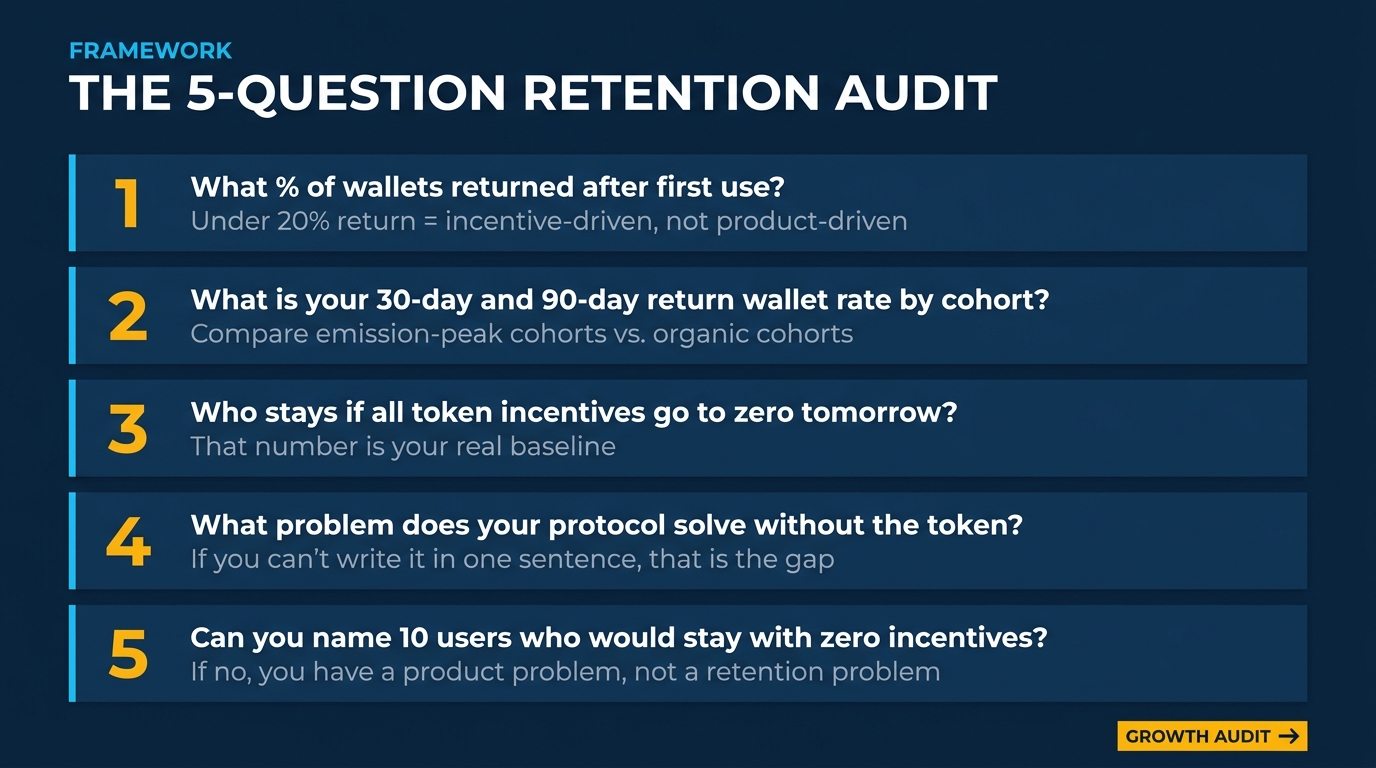
Run this audit against your current data. Be honest. The answers tell you whether you have an execution problem or a design problem.
What percentage of your wallets have transacted more than once?
If you have 100,000 wallets but fewer than 20% have returned, the first interaction was likely incentive-driven, not product-driven. A healthy multi-transaction rate for a non-trivial product sits above 35-40%.
What is your return wallet rate at 30 days and 90 days?
Segment this by cohort and by incentive period. If your 30-day return rate during emission peaks was 40% and is now 8%, the product didn't retain users, the incentive did. That's a design signal, not a marketing problem.
What does your wallet activity look like with zero token incentives removed?
Run the hypothetical: if all token rewards went to zero tomorrow, which users would still interact with the protocol? That cohort is your real baseline. Build your retention strategy around them, not the total number.
What problem does your protocol solve that has nothing to do with your token price?
Write it in one sentence. If you can't, that's the design gap. Not the marketing copy, not the community strategy. The product itself doesn't have a non-incentive reason to exist for most of your users.
Can you name 10 users who would stay if you removed all incentives tomorrow?
Not 10 big holders who'd stay to protect their position. Ten users who'd stay because the protocol solves something real for them. If you can't name 10, you don't have a retention problem. You have a product problem.
What Growth Operators Can Do Right Now
Assume you're past the design audit and you do have real users in your base. The execution layer still matters. Here's what works.
Track return wallet rate, not TVL. TVL is a lagging indicator of capital allocation, much of which is incentive-driven. Return wallet rate at 30, 60, and 90 days tells you whether users who tried the protocol came back. This is the metric that predicts long-term protocol health. Run it weekly, segmented by acquisition cohort.
Find the activation event that predicts 90-day retention. In most protocols, there is one specific action that, once a user takes it, predicts long-term retention at a much higher rate. It might be the second transaction. It might be using two distinct features. It might be interacting across two connected protocols. Find that event in your on-chain data. Then rebuild your onboarding around getting users to that event as fast as possible.
This connects directly to attribution. You can't fix what you can't trace. If you don't know which acquisition channels produced your highest-retention wallets, you're optimizing blind. The DeFi attribution framework for growth marketers covers the upstream mechanics here. Retention starts with knowing where your best users came from.
Build a high-intent community segment. Not all wallet holders are equal, and not all community members are users. Identify the wallets that return consistently, transact in meaningful sizes, and interact with governance or new features early. These are your high-intent users. Pull them into a dedicated Telegram or Discord segment. Not a whale VIP program. A power-user feedback loop. These people will tell you what they actually use the protocol for, which will almost always be more specific than your team's assumptions.
The channel structure you use here matters more than most teams realize. If you're still debating Discord vs. Telegram vs. email for your retention communications, the framework in Web3 email vs. Discord vs. Telegram is the right starting point. The short answer: high-intent users respond to email. Discord is for discovery. Telegram is for real-time coordination. These are not interchangeable.
Stop reporting Discord member counts to leadership. I've seen growth decks where Discord membership is the primary retention metric. Discord membership does not measure retention. It measures who clicked a link. Report return wallet rate, 30-day active wallets, and average transaction frequency per retained wallet. If your leadership doesn't understand what those metrics mean, that's a separate problem worth fixing.
The broader playbook for tying these metrics together at the channel level is in the Web3 growth marketer's DeFi playbook. The retention metrics layer from this article maps directly onto the distribution mechanics there.
The Retention Era Is a Correction
This moment in Web3 growth isn't a trend. It's a correction.
Protocols that built on emissions-driven TVL and call it a user base will keep misreading the emissions cliff as market conditions, competitor moves, or macro headwinds. The protocols that survive this cycle understood something different: incentives are a tool for scaling adoption after you have product-market fit. Not for finding it. And the exit from incentives has to be designed before the incentives begin. What does the protocol look like at month 18, when the initial emission curve flattens? If no one on the team can answer that, the design failure is already in motion.
The protocols worth watching in the next 12 months are the ones rebuilding their user metrics from the bottom up. Stripping out the incentive-period cohorts. Measuring the real retention floor. Then designing acquisition, onboarding, and community strategy around users who actually wanted the product.
If your retention curve looks like the one at the top of this article, the Web3 Growth Audit identifies whether you're facing a design problem or an execution problem, and which part of the stack to address first.
Analyst in the Arena · Gabriel Mangabeira
Run the 5-question audit on your protocol
30-minute strategy call. Free. No pitch. Just a structured diagnosis of where your retention actually sits, what's driving the gap, and what to fix first.
Schedule your call →Frequently Asked Questions
What is web3 user retention and why does it matter more now than in 2021?
Web3 user retention measures the percentage of wallets that return to interact with a protocol after their first transaction. In 2021, most protocols reported growth metrics that included incentive-driven wallets. Those wallets were never genuinely retained. They left when the incentive math changed. Now that major emission programs have wound down across DeFi, the gap between incentive-driven TVL and real retained users is visible in on-chain data. That's why retention is the defining challenge of the current cycle.
How do you measure DeFi retention strategy effectiveness with on-chain data?
The most reliable signal is return wallet rate, segmented by cohort and by incentive period. Pull wallets that first transacted during an emission peak, then measure what percentage returned at 30 and 90 days. Compare that to wallets acquired before or after the emission peak. The gap between those cohorts tells you how much of your "growth" was incentive-dependent. Dune Analytics and Nansen both support this cohort analysis with public data for major protocols.
What's the difference between a design failure and an execution failure in token incentive design?
A design failure means the protocol used incentives as a substitute for product-market fit. The incentive was the reason users engaged. When it ended, there was nothing left. An execution failure means the protocol has real utility but poor onboarding, communication, or activation mechanics that prevent users from sticking. Design failures require product rethinking. Execution failures require operational fixes. Most growth teams try to apply execution solutions to design failures, which is why retention campaigns often produce no lasting improvement.
Can token incentives ever be a good retention tool?
Yes, but only after you have product-market fit and only when the incentive is designed to accelerate an action users were already taking. Incentivizing borrowing on a protocol people already borrow on brings forward demand. Incentivizing borrowing to create demand where none existed creates a cohort that leaves when the incentive ends. The sequencing is what matters: prove the use case exists, then use incentives to scale adoption of a proven behavior. Don't use incentives to discover whether the use case exists.
What metrics should web3 growth operators report instead of TVL and Discord member counts?
The core stack: return wallet rate at 30 and 90 days, average transactions per retained wallet per month, percentage of wallets with more than one transaction, and the activation event completion rate (the specific action that predicts 90-day retention). Secondary signals worth tracking: share of volume from wallets with no concurrent incentive activity, governance participation from non-whale wallets, and protocol fee revenue from wallets acquired before emission peaks. These metrics tell you about genuine product adoption. TVL and Discord members do not.
References
- Aave Protocol usage data: DefiLlama
- Pendle Finance protocol overview: Pendle Docs
- SkyEcosystem (formerly MakerDAO) governance and ecosystem data: sky.money
- On-chain cohort analysis methodology: Dune Analytics
- Retention Era discourse: Crypto Twitter / X, May 18-21, 2026
Related Articles
Gabriel Mangabeira is a Web3 growth consultant and the author of the Analyst in the Arena newsletter at mangabeira.net. He advises DeFi protocols, dApps, and Web3 teams on distribution systems, attribution, and growth mechanics post-PMF.