
Framework in play: Thinking in Systems (Donella H. Meadows). A system's behavior comes from its parts, its information flows, its incentives, and its purpose. Headcount only shows you one visible stock.
Applied rule: map the flows and feedback loops before you credit one team, or copy one parameter.
Hyperliquid's story usually gets told with one number: 11 people.
Jeff Yan confirmed that core-team size in an interview published on August 17, 2025. No newer first-party source updates it. The honest phrasing is "11 people in August 2025," not "11 people today." Yet that dated figure keeps getting stretched into a bigger claim. It implies a tiny team built and now runs a multibillion-dollar exchange almost alone.
I don't think that claim holds up. Here is what I found instead.
Hyperliquid's small team is not the operating model. It's the visible core of a much larger workforce, and that workforce gets coordinated through protocol economics instead of a payroll. Validators secure consensus and the bridge. HLP depositors and market makers supply liquidity. Referrers and builder-code interfaces distribute the product. HIP-3 deployers build entire markets and keep a cut of the fees. None of them show up in a headcount slide. All of them do real, priced work.
This analysis walks through the live data, the five findings behind that structure, the growth engine that built it, where it creates risk, and what founders can and can't copy.
What the Live Data Shows
I pulled Hyperliquid's numbers directly from its public API and DefiLlama on August 4, 2026, at 12:27 UTC. The snapshot shows a dense trading system, not a full income statement.
The Hyperliquid API reported 232 native perpetual markets and $3.299 billion in 24-hour perp notional across the default validator-operated universe. Estimated open interest, calculated from open interest times live mark price, was $6.796 billion. The same snapshot showed 321 spot markets with $68.98 million in 24-hour spot notional.
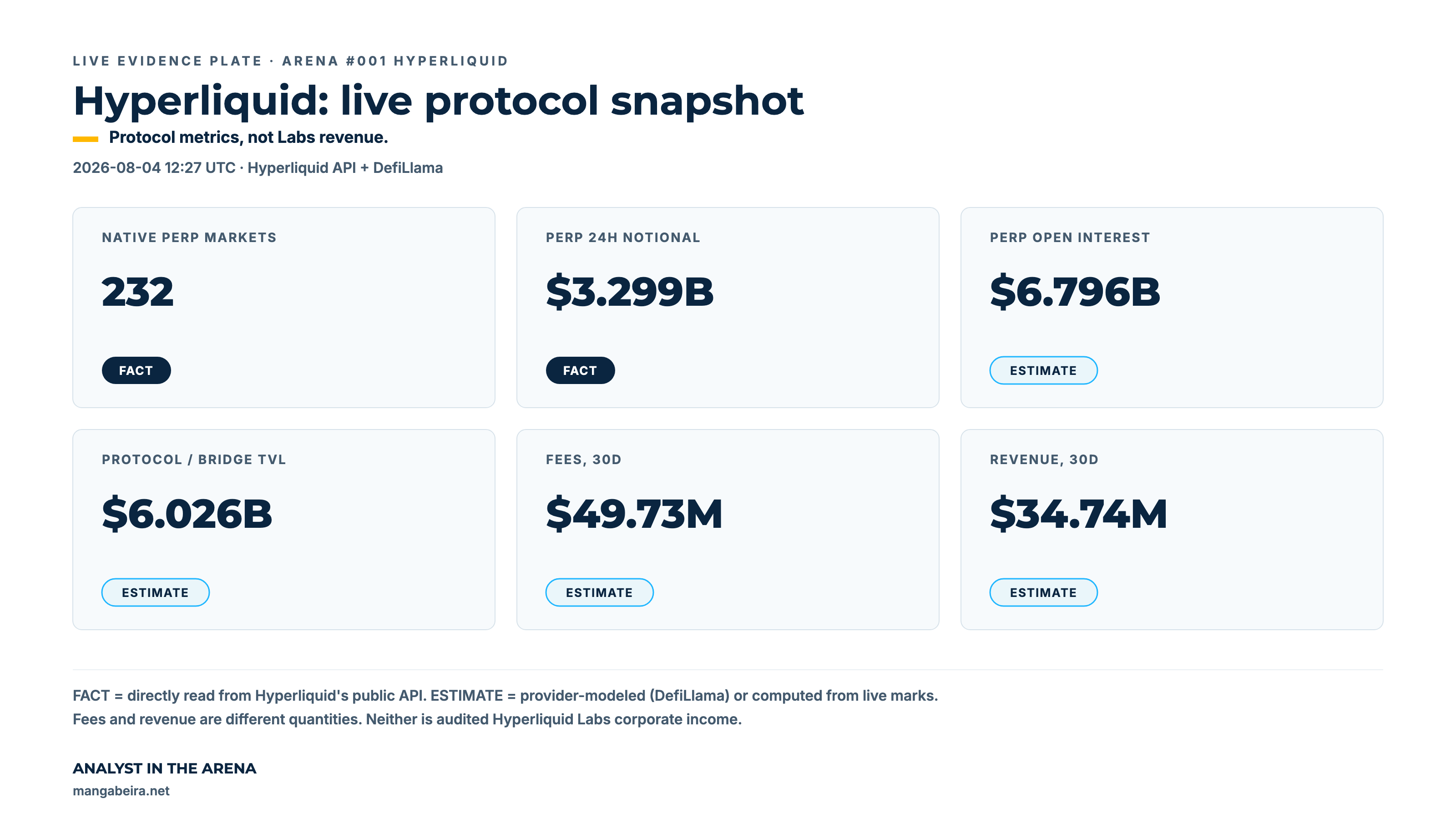
DefiLlama's protocol API estimated $6.026 billion in protocol and bridge TVL. Over the trailing 30 days, its fees API showed $49.73 million in user-paid fees, and its revenue API classified $34.74 million of that as protocol revenue.
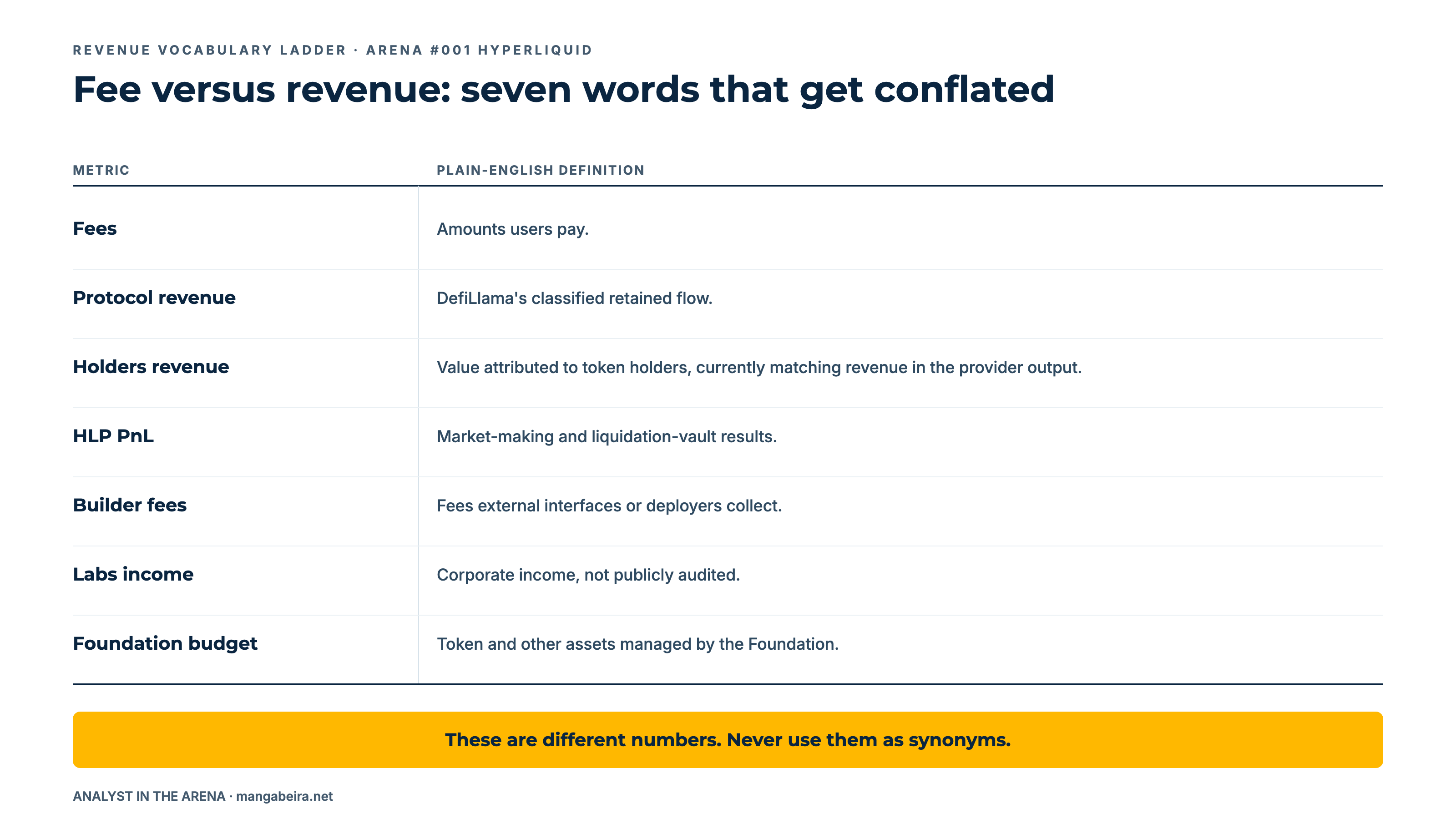
Those categories need clean boundaries and I'm going to hold them apart through this whole piece. Fees are what users pay. Provider-classified revenue is DefiLlama's modeled destination for some of that fee flow. HLP's profit and loss belongs to the vault. HYPE burned through the Assistance Fund is a token flow, not a cash flow. Hyperliquid Labs' actual corporate revenue is private unless Labs discloses it, and nothing here proves what that number is.
Five Things the Data Reveals
1. The moat is operational density, not one feature. Hyperliquid put execution, liquidity, market creation, distribution, and token value on a single economic rail. Traders create fees. The Assistance Fund converts a share of those fees to HYPE and burns it. HLP and market makers support liquidity. Referrers bring users. Builder codes let outside interfaces earn from routed order flow. HIP-3 lets outside teams launch entire markets and keep a fee share. A competitor can copy any one piece. It's harder to copy a network where all the pieces reinforce each other.

2. The tiny-team story is true, dated, and incomplete. Yan described Labs' operating boundary directly: it keeps protocol core in-house while outside teams build interfaces, stablecoins, tokenization products, and markets. Hyperliquid Labs says it took no outside capital. Those are strong first-party disclosures, not audited statements about today's headcount or finances. The work that "11 people" implies didn't disappear. It moved outside the company's legal boundary and into roles that validators, builders, and deployers now fill and get paid for.
3. Growth ran on a subsidy that later became a wage. Hyperliquid's points program started in November 2023 and rewarded activity ahead of a token. The November 2024 genesis distribution allocated 31% of HYPE supply, about 310 million tokens, to roughly 94,000 eligible wallets, which aren't the same as retained people. What replaced that one-time airdrop is more durable: referral fee shares, builder-code fees, and HIP-3 deployer fees, all paid from real trading activity instead of a promise.
4. Speed and discretion share one design choice. Official docs describe roughly 200,000 orders per second, a 0.2-second median latency, and a 0.9-second p99 latency for co-located clients. These are first-party claims, not an independent benchmark. That same compact architecture also concentrates control. Automatic validator slashing isn't implemented. During the March 2025 JELLYJELLY event, validators delisted a market and settled it by hand, protecting users while showing that emergency power sits with a small group.
5. The next growth engine looks like infrastructure, not a destination. Builder codes let wallets, terminals, and agents route Hyperliquid execution without becoming an exchange. HIP-3 lets outside teams deploy markets. HIP-4, live as of this research, extends the same logic to fully collateralized outcome markets settling on oracle data with no liquidation risk. Early unofficial usage on the first HIP-4 market cooled within weeks, which is worth watching rather than ignoring.
Key insight
Hyperliquid didn't reduce headcount by doing less work. It turned necessary exchange functions into economic roles that outsiders compete to fill. The protocol coordinates a larger organization than the Labs payroll shows.
The Growth Engine, Reverse-Engineered
The pattern breaks into four phases, and each one hands off to the next.
Phase 1: earn trust through the product. Hyperliquid removed the usual DeFi friction: slow confirmations, split liquidity, clumsy wallets. It feels like a centralized exchange while keeping trading state onchain. Better execution attracts traders, more trader flow attracts liquidity providers, and deeper liquidity supports bigger positions and more fees.
Phase 2: turn usage into ownership. The points program made future ownership visible before HYPE existed. The genesis event then converted a slice of past activity into tokens. A 31% public allocation is large enough to make the "we're the users" story credible, even though wallet count alone can't prove retention.
Phase 3: pay outsiders from real activity. This is the durable loop. Referrers earn a share of the trading fees they bring in. Builder-code interfaces monetize routed orders. HIP-3 deployers earn from the markets they launch. Stakers get fee discounts. The Assistance Fund keeps converting fees to HYPE and burning them, under current documentation. Distribution becomes a variable cost tied to activity, not a fixed marketing budget.
Phase 4: let other products hide the venue. A trading agent, a mobile wallet, or a regional broker can route execution through Hyperliquid while owning the customer relationship itself. Hyperliquid still earns the underlying flow. Destination dominance built the brand; embedded execution could build the bigger business.
The Business Model: Fees Are Not Revenue
I see one mistake repeated across most Hyperliquid coverage: fees and revenue get used as if they're the same number. They aren't.
Fees are what a user pays on a trade. DefiLlama's revenue API classifies a modeled slice of those fees as "protocol revenue," a provider definition, not an audited accounting figure. HLP's returns are a separate vault mechanism, and Hyperliquid Labs' actual corporate revenue has never been disclosed.
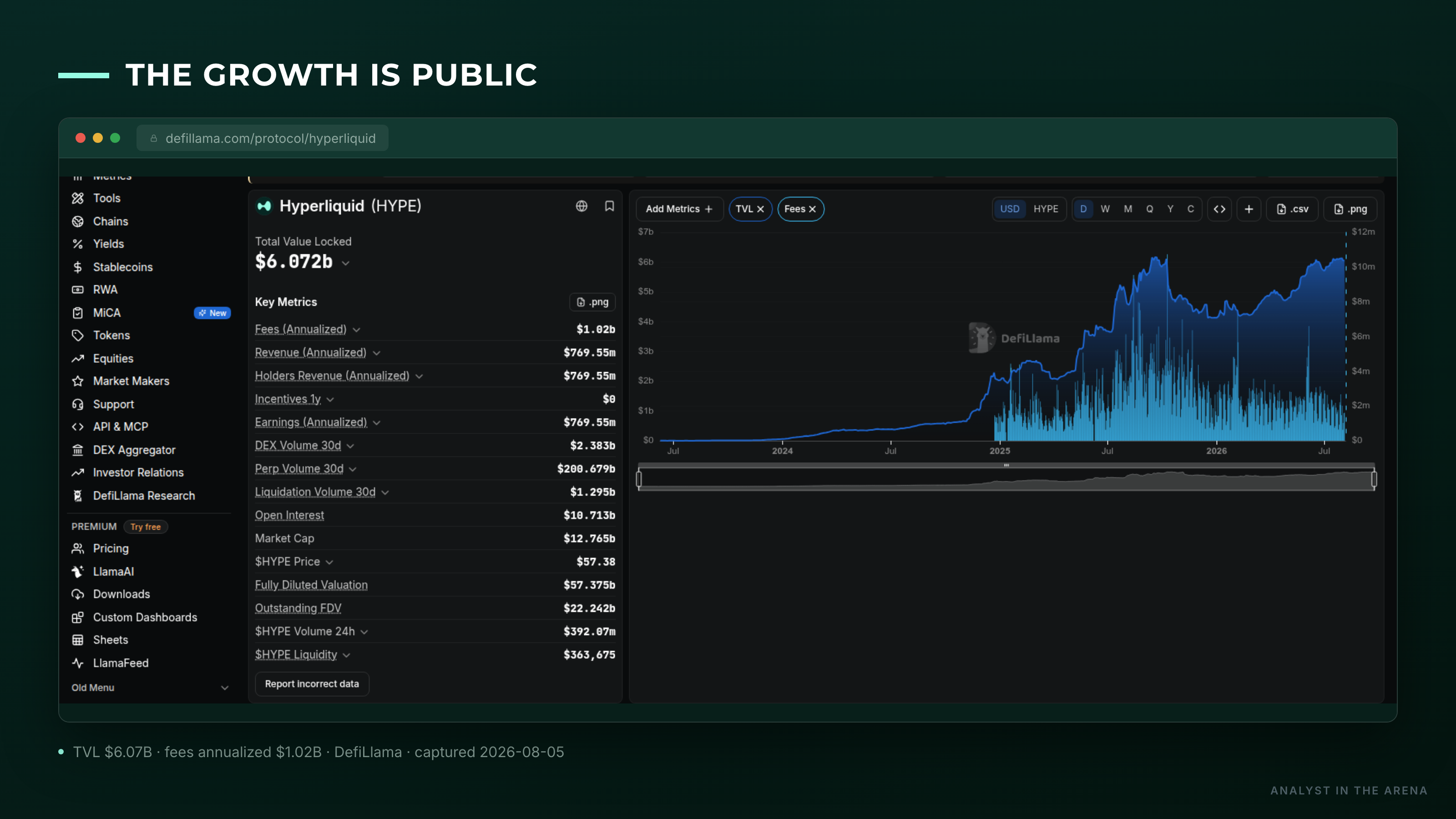
Over the trailing year, DefiLlama's fees API shows $1.022 billion in fees and its revenue API shows $770.96 million in protocol revenue. Both are provider estimates, neither an audited Labs financial statement. Divide either figure by "11 people" and you get a headline-friendly revenue-per-employee number. That math is weak. The denominator is a year-old team count, and the numerator ignores every validator, market maker, builder, and deployer doing paid work outside the payroll.
Where the Small-Core Model Creates Risk
The same tight architecture that gives Hyperliquid its speed also concentrates who gets to make emergency decisions.
Foundation delegation is discretionary, requires an application plus KYC or KYB, and Foundation validators weigh program participation when deciding which peers to trust. Automatic slashing for validator misconduct isn't implemented; jailing exists, but malicious behavior otherwise relies on manual or social-layer responses. Bridge deposits and withdrawals need signatures from more than two-thirds of stake.
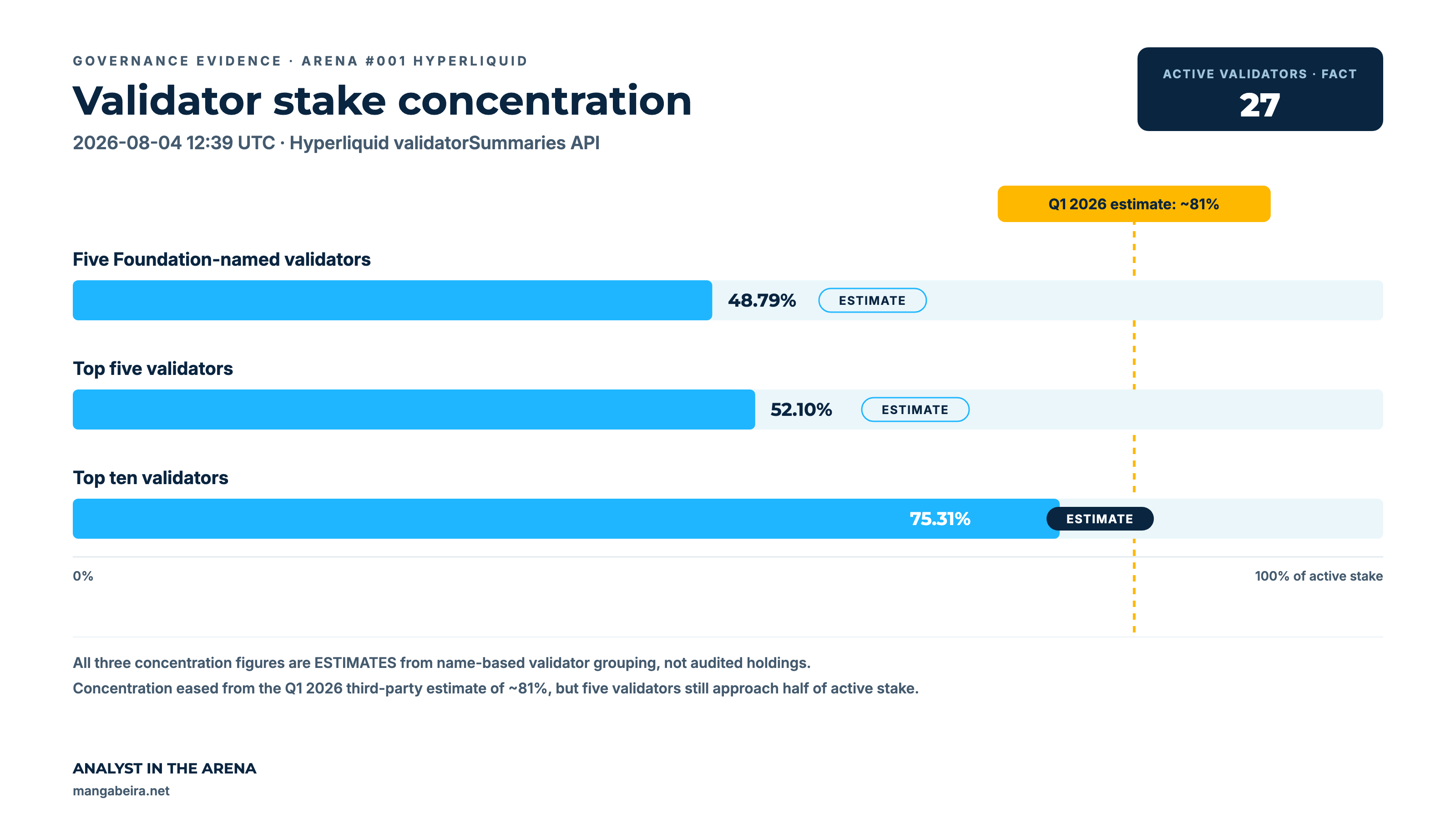
The live validator API showed 27 active validators at 12:39 UTC on August 4, 2026. The five named Foundation validators controlled 48.79% of active stake, and the top ten controlled 75.31%. That's a real improvement from a Q1 2026 third-party estimate that put five Foundation nodes near 81% of stake. It's still concentrated: five entities sit close to half the network.
This gap between the number and the conversation about it showed up in the wild. An April 2026 r/defi thread with 98 comments built its centralization argument on "16 validators, closed source." The live figure that week was 27. No one in the thread corrected it. When a protocol doesn't publish a canonical, dated trust page, stale numbers end up arguing its case for it.
Founder warning
Every function you move outside payroll creates a new dependency. Map who can fail, who can intervene, and which incentives stop working under stress before you copy the model.
The Next Growth Engine: Wholesale Execution
Hyperliquid started as a place traders go. Its newer mechanisms are built to make it infrastructure other products sit on top of.
HIP-3 lets outside teams deploy their own perpetual markets and keep a fee share, bringing their own audience with them. HIP-1 and HIP-2 extend the same native-token and native-liquidity logic underneath. HIP-4, the newest addition, extends it once more into outcome markets: fully collateralized, fixed-range contracts that settle on oracle data with no liquidation risk. The first mainnet market is a recurring daily BTC-price binary settling at 06:00 UTC.
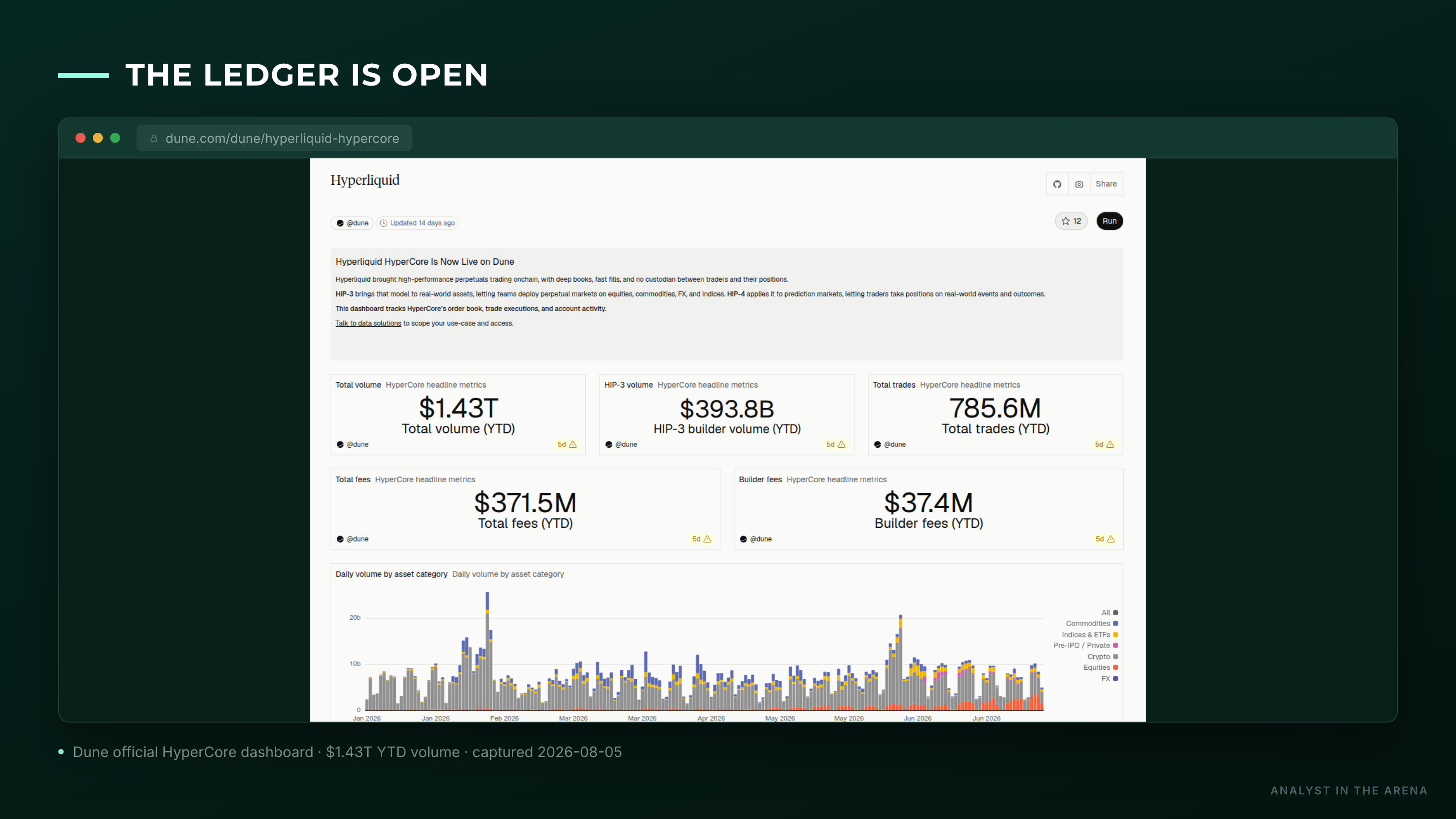
This is worth watching rather than assuming it's a straight win. Community-sourced Dune data on HIP-4's first market shows daily unique users peaking near 2,500 to 2,800 in mid-to-late June 2026. That figure fell to 600 to 1,500 by June 29, with roughly 12,756 cumulative unique users. It's an unofficial, unaudited dataset a month stale against this research's cutoff. Treat it as a signal that early enthusiasm cooled, not as a protocol fact.
What AI Search Gets Wrong About Hyperliquid
I sent an identical question about Hyperliquid's success, team size, and vulnerabilities to ChatGPT, Claude, Gemini, and Perplexity through OpenRouter on August 4, 2026. Only Perplexity had live search in that comparison, and the gaps in the other three were telling.
ChatGPT missed the 2024 HYPE genesis distribution entirely and said no major distribution had happened. Claude cited an unsupported team estimate of 20 to 30 people and mixed up an incident narrative. Gemini placed Hyperliquid on the Arbitrum Nitro stack, which is wrong: Hyperliquid runs its own purpose-built L1, and Arbitrum only appears in the bridge path. Perplexity was current and cited sources but blurred the fee-versus-revenue distinction this article keeps separate.
All four models recognized speed and community. None of them clearly explained builder codes as the actual small-team force multiplier, and none surfaced that automatic validator slashing isn't implemented. Hyperliquid owns the "fast, small, no VC" narrative in AI search. It doesn't yet own the more useful explanation of how the system actually works, so that gap gets filled by stale articles and model guesswork.
The Protocolized Organization Test
Here's the reusable framework, built from what Hyperliquid actually did rather than the slogan version of it.
Five questions before you copy the model
The goal is a smaller core surrounded by accountable economic roles, with every dependency visible instead of buried in a headcount slide.
For related frameworks, see the DeFi go-to-market checklist, the guide to DeFi growth, and the agency vs. in-house vs. consultant decision guide for drawing this same boundary around hiring.
Frequently Asked Questions
How many people work at Hyperliquid?
Jeff Yan said the core team had 11 people in an interview published August 17, 2025, split roughly evenly between engineering and non-engineering roles. No newer first-party headcount source exists in this research, so "11 people today" isn't supported. The dated figure also excludes validators, HLP participants, referrers, builders, and HIP-3 deployers, who perform paid work outside Labs' own payroll.
Does Hyperliquid run on Arbitrum?
No. Hyperliquid runs its own purpose-built L1, split into HyperCore and HyperEVM, using its own HyperBFT consensus. Arbitrum shows up in the bridge path and in some third-party TVL classifications, but it isn't where HyperCore's order book executes.
Can validators slash automatically?
No. Current staking documentation says automatic slashing for validator misconduct isn't implemented. Jailing exists as a mechanism, but responding to genuinely malicious behavior currently depends on a slashing decision or a social-layer response rather than an automatic protocol rule.
What is a HIP-3 builder market?
HIP-3 lets an outside team deploy its own perpetual market on Hyperliquid's infrastructure and, depending on configuration, keep a share of the fees that market generates. The deployer brings the market idea, the interface, and often an existing audience. Hyperliquid supplies execution, which turns market creation into a distribution channel a third party can run as its own business.
How does Hyperliquid actually make money?
Users pay trading fees across products. Those fees route to several places depending on configuration, including HLP, the Assistance Fund, and deployers, not to one central account. DefiLlama's "protocol revenue" figure is a provider classification of part of that flow, not audited Hyperliquid Labs corporate income, which has never been publicly disclosed.
Is Hyperliquid fully decentralized?
That single label hides several different questions. Order execution is represented onchain, but Foundation delegation, bridge signing, validator stake concentration, upgrade authority, and emergency intervention are each separate control surfaces with their own degree of concentration. Each one deserves its own answer rather than one yes-or-no claim.
What I'm Watching Next
The next real proof point is external distribution. Can builder codes and HIP-3 actually turn Hyperliquid into a wholesale execution layer sitting behind products that don't look like an exchange at all? The mechanism exists. The cohort-level volume, retention, and revenue data to prove it at scale doesn't exist publicly yet.
The second proof point is governance under more scale, not less. Every new market and every new outside product raises the cost of a concentrated failure or a discretionary intervention like the one seen during JELLYJELLY.
If your protocol's product, token, liquidity, and distribution layers aren't reinforcing each other the way Hyperliquid's do, the Web3 Growth Audit maps the gaps. It covers all six dimensions: website, dApp, social, community, SEO, and PR.
Ready to diagnose your protocol's growth gaps?
A structured Web3 Growth Audit across 6 dimensions: website, dApp, social, community, SEO, and PR. Delivered in 72 hours.
Run the Growth Audit →Related Articles
The Web3 Founder's Guide to DeFi Growth
Where Hyperliquid's protocolized-organization pattern fits inside the broader 3-engine growth framework.
Read the Main Guide →DeFi Go-to-Market Checklist
The survival-first launch framework this analysis's Protocolized Organization Test extends.
Get the Checklist →DeFi Agency vs In-House vs Consultant
The same in-house-vs-outside boundary question, applied to hiring instead of protocol design.
Read the Decision Guide →From Vanity to Viability: The DeFi KPI Stack
The measurement discipline this piece's fees-vs-revenue distinction depends on.
Read the KPI Stack →