
Uniswap growth audit: the verdict and scope
My public-evidence audit finds a strong record for product design and governance, but not enough public evidence to prove acquisition source, user retention, or marketing return. I score what an outside analyst can verify, not whether Uniswap is a good protocol or whether its growth strategy worked.
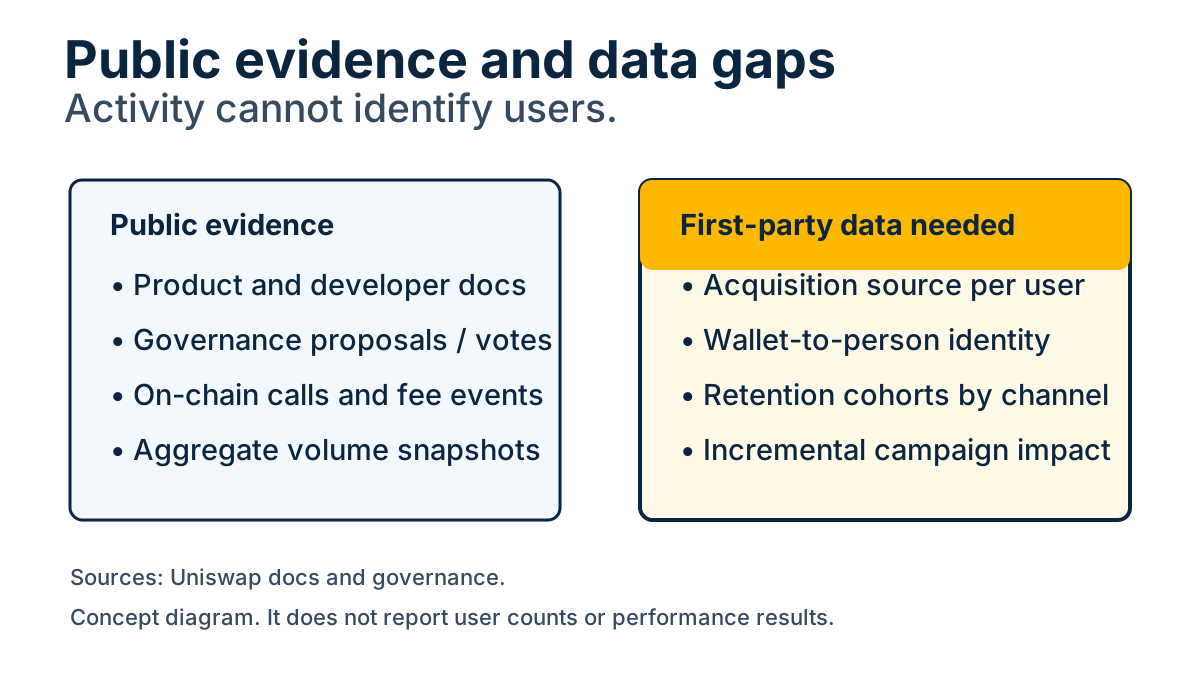
That distinction matters because public blockchains reveal transactions, not the person, campaign, or reason behind each transaction. A wallet can interact with a pool. That event does not tell me whether the user came from a campaign, returned because of a product feature, or would have traded anyway. The audit therefore separates documented product facts, governance proposals, and user-level growth outcomes.
I reviewed current Uniswap developer documentation, the official governance forum, and the public UNIfication proposal. I also use public protocol records as a discovery layer where relevant. The source set supports an evidence map, not a complete growth attribution study. My broader DeFi growth KPI framework explains how to keep outcome definitions separate from activity measures.
What Uniswap does and who its products serve
Uniswap Protocol is an on-chain system for swapping tokens through liquidity pools. The developer documentation covers swaps, liquidity, pool creation, and versions of the protocol. Uniswap Labs also documents products and services around that protocol, including the web app, Wallet, API, and Unichain. These surfaces serve different jobs. A protocol integration, an app session, a wallet action, and a chain transaction should not be merged into one “user” metric.
The official documentation is useful for defining what the product lets a developer or user do. It does not provide a complete marketing funnel. A developer guide can show how an integration works. A governance post can show a proposal. Neither one reports the source of a new user or the rate at which that user comes back.
Governance is another measurable surface. UNI holders can debate and vote on protocol changes through defined governance processes. A proposal is a record of a request or design. A passed vote is a record of a governance decision. An implemented contract change is a separate technical fact. This sequence matters in the audit below because public announcements can describe a plan before the plan is live.
Growth scorecard: public evidence versus unknowns
I use a three-point evidence scale. A score of 2 means a current primary source clearly documents the item. A score of 1 means a source documents a proposal or partial fact, while implementation or measurement remains unverified. A score of 0 means the public sources reviewed do not establish the outcome. The total is an observability score out of 12, not a grade for Uniswap’s growth or product quality.
| Criterion | Score | What the record supports |
|---|---|---|
| Product documentation | 2 / 2 | Official developer docs describe product surfaces and integration concepts. |
| Governance process | 2 / 2 | The forum publishes proposals and discussion records. |
| Fee policy implementation | 1 / 2 | The UNIfication proposal describes a proposed fee route. Current implementation is not established by that proposal alone. |
| Acquisition attribution | 0 / 2 | Public protocol transactions do not identify campaign source. |
| Retention cohorts | 0 / 2 | The reviewed sources do not connect first use to repeat use by acquisition cohort. |
| Campaign return | 0 / 2 | The reviewed sources do not combine campaign cost, attributed outcomes, and a causal comparison. |
The 5 out of 12 total reflects the reviewed public evidence set only. It does not mean five out of twelve growth goals are achieved. The score can change when a new primary source or a properly defined first-party dataset becomes available. I would publish the rubric beside any updated score to prevent readers from mistaking evidence access for performance.
Three evidence gaps that limit growth claims
First, acquisition source is not on-chain. A swap or liquidity position can be observed at an address. The address does not tell me whether the user arrived through search, a partner, an incentive, an aggregator, or direct product discovery. Campaign parameters, referral events, and privacy-safe identity rules have to be captured before the wallet event if the team wants a credible source connection.
Second, repeat use needs a cohort definition. A returning address is not automatically a returning person. A user may split activity across wallets, use a smart account, or interact through a router. The team needs a consistent definition of first use, repeat use, observation window, and eligible product surface. Public transactions alone do not supply those rules.
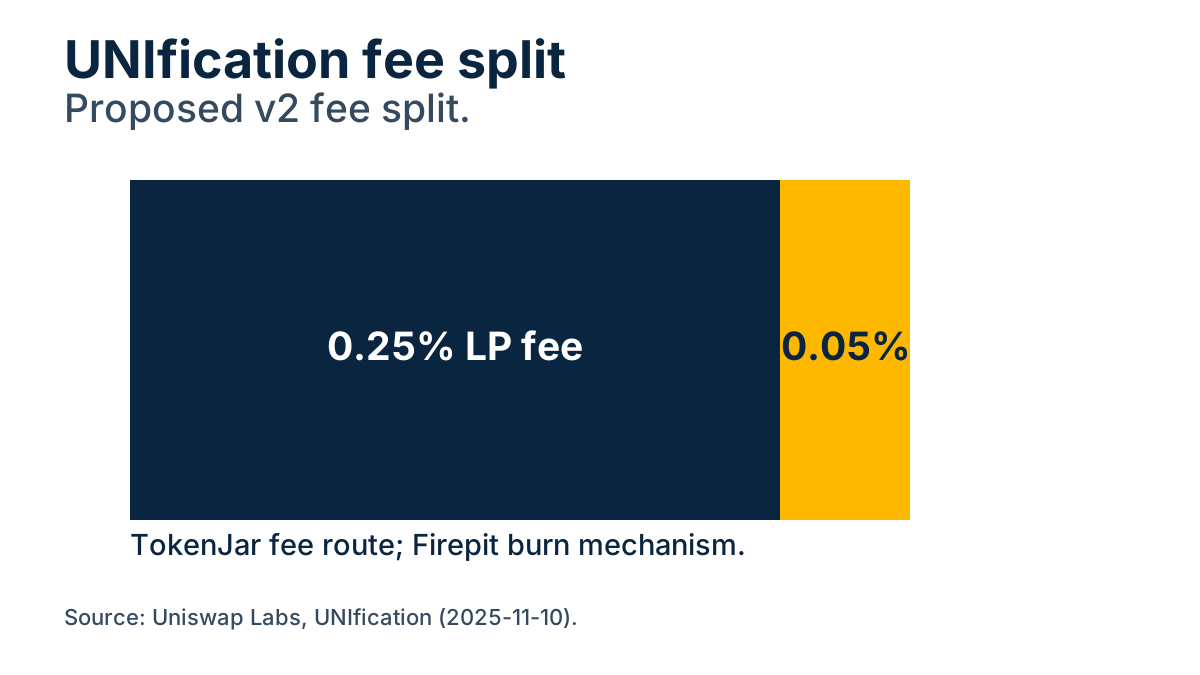
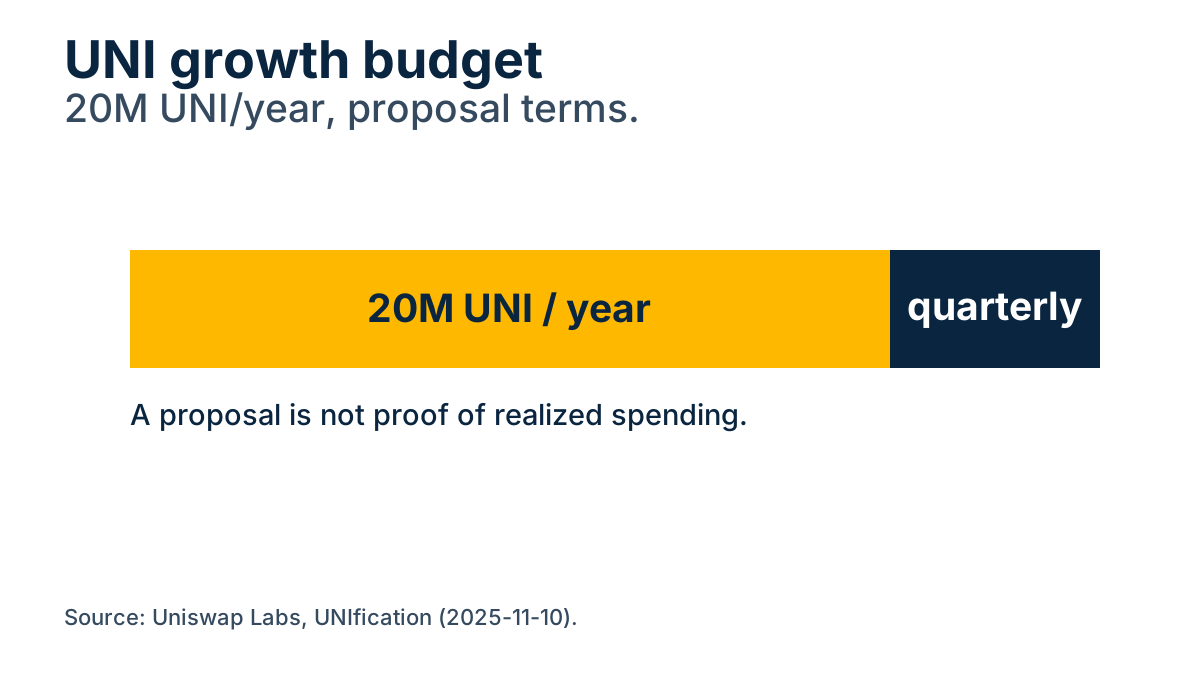
Third, a governance proposal does not establish realized growth spend. The November 10, 2025 UNIfication proposal describes a 20 million UNI annual growth budget, distributed quarterly starting in January 2026. It also describes a proposed protocol-fee mechanism. Those figures are valuable governance evidence. The proposal by itself does not show how much was ultimately allocated, spent, or caused incremental adoption. The charts below preserve that distinction.
What I would verify over the next 30 days
In week one, I would confirm the current state of each public product surface and record its canonical documentation, supported chains, and the events the team can instrument. I would define a qualified first use for each product. A wallet connection, a completed swap, a liquidity deposit, a developer API call, and a chain deployment are different events. The growth team should not combine them without a stated rationale.
In week two, I would connect acquisition records to product events using campaign parameters, referral identifiers, and a privacy-reviewed pseudonymous key. For on-chain products, the team can ask users to link a wallet or use a consented authentication flow. The method needs to account for shared devices, multiple wallets, smart accounts, and aggregator flows. If the team cannot connect a person to a wallet responsibly, report wallet-level activity and call it that.
Before that test, I would write a short measurement contract for the team. It would define which product version counts, which chains are included, how reverted or bot-like transactions are handled, how address clustering is treated, and how missing campaign tags are reported. I would keep the raw event table separate from any derived metric so another analyst can reproduce the transformation. For governance spend, I would capture the proposal identifier, the vote result, the authorized amount, the transfer or invoice evidence, and the reporting period. A budget approved by governance is not the same as cash spent, and spend is not the same as incremental users.
I would also add an explicit evidence date to every public chart. A protocol dashboard can be updated after a page is written. A proposal can be amended. A contract can change while a documentation page remains online. The audit should therefore preserve the retrieval date, the underlying URL, the calculation, and the exact wording of the claim. If the source does not answer a question, label the field “not established by the reviewed public record” instead of assigning a proxy.
In week three, I would build a cohort view with a fixed starting event and repeated-use window. Compare channel cohorts only when the same event definition and observation period apply. Label missing data. Do not fill the gap with public transaction volume. In week four, I would compare one campaign or product change against a baseline or holdout when practical. Track cost, qualified first use, repeat use, and any guardrail such as failed transactions or support issues.
The useful next step is not a bigger dashboard. It is a better link between a defined exposure and a defined product outcome. I would keep public protocol data as a context layer and first-party event data as the source for acquisition and retention. The DeFi growth guide covers the operating framework around those measurements.
FAQ
What does a Uniswap growth audit measure?
This audit measures how much public evidence an outside analyst can verify across product, governance, acquisition, retention, and campaign measurement. It does not grade Uniswap’s product quality or estimate campaign return.
Can public on-chain data prove user retention?
It can show repeat transactions from an address under a defined query. It cannot by itself confirm that the same person returned, why they returned, or which campaign acquired them.
What does Uniswap governance data show?
Governance records can show proposals, discussion, and votes. The implementation state requires separate verification in deployed contracts or official technical documentation.
Which Uniswap growth metrics should a team verify?
Define a qualified first product action, a repeat-use window, and the cohort source. Keep those separate from transaction volume, liquidity, or proposal budgets, which describe different things.
Need to separate growth signals from outcomes?
I use a structured audit to connect product evidence with acquisition, retention, and measurement gaps.
Review the Web3 Growth AuditReferences
- Uniswap Developers documentation.
- Uniswap Governance forum.
- Uniswap Labs, “UNIfication,” November 10, 2025.
- Dune documentation, query reproducibility and data model context.
- About Uniswap Labs, product and organization overview.