
Curve, Uniswap and Aave use different token mechanisms to influence protocol operations. Curve routes CRV emissions through governance-weighted gauges. Uniswap documents a fee-funded UNI burn on enabled deployments. Aave describes a DAO buyback that sends acquired AAVE to its Ecosystem Reserve.
If you run growth, the useful question is what behavior each mechanism can support. I compare control, trigger, recipient and limitation. The comparison does not rank tokens or claim that any mechanism caused user growth.
Protocol mechanism findings
What the comparison measures
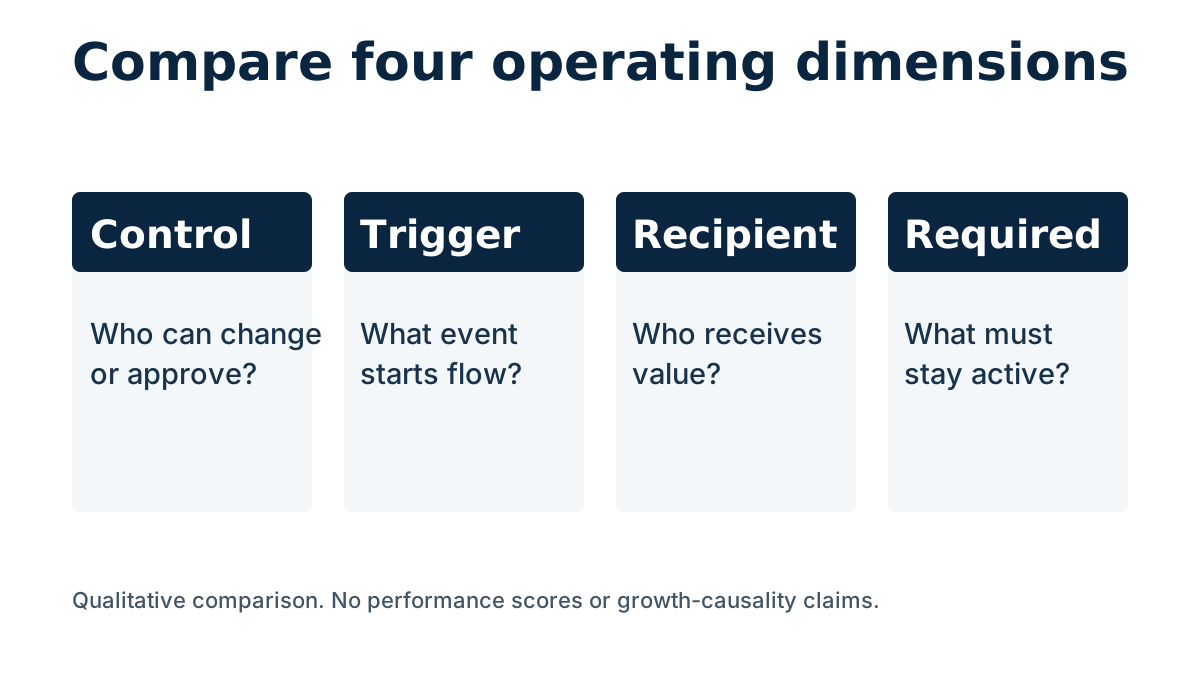
Tokenomics is not one mechanism. It is a set of rules about authority, incentives, supply and use. A useful comparison starts by asking who can change the rule, what event activates it, who receives the value, and what has to remain true for the route to work.
tokenomics design principles for founders
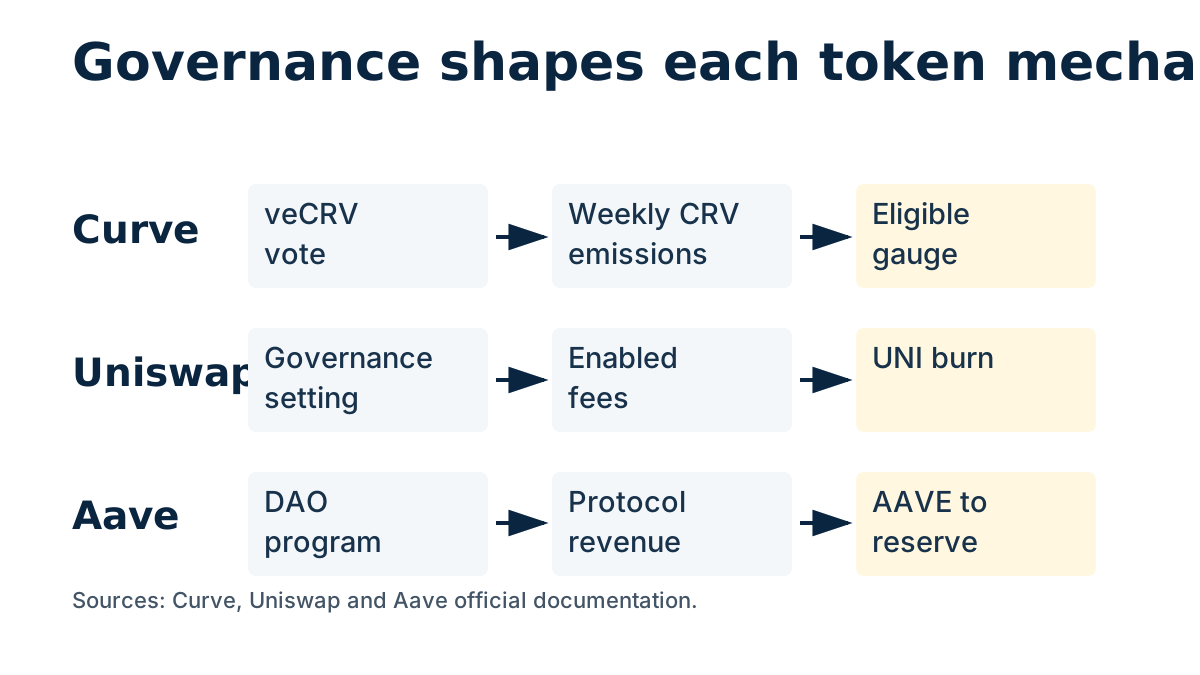
I use those same dimensions for all three protocols. I do not compare token prices, emission rates or budgets because those values vary by deployment and time. A mechanism description also does not establish whether a protocol is growing. That requires product and user evidence outside the token flow.
Curve uses votes to direct emissions
Curve documents a voting-escrow model. veCRV holders vote on DAO-whitelisted gauges, and each gauge receives a share of weekly CRV inflation according to its share of gauge-weight votes. A gauge with no votes gets no CRV. The protocol updates weights on a weekly cycle, while votes have a change delay. These rules give operators a route to direct liquidity incentives, but only through eligible gauges and governance-defined controls. Curve’s official emissions documentation.
The distinction between eligibility and allocation matters. A pool can exist without being eligible for CRV emissions. The DAO must first add its gauge. Then veCRV voters choose the relative weight. An operator may also pay for votes or add an external reward, but those are separate mechanisms with separate funding and dependencies. Curve documentation describes them as routes to liquidity incentives, not proof that an incentive produces durable users. Curve’s official emissions documentation.
For a growth team, Curve fits a goal that depends on directing emissions toward selected liquidity venues. The trade-off is that access depends on governance, voter participation, the value of rewards, and the continued usefulness of the pool. If the product needs repeat borrowing, payments or another action, measure that action separately from liquidity deposited. Curve’s official emissions documentation.


Uniswap links enabled fees to a burn route
Uniswap describes UNI as a governance token. Its documentation also says that protocol fees collected across products have been used to burn UNI since December 2025. The fee documentation says protocol fees are active on all v2 pools and selected v3 pools, while v4 fee-adapter flows can be enabled through governance. The active surface is therefore a deployment and governance question, not a universal property of every pool. See UNI documentation and protocol fee documentation.
The documented route is indirect. Protocol fees accrue to on-chain collectors. Independent participants can claim those assets by burning a required amount of UNI. The documentation explicitly says UNI holders do not hold a personal or pro-rata claim on protocol revenue. A burn mechanism changes supply through an enabled process. It does not distribute cash to every holder or establish a causal link to user acquisition. See UNI documentation and protocol fee documentation.
For an operator, this model is relevant when governance has enabled fee collection on the target deployment and the team needs to understand the protocol-level value flow. Before making a plan, check the product version, chain, pool, fee setting and current governance decisions. Do not describe the mechanism as revenue sharing unless the source establishes that right. See UNI documentation and protocol fee documentation.
Aave uses DAO revenue for buybacks
Aave documentation describes AAVE as a governance token and states that the DAO operates a buyback program funded by protocol revenue. Acquired tokens go to the Aave DAO Ecosystem Reserve. The documentation says the reserve supports governance-approved programs such as staking rewards, grants and service-provider payments. The buyback is a treasury and governance process, not an automatic payment to token holders. See Aave’s current AAVE documentation.
The decision surface is different from Curve gauge voting. Curve voters influence a relative allocation of emissions across approved gauges. Aave’s DAO and its delegated execution process set and carry out a program that acquires AAVE. Uniswap’s documentation describes a route that converts collected protocol fees into UNI burns on enabled deployments. All three involve governance, but the mechanism, recipient and accounting differ. See Aave’s current AAVE documentation.
Aave’s current documentation provides program details, while governance discussions can propose adjustments to budgets and funding sources. I treat those as different evidence states. A proposal is not an approved or completed change. For an operating decision, check the latest approved governance record and execution evidence rather than copying a number from an older summary. See Aave’s current AAVE documentation.
Compare the mechanisms on the same dimensions
The table summarizes what the official documentation supports. “Growth use” means an operating objective the mechanism may support. It does not mean the protocol has demonstrated growth because of that mechanism. The source and date for each row are linked in the table.
| Protocol | Control surface | Trigger and flow | Recipient or outcome | Key dependency |
|---|---|---|---|---|
| Curve | veCRV voters; DAO whitelists gauges | Weekly CRV inflation follows gauge-weight votes | Liquidity providers at eligible gauges | Gauge approval, voter allocation and current weights |
| Uniswap | Governance sets protocol-fee parameters | Enabled protocol fees fund a process that burns UNI | UNI supply is reduced by burn | Chain, product version, pool and active setting |
| Aave | DAO governance and program execution | Protocol revenue funds AAVE purchases | Tokens go to DAO Ecosystem Reserve | Current approved program and treasury decisions |
Pattern Recognition
Choose by operating objective
If the constraint is liquidity allocation, Curve offers the clearest fit among these examples. Its gauge system gives voters a direct way to allocate CRV emissions among eligible pools. The operator still needs to measure the behavior that matters after liquidity arrives. A deposit, pool balance or vote count is not the same thing as product retention.
Across the three sources, governance is a control surface, not evidence of a growth result. Eligibility, activation and the recipient differ. Those differences matter more to an operator than a token-price comparison.
If the objective is to understand how protocol fees interact with token supply, Uniswap’s documented burn route is the relevant comparison. First confirm the deployment is enabled. Then distinguish collected protocol fees, the claim process and UNI burned. These are separate steps. Do not convert the mechanism into a claim that UNI holders receive protocol revenue.
If the DAO wants to use protocol revenue to acquire tokens for a reserve, Aave documents that route. The growth question is what approved program uses the reserve and whether its outcome can be measured. Treasury acquisition is an input. A grant, staking reward or service payment is another input. Product use and retained users require their own event definitions and observation windows.
Growth Framework
What founders should verify before changing incentives
Write down the behavior you want before selecting a token mechanism. If the goal is liquidity, define the eligible pool and useful depth. If the goal is a transaction, define the qualifying action and the recipient. If the goal is repeat use, define the return event and time window before the campaign starts. This prevents an incentive metric from replacing the product outcome.
the DeFi tokenomics simulator guide
Next, map the governance path. Identify who can approve the change, what contract or deployment implements it, and how a user can verify that it is active. Record the source, timestamp and scope. For a live deployment, inspect the relevant governance proposal, contract configuration and current interface. Documentation explains intended behavior; a proposal explains a decision; on-chain state shows execution.
Finally, define the failure condition. An emission route may attract liquidity that leaves when rewards stop. A fee mechanism may not be enabled where you need it. A buyback reserve may be redirected by governance. Decide what you will pause, adjust or stop if the target action does not improve. Do not promise a growth result from token design alone.
Frequently Asked Questions
How does Curve direct CRV emissions?
DAO-approved gauges receive a share of weekly CRV inflation based on veCRV votes. A gauge with no weight receives no CRV, and the allocation depends on the live voting state.
Does UNI give holders a share of protocol revenue?
No. Uniswap documentation says holders have no individual or pro-rata claim on revenue. On enabled deployments, protocol fees can fund a process that burns UNI.
How does the Aave buyback work?
Aave documentation says the DAO uses protocol revenue to buy AAVE and sends acquired tokens to the Ecosystem Reserve. Governance-approved programs decide how that reserve is used.
Which token mechanism should a growth team choose?
Choose based on the operating behavior you need to support, the authority that controls it, and the cost or governance dependency. None of these mechanisms proves a growth outcome by itself.
References
- docs.curve.finance source documentation (checked 16 November 2026)
- docs.curve.finance source documentation (checked 16 November 2026)
- developers.uniswap.org source documentation (checked 16 November 2026)
- developers.uniswap.org source documentation (checked 16 November 2026)
- aave.com source documentation (checked 16 November 2026)
- governance.aave.com source documentation (checked 16 November 2026)
Closing
I would treat tokenomics as an operating system with governance dependencies, not as a shortcut to growth. The evidence tells you what a mechanism is designed to do. Your product data has to show whether it supports the behavior you care about.
Need a clearer growth measurement plan?