Most DeFi growth marketers report TVL to their leadership team. That's the wrong metric, and when TVL drops for reasons that have nothing to do with campaign performance, they'll be the ones explaining it.
Here's the problem. Protocol founders need a KPI stack that covers everything: TVL quality, wallet stickiness, retention cohorts, unit economics, and governance health. That's the full picture of whether the protocol is working. Growth marketers need a much narrower set of metrics: the ones they can actually drive with campaigns and defend in a weekly report.
These two sets overlap, but they're not the same. Confusing them creates accountability for things marketing doesn't control, and gaps where marketing has genuine influence but no measurement.
This article draws a clear line: metrics you own, metrics you reference, and how to build the weekly growth update that lets you report on the first category with confidence. It's marketing analytics for DeFi growth teams, not protocol analytics with a marketing label on it, and it's part of the Web3 Growth Marketer's Resource Cluster.
TL;DR
- • DeFi marketing teams report TVL but don't control it. That creates false accountability
- • Metrics you own: campaign-sourced wallet acquisition, post-campaign retention, on-chain CAC by channel
- • Metrics you reference: total TVL, DAW/MAW ratio, fees-to-incentives ratio, holder concentration
- • The weekly growth update covers 4 data points. Everything else is context, not accountability.
The Reporting Problem: What Marketing Owns vs. What It Touches
I've reviewed growth marketing setups at DeFi protocols at every stage from pre-TGE to Series B. The same mistake appears across almost all of them: growth marketers present protocol-wide metrics in weekly reports as if those metrics are marketing outcomes.
TVL went up this week. Wallets grew 18%. DAW/MAW improved to 22%. These numbers look like marketing wins. But TVL moved because a whale migrated from a competing protocol. Wallet growth included 200 Sybil accounts from a quest campaign. And DAW/MAW improved because the protocol changed its reward distribution schedule, which engineering shipped, not marketing.
When those same numbers go down next week for similar reasons outside marketing's control, the growth team is explaining a number they never actually drove. That's the reporting problem, and it starts with not drawing the line between what you own and what you just touch.
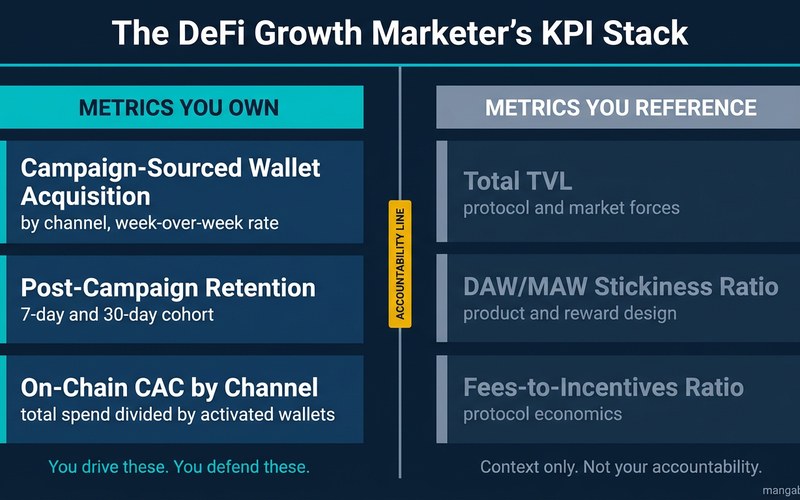
| Metric | Who Controls It | Marketing's Role |
|---|---|---|
| Total TVL | Protocol + market forces | Reference only |
| DAW/MAW Stickiness | Product + reward design | Reference only |
| Fees-to-Incentives Ratio | Protocol economics + tokenomics | Reference only |
| Campaign-sourced wallet acquisition | Marketing | Own it |
| Post-campaign wallet retention | Marketing + Product | Own it (marketing sourced cohort) |
| On-chain CAC by channel | Marketing | Own it |
Key Insight
The distinction between "own" and "reference" is about accountability, not credit. Marketing teams can contribute to TVL growth, DAW/MAW improvement, and protocol fees without claiming those metrics as their KPIs. Own what you drive directly. Reference what gives leadership context about the protocol's health.
Metrics You Own: The Growth Marketing KPI Stack
These three metrics are what a DeFi growth marketer can defend in a room. They're campaign-attributable, measurement-possible, and directly connected to decisions you make with your budget and channels.
1. Campaign-Sourced Wallet Acquisition Rate
Total new wallets that reached your activation threshold (first transaction, minimum deposit, or minimum volume) traced to a specific campaign or channel in a given week. This is the output you control: you ran a Galxe quest, you tracked which wallets came in during the quest window and completed an on-chain action, and you count those.
The "rate" part matters. Track it week-over-week rather than cumulative. Cumulative always goes up. A rate shows whether your campaigns are getting more or less efficient at producing activated users.
Important
Sybil wallets must be excluded before this number is reported. A Galxe quest running without Sybil filtering will show inflated wallet acquisition numbers that collapse when retention is measured 30 days later. Run the exclusion filter first, every time. Attribution setup determines how many wallets you can actually source to campaigns.
2. Post-Campaign Retention: 7-Day and 30-Day
Of the wallets sourced through your campaigns, what percentage completed at least one transaction after 7 days? After 30 days? This tells you whether your campaigns are bringing sticky users or tourists.
You're not measuring protocol-wide retention here. You're measuring the retention of the specific cohort your campaigns produced. That's an important distinction. Protocol retention can be strong while your campaign cohort churns, or vice versa. Both pieces of information matter, but only one is yours to own.
7-Day Campaign Cohort Target
Campaign-sourced wallets still active after 7 days. Aligns with top-10 protocol benchmark from published analytics research.
30-Day Campaign Cohort Target
The harder number to hit. A cohort retaining >15% at 30 days signals your channel is producing users with real intent, not just airdrop hunters.
3. On-Chain CAC by Channel
Total spend per channel (ad spend + quest incentives + referral payouts + any token allocation for the campaign) divided by wallets reaching your activation threshold. This is your unit economics statement as a growth marketer.
The formula: Total Channel Spend ÷ Activated Wallets Sourced from Channel = On-Chain CAC
Compare this across your active channels weekly. A Reddit campaign with $40 CAC that produces 30% 30-day retention beats a Galxe campaign with $12 CAC and 4% retention. The combined view (CAC + retention) is what tells you where to allocate next week's budget.
Best Practice
Always include token incentives in your CAC calculation, not just cash ad spend. Galxe quest rewards, points program token allocations, and airdrop eligibility that drives campaign participation are acquisition costs. Leave them out and your CAC is understated, which makes underperforming channels look viable longer than they are.
Metrics You Reference: Protocol Health Context
These metrics tell you whether the protocol is healthy. They don't belong in your weekly marketing report as claimed outcomes, but you need to understand them to know when your campaign results are inflated by external tailwinds or dragged down by protocol-level problems.
TVL and Capital Efficiency
Total TVL is a signal of overall protocol adoption, but it's not a marketing output. Raw TVL can be inflated by yield farming loops (the same capital counted multiple times through nested positions), by a single whale entering, or by short-term incentive spikes. The number that matters more is Volume/TVL: how much of the locked capital is actually being used.
Use TVL as context. If you launched a campaign and TVL jumped, you can note the correlation. But don't claim the TVL move as a campaign outcome unless you can show the wallet-to-TVL attribution chain.
DAW/MAW Stickiness Ratio
The DAW/MAW ratio (Daily Active Wallets divided by Monthly Active Wallets) tells you how often monthly users return on a daily basis. Between 20-35% signals healthy engagement. Below 5% suggests users only appear to claim rewards.
Marketing influences this indirectly by acquiring users who have genuine intent. But the DAW/MAW ratio is driven more by product design, reward distribution schedules, and UI/UX than by campaign work. Reference it as a health indicator. Don't put it in your marketing accountability stack.
Fees-to-Incentives Ratio
A fees-to-incentives ratio above 1.0 means the protocol collects more in fees than it pays in incentives. That's the sustainability threshold. Below 1.0, growth is subsidized.
Growth marketers should watch this number because it determines how long the growth strategy can run. If the ratio is below 1.0 and declining, the emission schedule that's funding your quest campaigns is burning down. You need to know that before leadership does.
How to Use Protocol Metrics in Reporting
Reference these metrics in your weekly update with a single sentence of context: "Protocol DAW/MAW is at 18%, below the 20% threshold, which suggests product-level friction is affecting retention for all cohorts, including campaign-sourced ones." That's useful context. It's not a marketing claim.
Which KPIs to Prioritize at Each Protocol Growth Stage
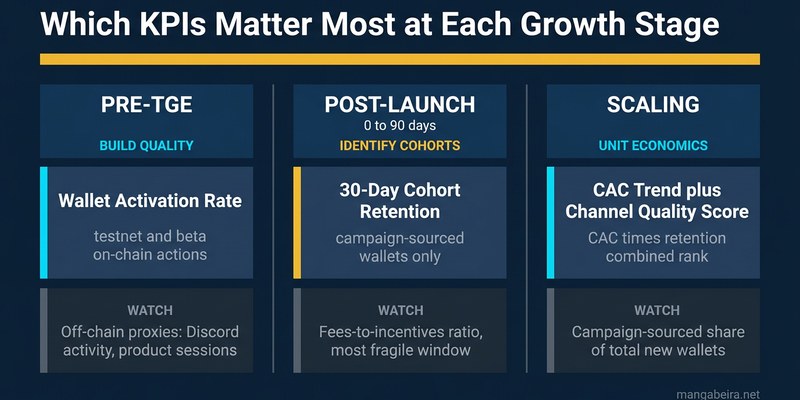
The three metrics you own don't change across stages. What changes is which one deserves the most attention, what benchmarks apply, and where the protocol-level context puts the most pressure on your budget.
| Stage | Primary KPI Focus | Protocol Context to Watch |
|---|---|---|
| Pre-TGE | Wallet activation rate (testnet or beta) | Off-chain proxies: Discord activity, product engagement |
| Post-Launch (0–90 days) | 30-day campaign cohort retention | Fees-to-incentives ratio (most fragile in this window) |
| Scaling | On-chain CAC trend + channel quality score | Campaign-sourced share of total new wallets |
Pre-TGE: Build for Quality, Not Size
No token is live yet, so emissions-based acquisition doesn't apply. The wallet base you build in this window will be your day-one distribution audience and your airdrop cohort. Airdrop farmers identify protocols 3–6 months before TGE — they'll be in your pre-launch community regardless of what you do. Your job is making sure qualified users outnumber them by launch day.
KPIs that matter: waitlist-to-wallet conversion rate, testnet or beta activation rate (wallets that completed at least one on-chain action), and the ratio of community members who progress to on-chain participation. You can't measure on-chain retention yet, so Discord activity and product engagement sessions are your proxies for intent.
Post-Launch (First 90 Days): Identify Your Real Cohorts Fast
This is the highest-pressure window. Most protocol user bases shrink 60–80% within 30 days of TGE. Marketing teams that treat raw wallet numbers as their KPI here are setting themselves up to explain a number that was never theirs to defend.
The metric that earns credibility in this period is 30-day campaign cohort retention. It tells you which channels brought users who stuck around after the airdrop or quest campaign closed. That's the only reliable signal separating real users from farmers, and it's the data you need to shift budget before the emission schedule runs thin.
On-chain CAC will be elevated in this window. Don't optimize for low CAC yet. Optimize for identifying which high-CAC channels also produce high retention, then shift budget there before leadership notices the fees-to-incentives ratio.
Scaling: Shift from Volume to Unit Economics
Once emissions normalize, acquisition volume stops being the primary signal. The question becomes whether your channels can produce wallets without heavy token payouts — and whether CAC is declining as brand compounds.
The most useful metric at this stage is a channel quality score: combine on-chain CAC and 30-day retention into a single rank across your active channels. The channel with the best score gets next week's budget increase. The channel at the bottom gets a retool or a cut. This is what efficient DeFi growth looks like once the protocol is past the launch window and fees-to-incentives is approaching 1.0.
Building the Weekly Growth Update Leadership Actually Reads
The goal of the weekly growth update is to answer four questions in two minutes or less. If leadership has to dig through a deck to find the number, the report isn't working. Here's the format that works:
Weekly Growth Update Format
Number of activated wallets attributable to campaigns. Channel breakdown in parentheses. Week-over-week change. Example: "147 activated wallets (Reddit: 61, Galxe: 52, Twitter: 34). Up 12% from last week."
Retention rate for wallets acquired through campaigns 30 days ago. Example: "19% 30-day retention on the June 1 campaign cohort (n=210 wallets). Above the 15% target."
Cost per activated wallet for your top 2-3 channels this week. Example: "CAC: Reddit $38, Galxe $24, Twitter $61. Galxe lowest CAC but Reddit 3x retention rate."
Only include if something notable happened that explains a result or sets up a risk. Example: "TVL down 8% from whale exit. Not related to campaign activity, wallet acquisition rate held steady."
That's it. Four lines. Leadership can scan it in 90 seconds. If they want to go deeper on any number, the Dune dashboard is the next click.
The discipline is keeping the protocol-wide metrics off the main report. Put them in a context section at the bottom if you need to include them. Don't let them crowd the three numbers you actually own.
What DeFi Marketing Teams Should Stop Tracking as Outcomes
Some metrics show up in growth marketing reports because they're easy to pull from DefiLlama or Dune, not because marketing drives them. Stop tracking these as outcomes and start tracking them as context.
| Stop Reporting As | Report Instead | Why the Swap |
|---|---|---|
| Total TVL growth | Campaign-sourced wallet acquisition | TVL moves on whale activity, token price, and market conditions. You can't defend it. |
| Cumulative new wallets | Week-over-week activated wallet rate | Cumulative always goes up and hides whether growth is accelerating or decelerating. |
| Discord members or Twitter followers | Campaign-to-wallet conversion rate | Social counts don't connect to on-chain behavior. They're vanity metrics in a DeFi context. |
| Protocol-wide DAW/MAW | Campaign cohort 30-day retention | Protocol stickiness is driven by product and reward design. You own the retention of wallets you acquired. |
| Raw APY or emission rate | Campaign incentive spend as % of CAC | APY is a tokenomics output. What you own is whether those incentives are efficiently converting to activated wallets. |
FAQs: DeFi Marketing Team KPIs
What metrics does a DeFi marketing team actually own?
Three metrics belong to growth marketing. Campaign-sourced wallet acquisition rate by channel: the number of wallets that reached your activation threshold traceable to specific campaigns. Post-campaign retention at 7 and 30 days for those campaign-sourced wallets. On-chain CAC by channel: total spend including token incentives divided by activated wallets. Protocol-wide metrics like TVL, DAW/MAW, and fees-to-incentives ratio are referenced for context but not claimed as marketing outcomes.
What is a healthy DAW/MAW ratio for DeFi protocols?
A DAW/MAW ratio between 20-35% signals healthy daily engagement where users return frequently without churning. Below 5% typically means users only show up to claim rewards and leave. Marketing teams reference this metric but don't control it directly. Product decisions like reward distribution schedules, UI friction, and transaction cost on the protocol drive the ratio more than campaign work does.
What should a DeFi marketing team include in their weekly report to leadership?
Four data points: campaign-sourced wallet acquisition for the week broken out by channel, 30-day retention rate for wallets acquired through campaigns 30 days prior, on-chain CAC by channel compared to the prior week, and a single context note if something protocol-wide moved significantly. That's what marketing owns and can explain. Protocol-wide metrics belong in a context section, not the main accountability table.
Why is TVL a misleading metric for DeFi marketing teams?
TVL is influenced by incentive schedules, token price movements, whale entry and exit events, and protocol-wide decisions that marketing doesn't control. TVL can be double-counted through yield farming loops where the same capital is counted multiple times across nested positions. Marketing campaigns can attract wallets that contribute to TVL, but TVL itself moves on factors outside the growth team's scope. Claiming TVL as a marketing outcome creates accountability for a number you can't reliably drive or defend.
How do I present DeFi marketing results without overclaiming what I control?
Lead with what you drove directly: campaign-sourced wallets, their retention rate, and their CAC. Then provide protocol-wide context where your work is clearly a contributing factor. The distinction protects your credibility in both directions. When TVL goes down for reasons outside marketing's control, you don't want to have been claiming TVL credit the week before. Own what you own. Reference everything else.
What Comes Next
The accountability layer matters more than it used to. As DeFi protocols tighten growth budgets and ask marketing to show ROI on every dollar, the teams that survive the next cut will be the ones who can point to three numbers they actually control: wallet acquisition rate, campaign cohort retention, and on-chain CAC by channel.
Build attribution first. Without it, these three metrics are estimates. With it, they're evidence. The attribution framework is covered in detail here.
Want to See What Your Protocol's KPI Stack Should Actually Look Like?
The Web3 Growth Audit includes a metrics architecture review: which numbers to own, which to reference, and how to restructure your weekly reporting to match what you can actually defend.
Get the Web3 Growth Audit →Related Articles
How Growth Marketers Can Attribute ROI in DeFi Campaigns
Three attribution methods ranked by engineering lift, the one-sprint pitch, and four reports leadership wants to see on Monday.
Read the Article →The DeFi Growth Marketer's Playbook
Channel selection, campaign mechanics, and the distribution frameworks DeFi growth teams actually use.
Read the Playbook →Sources and Citations
• Formo. "How to Improve User Retention in Web3." formo.so
• Andy Jagoe. "11 Metrics for DeFi Marketplaces." andyjagoe.com
• Nansen. "What is DeFi Analytics: Tools, Metrics, TVL Guide." nansen.ai
• r/CryptoCurrency. "TVL is a Nonsense Metric." reddit.com
• Token Terminal. Protocol analytics and standardized fee metrics. tokenterminal.com
• DefiLlama. TVL and protocol analytics. defillama.com