
Search "defi seo" right now. Every top result is the same agency pitch: Victoria Olsina, lengreo.com, naturallinks.net, embarque.io, garitboothe.com.
Five companies, one identical script: hire us to rank your protocol. None writes from inside a specific protocol's actual constraints.
You're staring at a rate page, a pair page, or a vault page that won't rank. Generic advice doesn't tell you which lever to pull.
This breaks down what actually works, by protocol type, with real technical fixes, not agency talking points. Screenshots from live protocol pages back every claim.
Lending, DEX, and yield first. Then the technical floor all three share, and the AI-citation layer that's rising fast. For the broader framework this builds on, see the complete guide to Web3 SEO and AEO.
Why generic "Web3 SEO" advice breaks down at the protocol-type level
Most Web3 SEO content stops at the category level: use schema markup, build backlinks, publish consistently. True, but useless for execution.
It doesn't tell a lending protocol's marketer whether to index individual rate pages. It doesn't tell a DEX whether its pair pages are an asset or a duplicate-content liability.
Lending, DEX, and yield protocols each generate a different kind of page at scale, and each kind of page has a different failure mode.
| Protocol type | Page generated at scale | Core SEO problem |
|---|---|---|
| Lending | Rate pages, one per asset | Real-time-data freshness and schema |
| DEX | Pair pages, one per trading pair | Duplicate content at scale |
| Yield / vault | Vault pages, one per strategy | Differentiation from near-identical competitors |
Key Insight
A DEX's pair pages are a programmatic-SEO problem. A lending protocol's rate pages are a real-time-data schema problem. A yield vault's page is a differentiation problem. Same category, three different jobs.
Treating all three the same way produces the same generic result. Pages exist but never rank, because the fix that would have worked was never applied.
Lending protocol SEO: rate pages, real-time data schema, comparison-query capture
Lending protocols like Aave and Compound Finance generate pages around a moving number: the current supply and borrow rate for each asset. That number changes multiple times a day. Most lending protocol sites treat these pages like static content, and that's the first mistake.
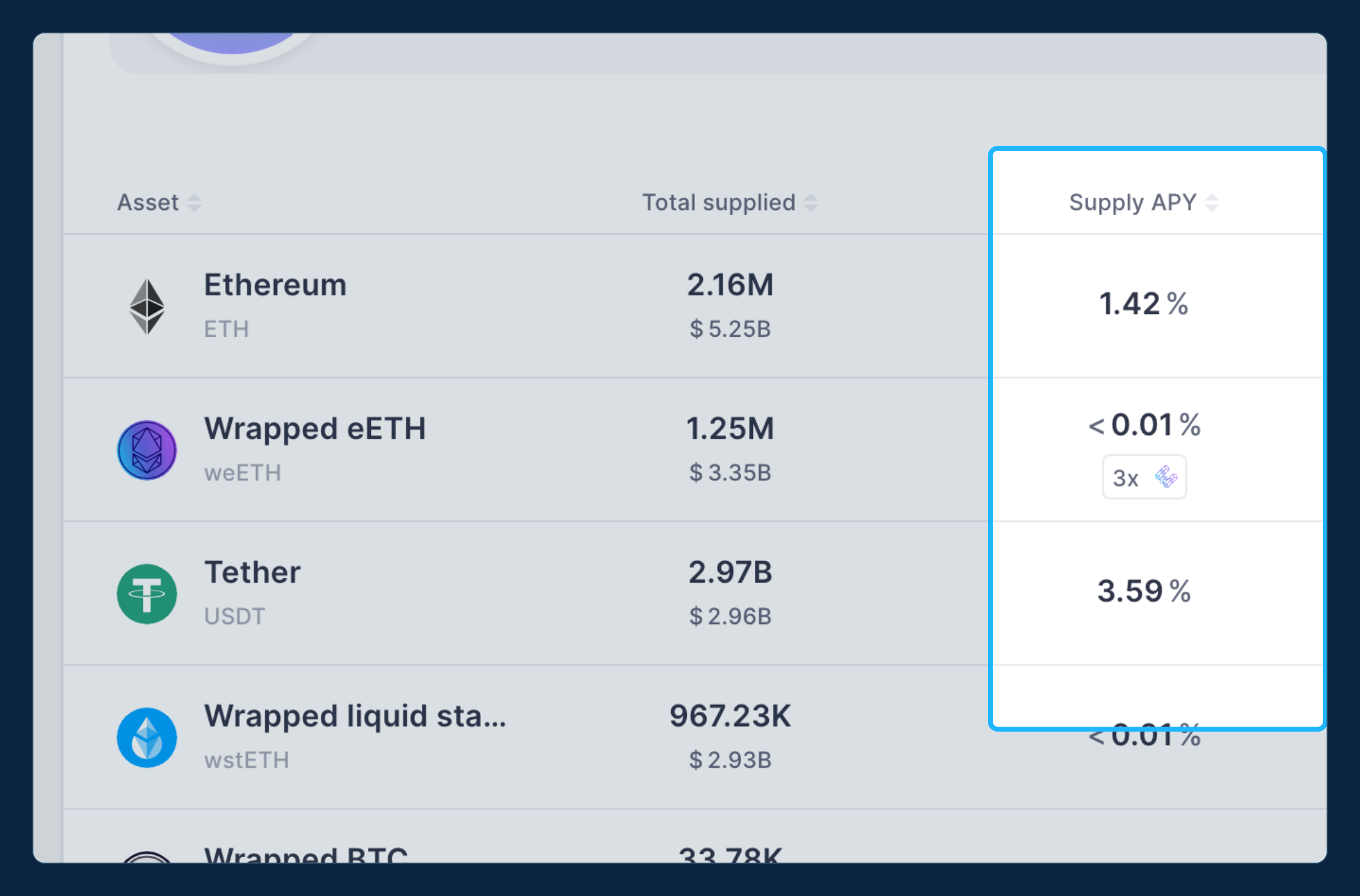
Rate pages need to declare their own freshness. "USDC supply APY: 4.2%" with no timestamp tells search engines nothing about whether the figure is current.
Add an explicit "as of [date/time]" marker and structure the rate as a dataFeedUpdate or similar time-sensitive schema property. A stale-looking number gets treated as unreliable content, not just an outdated one.
Comparison queries are the highest-intent traffic a lending protocol can capture. Searches like "Aave vs Compound APY" show a user actively deciding where to deposit.
Most protocols don't build a page for this, leaving the query to third-party aggregators who don't care which protocol wins.
Pull rate data from a live API or a public Dune dashboard rather than hardcoding it. This keeps the page accurate without manual updates, and gives you something to link to. That's a signal AI crawlers reward when checking whether a claim is verifiable.
Best Practice
Timestamp every numeric claim on a rate page. Almost no competitor does this, and it directly supports the accuracy signal AI engines now check for.
DEX SEO: programmatic pair pages, the duplicate-content trap, liquidity-pool schema
Uniswap-style DEXs generate a page for every trading pair. At scale, that's thousands of nearly identical URLs: ETH/USDC, ETH/USDT, ETH/DAI, each with the same template and boilerplate copy swapped for a different token symbol.
This is a programmatic-SEO problem with a real failure mode: duplicate content at scale. If a DEX auto-generates 3,000 pair pages from the same 200 words of template copy, search engines see thousands of pages saying almost nothing unique. Most never index, and the ones that do rank poorly.
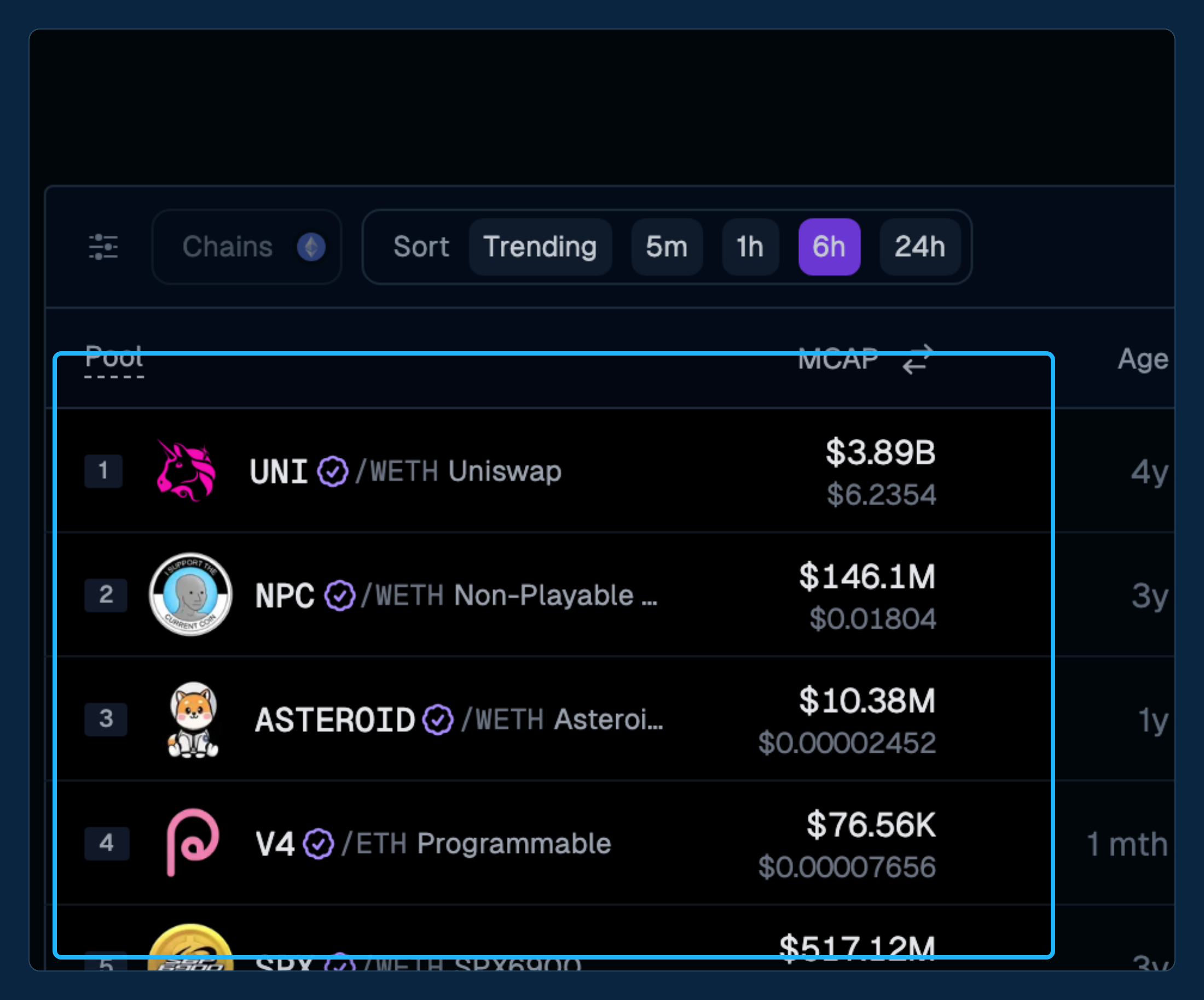
The fix isn't fewer pages. It's more differentiated ones.
- Pull in pair-specific data no other pair page has: liquidity depth, 24-hour volume, historical volatility.
- Use
Productor a custom liquidity-pool schema, not just genericWebPagemarkup, so crawlers can read the pool's actual state. - Consolidate low-liquidity pairs. A pair with $200 in liquidity and zero volume in 90 days isn't worth indexing. Noindex it or fold it into an "all pairs" view.
- Write unique intro copy for high-volume pairs only. Prioritize the top 50-100 by volume, where the return justifies the effort.
Warning
Auto-indexing every pair your contract can generate is how a DEX ends up with a Search Console report full of "crawled, not indexed" pages. That's a direct signal the content wasn't differentiated enough to earn a spot in the index.
Yield and vault protocol SEO: differentiating when 50 protocols describe the same strategy
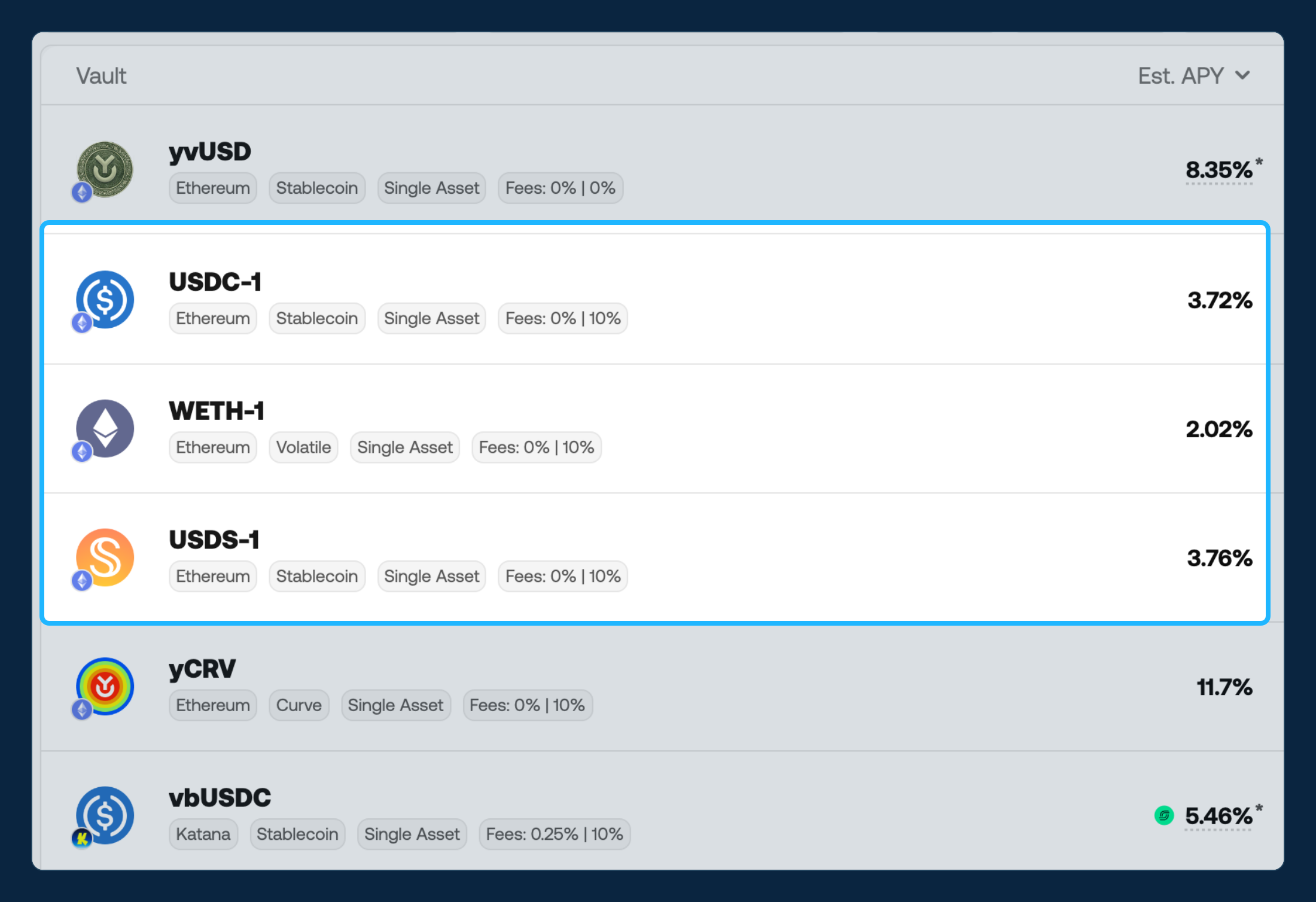
This is the hardest of the three. A yield aggregator's vault page for "ETH-USDC LP auto-compounder" describes a strategy dozens of competitors also offer. The language is nearly identical: "maximize your yield," "auto-compound your rewards," "set and forget."
When 50 protocols use the same three phrases, search engines have no signal to differentiate them, and neither do readers. The protocol that wins isn't the one with the best strategy copy. It's the one with the most verifiable specificity.
Lead with what's actually different, not the strategy description. Every vault has the same generic pitch. What's unique is the fee structure, the specific contracts it interacts with, the audit history, and the actual historical APY, not a projected one.
Name the underlying protocols the vault routes through. If a vault auto-compounds a Curve LP position, say Curve by name, and link to it.
Named entity density is one of the clearest ways AI engines distinguish a real, technically grounded page from a templated one. That means referencing specific protocols like Aave, Uniswap, Compound, and Curve, plus tools like Dune and DefiLlama.
Publish the vault's audit and risk profile on the same page, not buried in docs. This is both a trust signal for users and a differentiation signal for search, since most competing vault pages skip it.
Historical APY beats projected APY as a ranking asset. A page showing 90 days of actual realized returns is citable content. A projected APY with no track record is marketing copy, and search engines increasingly treat it that way.
Key Insight
The vault that wins isn't the one with the best strategy copy. It's the one with the most verifiable specificity: named protocols, published audits, historical returns.
The shared technical foundation across all three
Protocol type determines content strategy. But lending, DEX, and yield share the same technical floor, and if that floor is broken, none of the content-level fixes above matter.

The most common failure is invisible from the browser: the site renders fine for a human but shows nothing to a crawler. I found and fixed exactly this bug on my own site in August 2026. A one-line build misconfiguration silently hid most of the site from crawlers, while everything looked normal in the browser.
The full incident and the rendering pipeline that prevents it belong to the technical side of this cluster the Web3 Technical SEO piece covers that side in depth. What matters here is catching the same class of problem on a DeFi site specifically.
Three checks that do it:
Three checks that catch it
The GEO layer: why accuracy matters as much as citation for protocol data
Getting cited by an AI engine is only half the problem. The other half is whether what's cited is correct, and for DeFi protocols that's measurable.
In a test run on 2026-08-02, major AI models overstated Pendle's TVL by 244-320%. They overstated Lido's TVL by 80-96% relative to actual figures at the time.
Even a respected 2026 Web3 LLM-visibility guide cited "Lido holds $22.3B TVL as of January 2026." That figure had already drifted from the actual number by the time it was read. The reference material itself decays.
TVL, APY, supply, and holder counts are continuous numeric series. A number accurate today is stale within days, and neither the model nor most source content flags that decay. The practical fix is the same for lending, DEX, and yield protocols alike:
The practical fix, protocol type aside
This is the same accuracy problem covered in more depth in the Web3 SEO and AEO guide's GEO section. It walks through the full framework for getting cited accurately, not just cited.
FAQ
What is DeFi SEO?
DeFi SEO is search optimization for decentralized finance protocols, covering the technical, content, and trust signals specific to lending platforms, DEXs, and yield protocols. It differs from generic SEO because DeFi sites generate pages around live, decaying data like rates and TVL, not static product descriptions.
Why does generic DeFi SEO advice not work for my protocol?
Generic advice treats all DeFi protocols as one category. A lending protocol's rate pages, a DEX's pair pages, and a yield protocol's vault pages fail for different reasons: stale data, duplicate content at scale, and lack of differentiation. The fix has to match the failure mode.
How should a DEX handle thousands of trading pair pages?
Don't index every pair a smart contract can generate. Prioritize unique, data-rich pages for high-volume pairs, use liquidity-pool schema, and noindex or consolidate low-liquidity pairs with no real search demand.
How do yield protocols differentiate when every vault sounds the same?
Stop leading with strategy description, since every competitor uses the same language. Lead with what's specific: fee structure, named underlying protocols, audit history, and realized historical APY. These are verifiable and can't be copied by a templated page.
Why does AI accuracy matter for DeFi SEO specifically?
DeFi's most-cited facts, TVL, APY, and supply figures, are continuous numeric series that decay fast. A test in August 2026 found major AI models overstating protocol TVL by triple-digit percentages. Timestamping claims and linking to live dashboards is the practical fix.
What to watch next
The pattern across lending, DEX, and yield SEO is the same underneath the differences. The protocols that win publish verifiable, current, structurally sound data, not the best strategy copy.
That compounds. A protocol that gets this right in month one keeps compounding rankings and citations while competitors publish the same templated pitch everyone else uses.
Not sure your rate, pair, or vault pages are actually crawlable?
That's exactly what I check first. My Web3 Growth Audit covers crawlability, citation accuracy, and the protocol-type fixes from this article, applied to your stack.
Learn About the Web3 Growth Audit →