
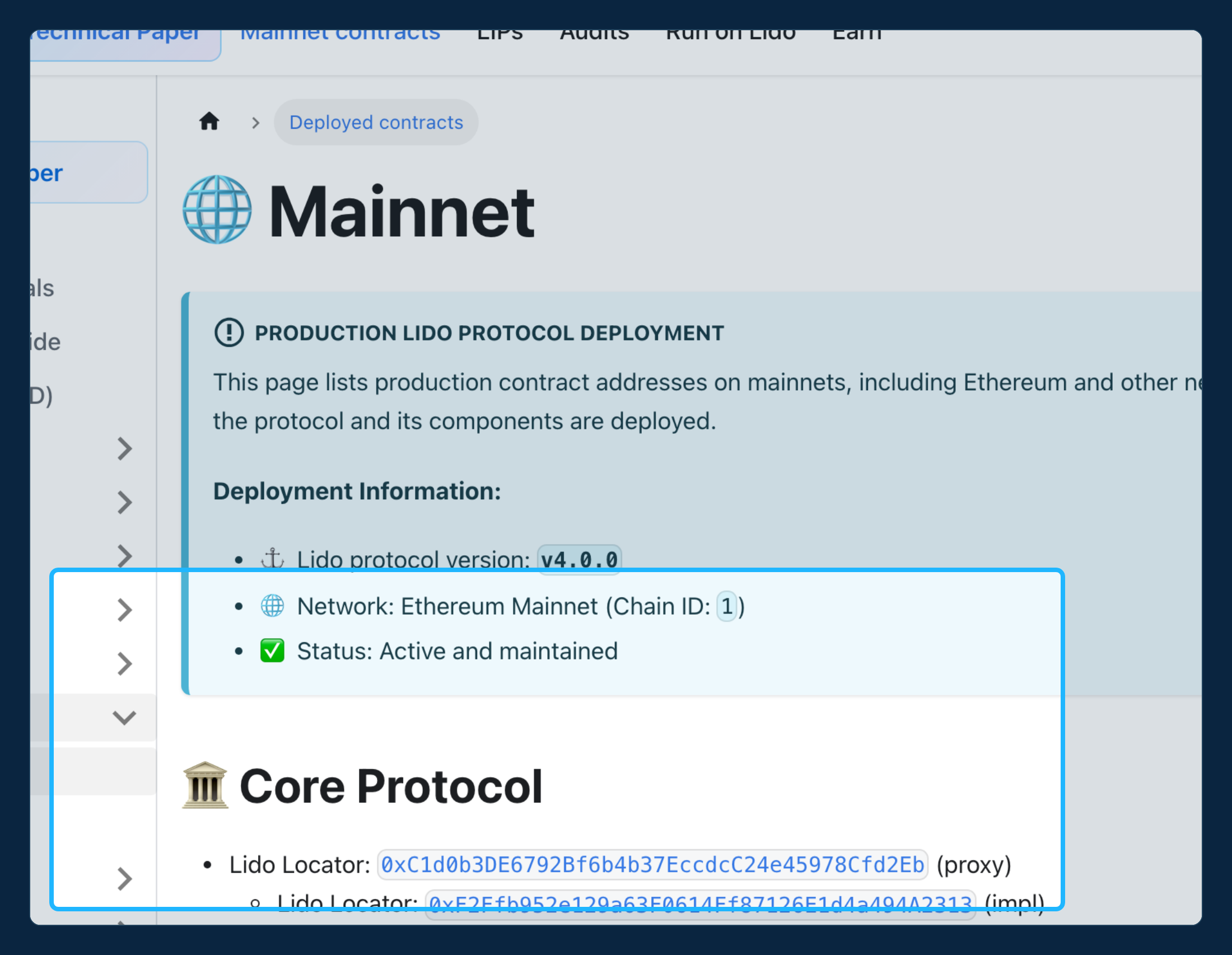
Lido's deployed-contracts page lists every audited address, network, and status, crawlable straight from its own domain. Almost no other protocol formats its on-chain proof that way.
Most Web3 teams hold the same proof, audited contracts, treasury addresses, live reserves, cryptographically verifiable, and still get zero search or AI credit for it.
This piece shows the exact crawlable format that turns that proof into E-E-A-T signals search engines and AI models can find, parse, and cite.
It covers the five signal categories worth publishing, and why a stale number hurts trust more than a missing one. For the technical layer this builds on, see the definitive guide to Web3 SEO and AEO.
What On-Chain Trust Signals Are
An on-chain trust signal is any piece of publicly verifiable blockchain data, an audited contract, a treasury address, live TVL, proof of reserves. It only counts when a protocol surfaces that data on its own site, in a format search engines and AI crawlers can read directly.
No user should need to click through to a block explorer to find it.
!On-chain trust signal inventory and its crawlable on-page format

The signal itself isn't new. Contract addresses have always been public.
What's missing is the bridge: most protocols treat that data as something users find on Etherscan or DefiLlama. Few treat it as something the protocol's own pages assert and structure.
If the proof lives only off-site, it contributes nothing to how a crawler assesses the site.
Why E-E-A-T Is Harder for Crypto Sites
Standard E-E-A-T guidance, author bios, credentials, bylines, was written for blogs and news sites. Protocols can prove claims cryptographically instead.
Google classifies most crypto content under Your Money or Your Life. YMYL pages get held to a higher trust bar because a bad answer can cost someone money. That bar is already steep for finance sites, and steeper for Web3.
Three structural problems compound it:
Anonymous teams are normal. A large share of legitimate protocols ship with pseudonymous founders. Standard E-E-A-T signals, author photos, LinkedIn profiles, named bylines, don't exist to show. A search engine trained on Web2 patterns sees an absence where a fintech site would show a credentialed team.
The category is scam-adjacent by volume. Rug pulls, wash-traded tokens, and fake audits share search real estate with real protocols. Google's models have to sort signal from noise in a category where a meaningful share of the content is deliberately deceptive.
Claims are usually self-reported. "Audited by [firm]" and "$X in TVL" are statements a project makes about itself. Nothing forces a crawler to believe them, and nothing on most pages proves them.
Verifiable on-chain data is the counterweight to all three. A pseudonymous team can still publish a contract address anyone can inspect. A real audit report can be linked directly instead of just claimed.
A TVL figure can point to the query that produced it instead of sitting there as prose. None of this requires disclosing an identity. It requires making the site's claims checkable.
Key Insight
For a crypto site, Experience isn't a bio. It's a contract address that resolves, an audit report that opens, and a number that matches the chain right now.
The Signal Inventory: What to Publish, and How to Format It
Five categories of on-chain proof carry real trust weight. Each needs the same treatment: a direct link, an explicit timestamp, and structured data rather than plain prose.
| Signal | Where it usually lives | Crawlable format |
|---|---|---|
| Contract addresses | Docs, sometimes buried mid-page | Dedicated addresses page, direct explorer links (Etherscan, Solscan), copy-to-clipboard, one row per chain |
| Audit reports | PDF link, often off-domain on the audit firm's site | Hosted or embedded on your own domain, named firm, audit date, scope, direct link to the source PDF |
| Proof of reserves | Third-party dashboard only | Summary on your own site, query or attestation source linked, refreshed on a stated cadence |
| Live protocol metrics (TVL, holders, volume) | DefiLlama, Dune, CoinGecko | On-page number with a "last updated" timestamp, linked to the exact dashboard or query |
| Team attestations | Signed messages in Discord or X threads | Verification page linking the signed message and its wallet, no identity disclosure required |
The pattern across all five: don't just claim it, link to the thing that proves it, and say when it was last checked. That last part matters more than most teams treat it.
The Accuracy Decay Problem
A live number that never gets updated becomes a liability. TVL, price, and holder counts change by the hour. A protocol page showing last quarter's TVL as if it's current isn't a stale detail, it's a claim that no longer matches the chain.
This isn't hypothetical. I ran a live test cross-referencing AI model citation accuracy against actual on-chain state for Pendle and Lido. Models were overstating current TVL by wide margins, while confidently dating their own numbers as recent.
Full methodology and figures are in the AI-citation accuracy piece the Web3 AEO/GEO piece. The pattern held even for well-known, well-documented protocols. If the reference material itself decays, a stale number on your own site is worse, not better.
Warning
A stale TVL number isn't neutral. It's an anti-trust signal. A page claiming a number the chain has already outgrown reads as unmaintained or deliberately misleading. A crawler comparing your claim against a live source has no way to know which.
The fix is structural, not editorial. Every live figure needs a visible "as of" timestamp and a stated refresh cadence, even if that cadence is manual.
Structured data and explicit timestamp markup do real work here too. Implementation details are in the site's technical SEO piece the Web3 Technical SEO piece.
The principle underneath it: a number without a date is a number nobody can verify.
Off-Page Trust: The Citation Graph Nobody Talks About
E-E-A-T doesn't stop at your own domain. For a protocol, the off-page citation graph is different from what a typical business builds. Instead of press mentions and backlinks, the equivalent authority signals are structural.
Does DefiLlama track your TVL. Does a block explorer show your contract as verified.
Does the audit firm's own site list your report. Does CoinGecko carry your token with a matching contract address.
These aren't backlinks in the traditional SEO sense. They're independent confirmations that your site's claims match what a third party, with no incentive to inflate your numbers, also shows.
A protocol listed on DefiLlama, verified on Etherscan, and indexed on the auditor's own site has three independent sources agreeing with itself. That consistency is the actual signal, not any single listing.
Unlike a Web2 press mention, none of this depends on an editor's judgment call. DefiLlama's tracker either shows your number or it doesn't.
Etherscan either shows your contract as verified or it doesn't. There's no editorial layer to court, and none to game.
Here's the order that works, aggregators first, then press:
The practical order
Fixing a mismatch between what your site claims and what an aggregator shows fixes more trust deficit than a press mention ever will.
Verifiable proof is a brand argument too, not just a ranking one. How a protocol presents its credibility shapes trust with users and partners. It shapes trust with a crawler the same way a companion piece in this cluster.
What This Actually Earns You
On-chain trust signals are not a confirmed Google ranking factor. Nobody, including Google, has published a ranking algorithm input called "on-chain verification."
Treat any claim that structured contract data directly moves your SERP position with real skepticism. Apply the same doubt you'd bring to a token with no real distribution.
What the evidence actually supports is narrower, and still valuable:
What structured on-chain proof actually earns
None of these are guarantees. They're the conditions that make trust possible to earn in a category where it's unusually hard to earn by default.
FAQ
What are on-chain trust signals in SEO?
On-chain trust signals are pieces of publicly verifiable blockchain data: contract addresses, audit reports, proof of reserves, live protocol metrics. A site earns credit for them only by presenting that data in a crawlable format on its own domain, not by leaving it on a block explorer or third-party dashboard.
Does on-chain data improve Google rankings for crypto sites?
There's no confirmed on-chain ranking factor. What structured, verifiable on-chain data does is make claims checkable, which is the underlying quality Google's YMYL and E-E-A-T guidance is trying to measure in the first place. Treat it as trust infrastructure, not a ranking hack.
How do anonymous Web3 teams build E-E-A-T without doxxing founders?
Publish what's verifiable without an identity: contract addresses, signed wallet attestations, audit reports, and live protocol data with timestamps. None of it requires a name or a photo. The proof stands on cryptography, not credentials.
Why does a stale TVL number hurt trust more than not showing one at all?
A missing number is an omission. A wrong number is a false claim that a live source can contradict in seconds. Once a figure is visibly out of date, it signals the page isn't maintained, which undermines every other claim on it too.
What's the simplest first step to add on-chain trust signals to a protocol site?
Build one dedicated page listing verified contract addresses per chain, linked directly to the relevant block explorer. Add a link to the audit report hosted on your own domain, with the firm name and audit date stated. That single page covers the two highest-impact signals before touching anything else.
Where This Goes Next
On-chain trust signals are the most original lever in this cluster because almost nobody in the "crypto SEO" search results connects E-E-A-T to verifiable data. Most guidance still treats on-chain metrics as a content input, something to publish so models cite you.
It's rarely treated as proof that backs up what the page already claims. That gap is the opportunity.
Start with the addresses page and the audit report. Add timestamps to every live metric after that.
If your site's technical setup isn't even getting these signals in front of crawlers, start there. The definitive guide to Web3 SEO and AEO covers the full stack this satellite builds on.
How much of your on-chain proof can a crawler actually see?
That gap is the first thing I audit. My Web3 Growth Audit covers the trust-signal inventory from this article, checked against your live pages.
Learn About the Web3 Growth Audit →