
Stablecoin SEO starts with pages that answer four separate questions: what backs the token, how redemption works, where the token is supported, and how the product behaves. Each answer needs a primary source, a visible date, and a clear scope.
That structure helps a founder or growth lead make product information useful. It also keeps a marketing page from sounding like a reserve audit or legal opinion. I use Circle as one example of page organization, not as a universal stablecoin model.

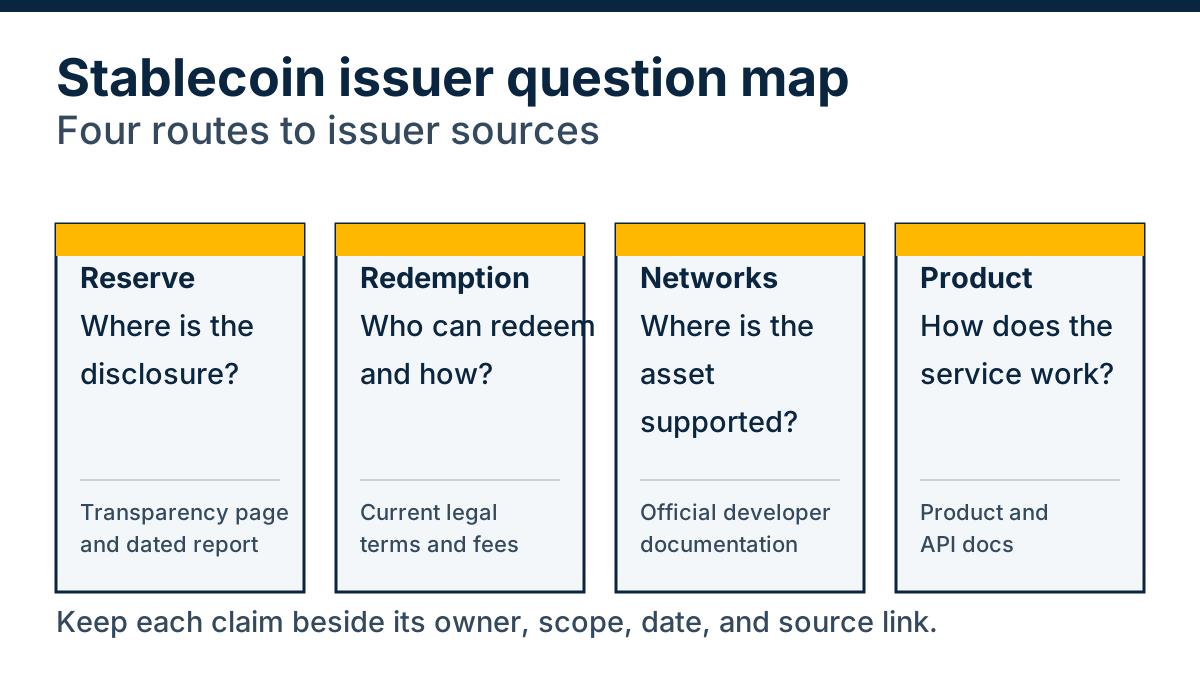
Map stablecoin questions to four page types
Begin with the task a reader is trying to complete. Do not begin with a keyword list. Reserve, redemption, network, and product questions may share a brand. Each needs different evidence and a different owner.
A stablecoin page should show the issuer claim, its source, who it applies to, and its check date. That gives readers the context they need to assess it.
A reserve page should point to the issuer's current transparency page and its dated reports. A redemption page should explain the route, eligibility, jurisdiction, fees, and terms that apply to the relevant user. A network page should list supported networks from current issuer documentation. A product documentation page should cover integrations, API behavior, custody boundaries, and operational steps that users need to act safely.
These are page roles, not a demand for four separate URLs. A small issuer may combine closely related content if the sections remain easy to find and each claim still points to its own source. Keep redemption terms prominent. Readers should not mistake a general token description for an unconditional right to redeem.
Circle illustrates why the source types should remain distinct. Its transparency page presents reserve disclosures and issuance and redemption information. Its legal terms describe conditions that vary by user type and location. Its developer documentation uses currency and chain pairs for API references. Those pages answer related questions, but each has a different purpose and scope.
Use source dates as part of the page architecture
Every page that contains changing information should make its freshness visible. A reserve disclosure can change on a different schedule from legal terms or network documentation. A generic “updated recently” label hides that difference and can make an old claim look current.
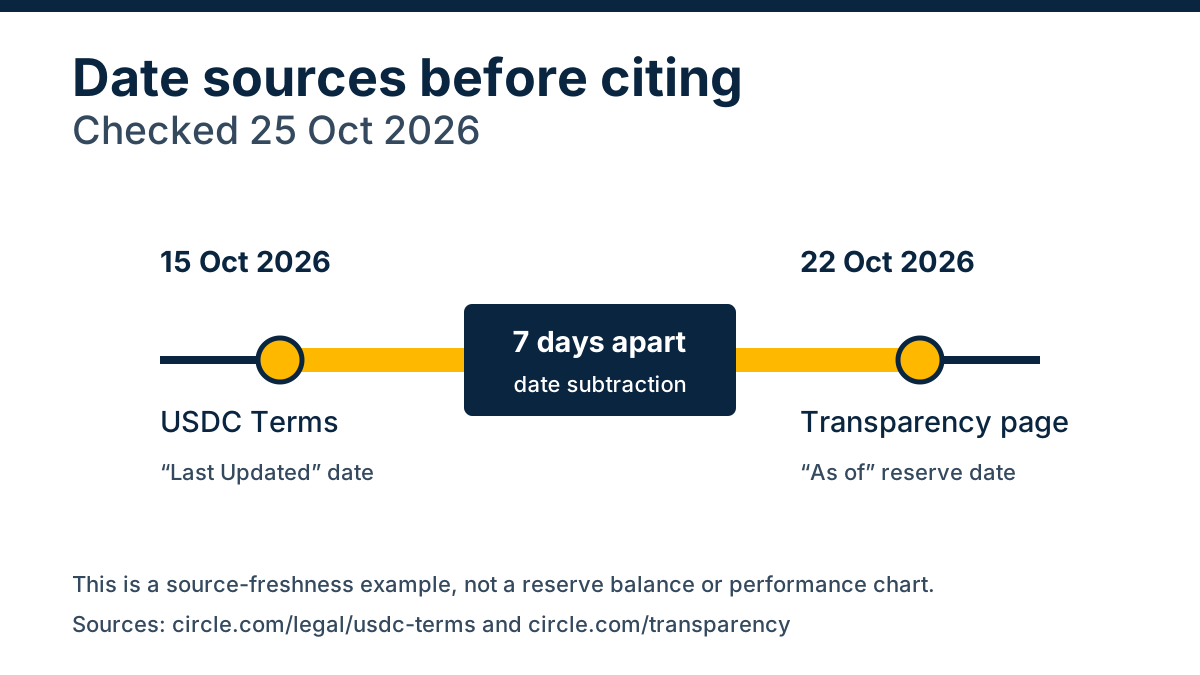
On October 25, 2026, I checked Circle's Transparency page. The page displayed “As of Oct 22, 2026” for reserve composition. It also says reserve holdings are disclosed weekly, with monthly third-party assurance. Circle's USDC Terms displayed “Last Updated: October 15, 2026.” I use these dates only to show how one issuer exposes different evidence dates. They do not establish the freshness of another issuer's pages.
When a page cites a report, link the report itself as well as the summary page. Record the reporting period, publication date, issuer, and any coverage limits. If the source does not show a date, say so. Do not silently substitute the date you checked the page for the date the underlying data covers.

Google's people-first guidance calls for clear sourcing and careful treatment of topics that can affect financial stability. It also warns against changing a page date only to make unchanged content appear fresh. That supports a practical rule: update a date when the underlying evidence or advice changed, and explain what changed.
Build the issuer page set around reader intent
Use the following sequence to decide what should exist and what each page must prove.
- Collect real questions. Review support tickets, sales calls, developer feedback, search queries, and product documentation. Group them by user task, such as checking reserves, qualifying for redemption, integrating a network, or moving funds safely.
- Assign one destination to each task. Give each task a clear URL or a named section. Keep one primary intent per destination. If a page serves both retail holders and institutional customers, separate the routes and explain the difference.
- Choose the source that can prove each claim. Use an issuer report for reserve claims and current terms for redemption conditions. Use official technical documentation for network support. Link the exact source section when possible. Third-party listings can aid discovery, but they do not prove issuer support.
- State scope and limits beside the claim. Name the issuer, token, date, geography, user type, and any condition that changes the answer. Circle's current USDC Terms distinguish Circle Mint customers from holders without an account. They also limit the stated terms by location. Those details belong beside the redemption explanation, not in an easy-to-miss footer.
- Connect the pages with descriptive links. Link a reserve page to the dated report and a redemption page to its terms. Link a network page to implementation docs. Use anchor text that names the destination, such as “USDC redemption terms,” instead of “learn more.”
- Set a review trigger for each source. A changed report, legal notice, product release, or network list should open a review task. The page owner can then check the claim against its source. Set review dates from the source's update pattern, not a generic content calendar.
This method also connects to a broader DeFi protocol SEO structure and the Web3 SEO guide. Those pages cover shared search foundations. The issuer page set adds a narrower layer for reserve, redemption, network, and product questions.
Stablecoin issuer page review checklist
Common mistakes that weaken stablecoin SEO
One generic token page creates avoidable ambiguity. It may introduce the token, yet still leave a user unsure where to check the latest reserve report, which redemption route applies, or whether a particular integration is supported.
A second mistake is presenting an issuer's terms as if they applied to every holder in every region. Circle's terms are a Circle-specific example, not a template for another issuer. An issuer should use its own current terms and identify differences across countries, user categories, and products.
A third mistake is treating a public reserve statement as an independent audit. Use the issuer's exact description of the report or assurance. Do not infer solvency, safety, or legal compliance from a page label. A marketing page can make evidence easier to find, but it cannot replace the underlying report or a qualified review.
Teams also break trust when they cite a landing page instead of the report. They weaken trust when they bury a key limit or leave an unsupported network in old copy. These are content operations problems as much as SEO problems. Assign owners, keep a source ledger, and make correction paths visible.
Finally, structured data does not guarantee a rich result or a higher position. It can help search systems understand page content when used correctly, but it cannot repair missing evidence, unclear page purpose, or inaccurate terms. I treat technical markup as an aid to interpretation, not proof of quality.
What to monitor after launch
Start with whether readers reach the right page from the right query. In Search Console, compare query and page pairs, then inspect impressions, clicks, and the landing page itself. A search result can attract the wrong task. This can happen when a title promises a broad overview but the page only answers a narrow redemption question.
Pair search data with support and product evidence. If users still ask where to find a reserve report, the navigation may be weak. Impressions alone will not reveal that problem. If a developer reaches the network page but still opens a support ticket, review the source. The official docs may be incomplete, or the integration path may be unclear.
Track corrections as well as traffic. Note when a source changes, which pages depend on it, who reviewed the change, and whether affected copy was updated. This creates a useful audit trail and helps the team see where the information architecture is fragile.
For a broader view of search visibility and answer engines, see my Web3 AEO and GEO guide. If your team needs an external review of its growth system, I can help through the Web3 Growth Audit.
FAQ
What pages should a stablecoin issuer publish?
At minimum, organize clear destinations for reserve disclosures, redemption terms, supported networks, and product documentation. Smaller teams can combine related topics when each section stays easy to find and links to the source that supports it.
How should a stablecoin issuer describe redemption?
Use the issuer's current terms and state who can redeem, through which route, under what conditions, and in which jurisdictions. Avoid wording that implies every holder can redeem directly when eligibility or account requirements apply.
How often should stablecoin reserve pages be checked?
Set the review schedule from the issuer's reporting cadence and source update pattern. If a source publishes weekly data, review that page on a schedule that can catch new reports. Record the report period separately from the date your team checked it.
Does structured data guarantee a rich result?
No. Structured data helps systems interpret eligible page information, but it does not guarantee a search feature or ranking. Clear evidence, accurate copy, and a useful page remain the core work.
References
- Google Search Central, Creating helpful, reliable, people-first content. Checked October 25, 2026.
- Google Search Central, General structured data guidelines. Checked October 25, 2026.
- Circle, Transparency and Stability. Checked October 25, 2026. The page displayed reserve composition “As of Oct 22, 2026” and described weekly reserve disclosures and monthly third-party assurance.
- Circle, USDC Terms. Last updated October 15, 2026; checked October 25, 2026. Terms shown for holders outside the EEA.
- Circle Developer Docs, Supported chains and currencies. Checked October 25, 2026. API currency and chain-pair documentation.