
Stablecoin supply by chain shows where circulating value is mapped. It does not show how many people use a product, how often they transact, or whether a chain expansion succeeded.
I treat supply as a liquidity and distribution signal. To assess use, I pair it with product-level activity, issuer support and redemption access. That separation helps growth teams avoid calling a larger balance an adoption result.
Evidence sections
What supply by chain measures
DefiLlama’s stablecoin data describes the aggregate circulating value of stablecoins associated with each chain. Its API exposes chain-level totals and historical charts. The provider’s definition is useful for comparing distribution, but it remains an aggregate. Its value depends on the assets covered, chain mapping and methodology used at the snapshot. See DefiLlama’s metric definitions and its official API documentation.
stablecoin search and issuer questions
The live chain endpoint returned totals when I checked it on 16 November 2026, but the response did not include a separate data timestamp. The approved brief says to omit a numeric comparison when the snapshot date is unclear, so I do not publish current chain values here. I use the source for its metric definition and keep the article focused on how to interpret the signal. The live chain endpoint can be queried again for a dated analysis. See DefiLlama’s metric definitions and its official API documentation.
This snapshot is descriptive, not a ranking of product quality. It includes the provider’s chain classification and circulating-value estimate. Stablecoins can be native, bridged or represented by more than one token contract. A chain total does not by itself explain which asset a user can redeem, which applications accept it, or how much activity is economically meaningful. See DefiLlama’s metric definitions and its official API documentation.
Supply is not a user count
A supply total is a balance measure. One large treasury, exchange or protocol position can change the total without creating more individual users. The same user can hold assets at several addresses. A single address can represent a smart contract, custodian or service. The aggregate does not reveal those relationships.
The live snapshot identifies balance distribution only. It does not expose unique people, product events or repeat use. Those outcomes need different sources and denominators.
It also does not separate dormant balances from money used in a product unless the dataset provides that breakdown. A token can sit in a wallet, a pool, a bridge contract or an exchange. Those positions have different implications for access and activity. A dashboard that shows total supply cannot tell you which use case produced the balance.
For a chain expansion, call the supply figure a distribution signal. Then ask a separate question: did the product complete more of the action it was built for? That answer needs a product event, a denominator, an observation window and a rule for repeat use.

Separate native, bridged and issuer-supported assets
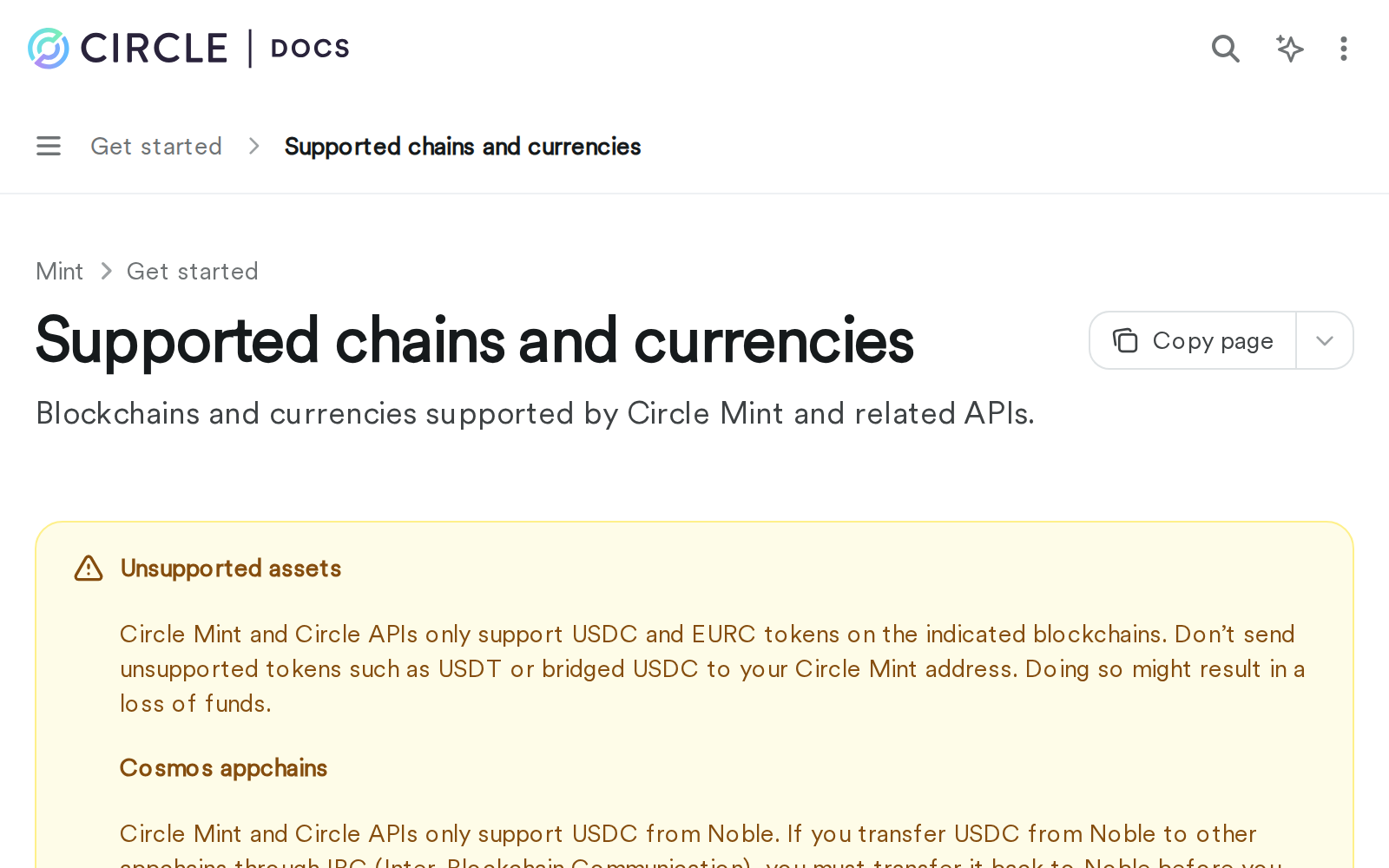
Chain labels can hide different paths to the same ticker. A stablecoin may be issued natively, bridged from another network, or represented by a token whose redemption route differs from the issuer’s main product. Treat token identity and issuer support as separate fields in your analysis. See Circle’s supported chains and currencies page.
Circle’s supported-chains documentation lists supported asset and chain pairs. It also distinguishes general availability from product-specific deposit and payout API support. A token appearing on a network does not prove that a particular Circle Mint workflow supports it. Before building a payment flow, check the exact asset, chain, product and operation you need. See Circle’s supported chains and currencies page.
Apply the same discipline to other issuers. Record the contract address, canonical or bridged status, issuer documentation, mint and redemption route, and operational restrictions. If your source does not establish a field, mark it unknown. Do not infer issuer support from a token tracker or an aggregate supply table. See Circle’s supported chains and currencies page.
Pair supply with product activity
Choose the event that represents use for your product. A payment product might count completed payments. A treasury tool might measure settled transfers. A lending app might count a borrow or repayment that meets its health conditions. The right event depends on the service, and a wallet transfer is not automatically equivalent to product use.
Define the unit and denominator. Are you counting addresses, accounts, merchants, transactions or settled value? State how you treat repeated events, smart accounts, internal transfers, failed calls and users who were already active before the chain launch. Keep the same rules across chains so that the comparison is interpretable.
Use a cohort with a complete observation window when measuring repeat behavior. If the first use happens near the end of the reporting period, that account has less time to return. Either give every cohort the same follow-up window or label incomplete windows. Do not compare a mature cohort to a new launch cohort as if their opportunity to act were equal.
Read the current snapshot with its limits
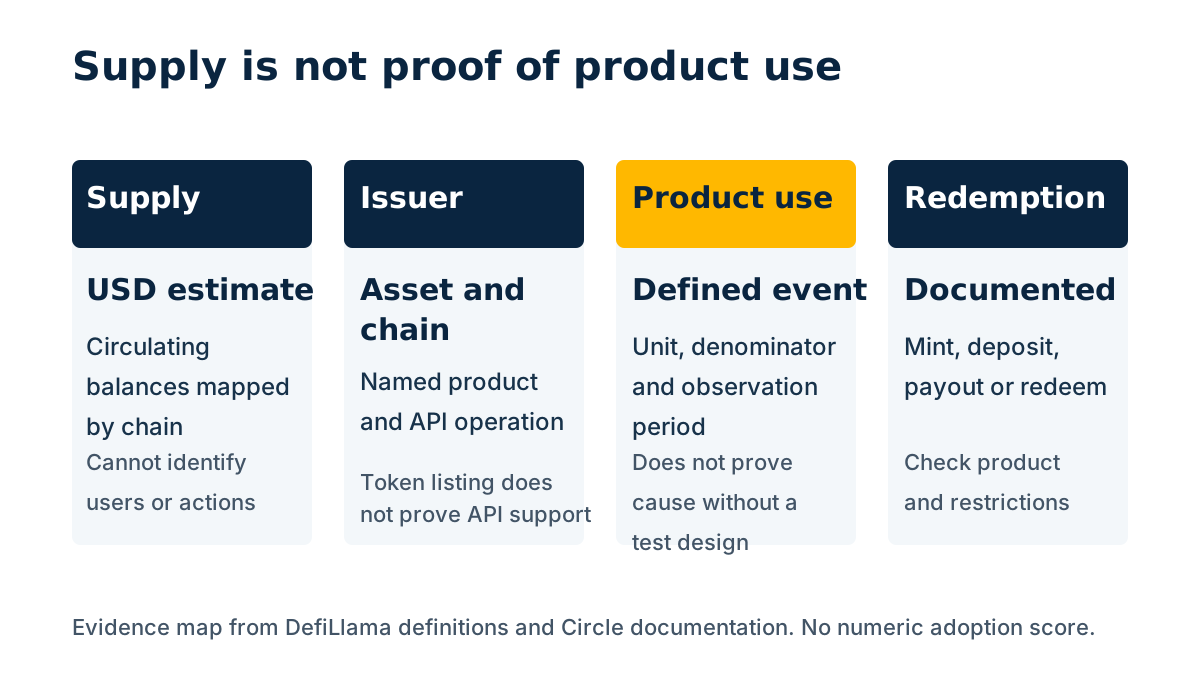
The visual separates the four evidence types a team needs to compare. Supply describes balances under a provider method. Issuer support describes a documented asset and operation. Product events describe actions in the service. Redemption access describes a path and its restrictions. These are different units, so I keep them side by side instead of combining them into an adoption score.
The chain endpoint is live and its totals can change. A later numeric comparison should record the source snapshot time and preserve the exact response used. Without that time in the returned data, the values would be easy to mistake for a stable series. A new query should not be treated as a historical trend.
If you need to compare change over time, query the provider’s historical endpoint for the same chain set and consistent dates. Preserve its methodology and unit. If you instead need product activity, build a separate query from product or contract events. Combining unlike measures into one score hides what each source can actually prove.
Evidence matrix for a chain-expansion decision
Before calling expansion successful, complete four evidence rows. Supply tells you about the distribution of balances. Issuer support tells you whether the asset and exact operational path are supported. Product activity tells you whether users completed the job the product offers. Redemption access tells you how value can enter or leave the system.
the broader DeFi growth KPI framework
Keep the units separate. Supply may be reported as a USD estimate; issuer support is an asset and chain pair; product use is an event count or settled value; redemption access is a documented capability and constraint. These units cannot be added into a single adoption score without a justified model. For most launch reviews, a side-by-side evidence table is more honest and more useful.
When a data source lacks a field, state the gap rather than filling it with a proxy. If product event logs are unavailable, say that adoption is unverified. If the issuer page lists a chain but not the needed API operation, say support for that operation is unverified. Clear missing-data rules prevent a large supply figure from carrying claims it cannot support.
| Signal | Unit | What it supports | What it cannot prove alone |
|---|---|---|---|
| Supply by chain | USD value estimate and retrieval time | Distribution of circulating balances under the provider method | Unique people, product use or retention |
| Issuer support | Asset/chain pair and named API operation | Whether a documented product path is supported | Use in your specific app or successful settlement |
| Product activity | Defined event count, account unit and period | Observed product actions under the query rule | Causal impact without a suitable evaluation design |
| Redemption access | Documented mint, deposit, payout or redemption capability | Operational access and stated restrictions | Real-world liquidity for every user |
Frequently Asked Questions
Does stablecoin supply by chain measure users?
No. It estimates circulating stablecoin value mapped to a chain. It does not identify unique people, active products or repeat use.
What does stablecoin market capitalization by chain mean?
It is an aggregate estimate of circulating pegged assets associated with a chain under the publisher’s methodology. Coverage and chain mapping can affect comparisons.
How can a team measure stablecoin use in its product?
Define product-specific events such as completed settlement or a successful payment, then report eligible accounts, period and repeat-use rule. Do not substitute supply for those events.
Does token availability mean an issuer API supports that chain?
No. A token may exist on a chain while an issuer’s mint, deposit or payout API supports a narrower set of products and networks. Check the exact issuer product documentation.
What to do with it
Use a three-step check. First, record the supply snapshot, provider, unit, chain labels and retrieval time. Second, verify the issuer’s support for the exact asset, chain and API operation. Third, define product events and repeat-use windows that match the intended use case.
Then compare the evidence without collapsing it. Supply can be a useful market-structure signal. Product event data can show that a defined action occurred. Neither source alone proves that the users are unique people or that an expansion caused growth. If you make a causal claim, use an evaluation design that supports it.
The operating decision should follow the evidence. A chain with high supply may have little activity in your product. A smaller supply base may be sufficient for a targeted use case. The sources reviewed here do not support an adoption ranking across chains, so I do not make one.
References
- defillama.com source documentation (checked 16 November 2026)
- api-docs.defillama.com source documentation (checked 16 November 2026)
- stablecoins.llama.fi source documentation (checked 16 November 2026)
- developers.circle.com source documentation (checked 16 November 2026)
Closing
Supply tells you where balances are recorded. A product event tells you whether your service was used. Keep those signals separate, then investigate the gap between them.
Need a clearer growth measurement plan?
If you need help defining that measurement plan, review the Web3 Growth Audit.