
A token vesting schedule tells you when an allocation may become transferable under stated terms. It does not prove that tokens entered circulating supply, reached a market, or were sold. I read the schedule, the contract that enforces it, and the token movements as three separate records.
That distinction matters after a token generation event. A date on a calendar can attract attention, but an unlock is only one step in a longer sequence. This guide shows founders how to read cliffs and linear releases, check a real public example, and describe the limits without implying price impact.
How to read a token vesting schedule
Start with the allocation, beneficiary, start date, lock period, release method, and any authority that can amend the terms. For token design context, compare the schedule with my DeFi tokenomics guide and the tokenomics simulator walkthrough. A schedule may apply to a team, investors, a foundation, contributors, or a treasury. Those groups can have different start dates and rules. Do not combine them into one unlock number unless the source does.
Next, identify the source of the schedule. A tokenomics page can explain the intended design. A governance proposal can record what voters considered or approved. The vesting contract can show the rule that executes on-chain. A wallet balance or transfer log can show what happened after that. Each source answers a different question.
ERC-20 defines a common interface for fungible tokens. It does not define an issuer’s vesting terms. The Ethereum documentation describes the interface and its transfer functions, while project documents and contracts supply the schedule details. I therefore avoid calling a token “vested” or “circulating” from a token standard alone. Read the ERC-20 overview for the limited role of the standard.
In the Arbitrum DAO’s public materials, the investor and team allocations are described as subject to four-year lockups. The first unlocks were scheduled one year after the March 16, 2023 token generation event, followed by monthly unlocks for the remaining three years. The Foundation allocation is described separately, with a lockup beginning April 17, 2023 and a linear release over four years. Those are distinct schedules, not one universal ARB calendar. The DAO’s distribution documentation provides the terms.
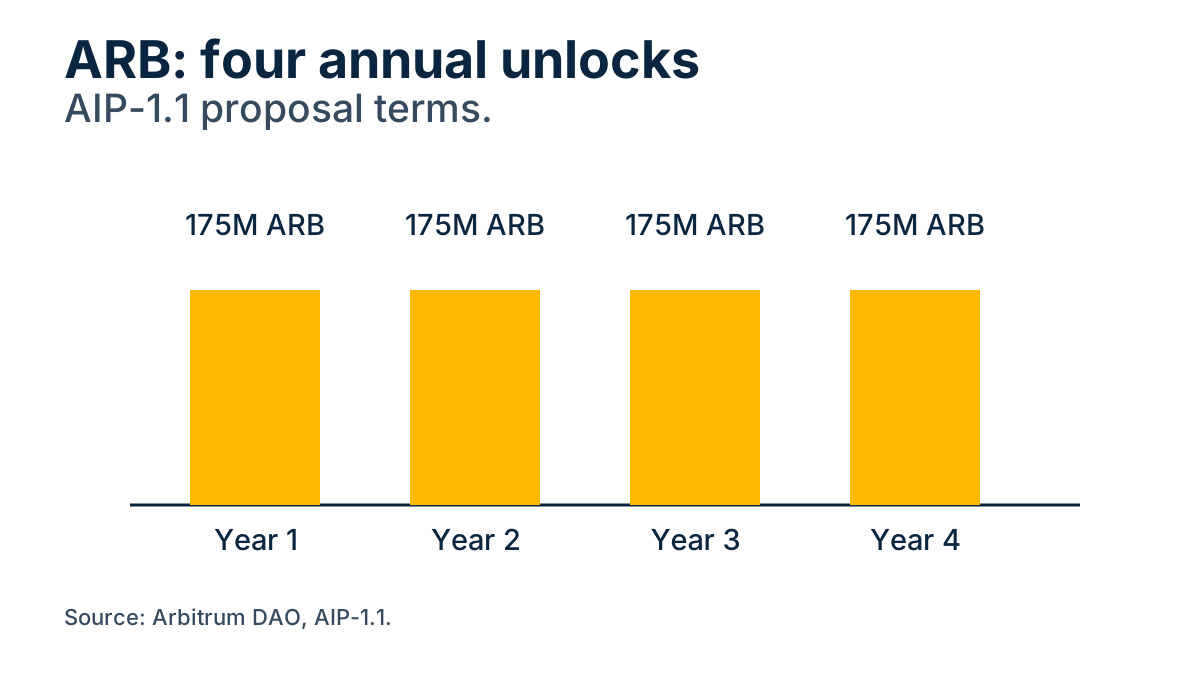
Cliffs and linear releases answer different questions
A cliff is a period during which no scheduled portion is released. Once the cliff ends, the schedule may release a portion at once or start a gradual vest. A linear schedule spreads release across time. A monthly schedule releases at stated intervals. The label alone is not enough. Read the contract or proposal language to learn whether the release is continuous, monthly, quarterly, or conditional.
The Arbitrum DAO’s initial launch announcement said team and investor tokens were locked for four years, with first unlocks one year after the token generation event and monthly unlocks through the remaining three years. That is an example of a first-year cliff followed by periodic releases. The statement concerns the planned schedule. It does not prove that each beneficiary claimed, transferred, or sold the exact amount on each date. The launch announcement explains the original design.
A schedule chart should preserve the units and the population. “175 million ARB per year” is not the same as “175 million ARB sold.” A release amount can move to a vesting beneficiary wallet, remain there, be delegated, or be transferred elsewhere. If a later report updates the remaining balance or final vest date, use the newer report for the current view and keep the original proposal as design history.
The Foundation’s first-half 2026 progress report provides a later snapshot. It states that, as of August 17, 2026, roughly 0.77 billion ARB remained in the original schedule and that the final vest was expected in March 2027. The report describes the Foundation’s own update, not every holder’s activity. I keep the snapshot date beside the figure and do not roll it forward automatically. See the Foundation’s report.
A schedule does not prove circulating supply
“Unlocked,” “circulating,” and “liquid” are not interchangeable labels. A project may define circulating supply with exclusions for treasury, locked, or otherwise restricted balances. A data provider may use its own methodology. A vesting contract may release tokens while an address still holds them. A bridge may represent the same economic token on more than one chain. A valid analysis records the issuer’s definition and the data provider’s definition separately.
To estimate the amount that became transferable, inspect the vesting contract’s release method and its beneficiary. Then compare contract events and token transfers around the relevant window. To claim tokens entered circulation, explain the chosen definition and show the address or methodology that supports it. To claim a sale, you need evidence of a sale transaction or a carefully qualified proxy. A transfer by itself does not establish who controlled the destination or why the movement happened.
This is where a public dashboard can help and mislead at the same time. It can summarize balances, events, and supply categories. It cannot resolve missing labels, private exchange deposits, beneficial ownership, or intent without additional evidence. Use an explorer or query as a traceable record, then state the exact network, contract, address, block range, and query date. If you cannot reproduce the claim, remove it.
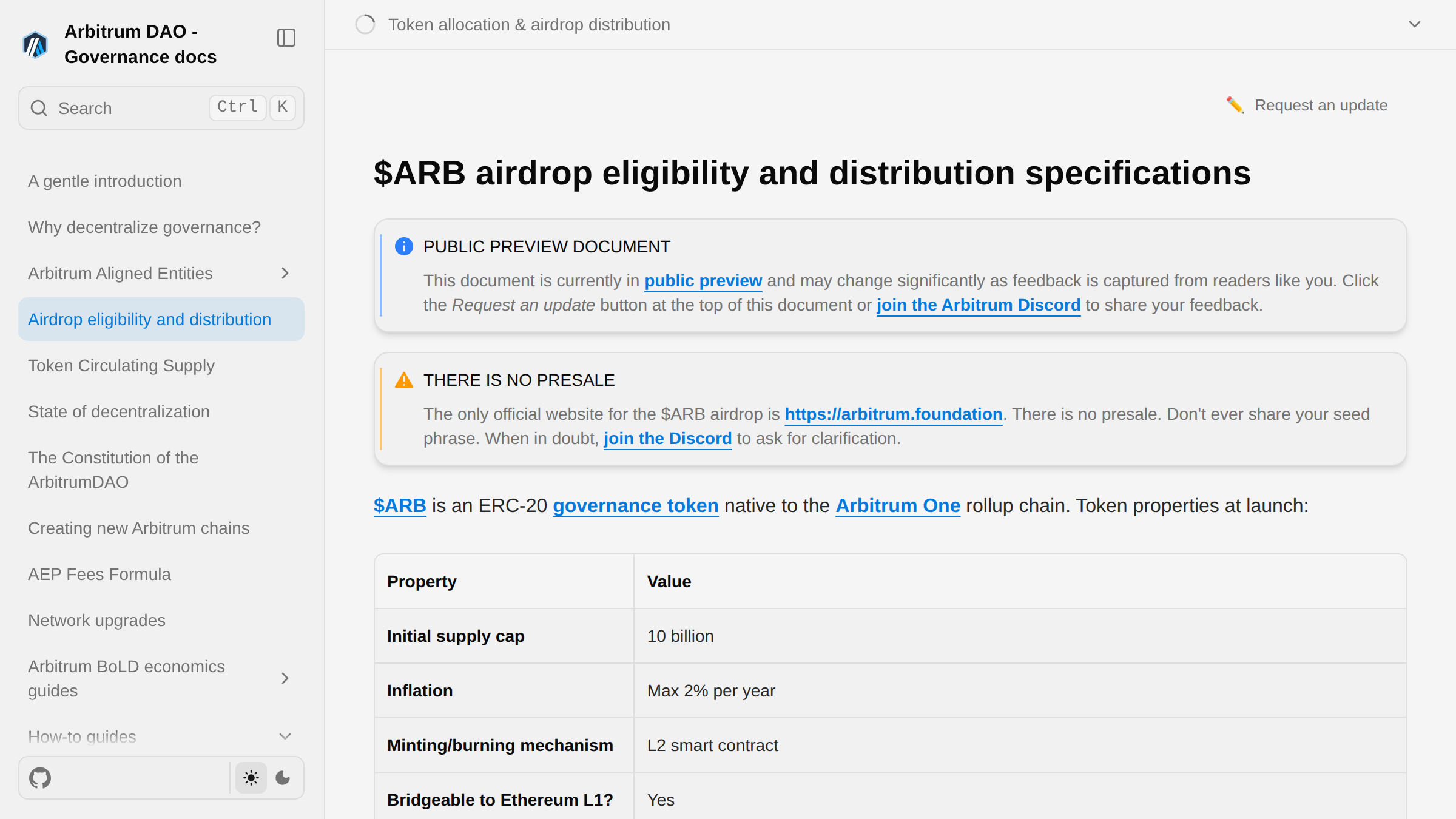

A four-step token vesting verification workflow
1. Capture the issuer’s terms. Save the proposal, token page, or disclosure that names the allocation, beneficiary, start date, cliff, cadence, and amendment rights. Record whether it is a proposal, approved rule, or current description. Never turn a proposal into an adopted schedule without the vote or implementation record.
2. Match the enforcing contract. Find the vesting contract or wallet address named by the issuer. Check that it is on the intended chain and that the verified contract exposes the relevant release logic. If the document names a multisig or a beneficiary, capture that too. Similar names are not proof that two addresses belong to the same allocation.
3. Reconcile scheduled and actual events. Compare expected releases with contract events and token transfers. Keep a column for scheduled amount and a separate column for observed movement. If the wallet is funded in advance, distinguish funding from vesting. If a contract can be modified, note who can modify it and whether governance has exercised that authority.
4. State the conclusion at the narrowest level. “The proposal schedules a release” is safer than “tokens will hit the market.” “The contract emitted a release event” is narrower than “supply increased.” “The receiving address transferred tokens to an exchange deposit address” is narrower than “the team sold.” Each step needs its own evidence.
| Record | Question answered | What it does not prove |
|---|---|---|
| Issuer schedule | What was planned or disclosed? | That a release occurred |
| Vesting contract event | What amount was released under the contract? | That the beneficiary sold |
| Token transfer and supply method | Where did tokens move, and how does the source define circulation? | Who controlled an address or why they moved tokens |
Key distinction
A scheduled unlock is a contractual event. Circulation, exchange availability, and selling are separate claims with separate evidence requirements.
Common mistakes when tracking token vesting
The first mistake is treating every unlock as a market supply increase. The schedule may name a beneficiary but say nothing about what that party does next. The second is adding allocations with different calendars. Team, investor, foundation, grant, and DAO treasury allocations may have separate terms, and some may be changed through governance.
The third mistake is using an aggregator’s current calendar without checking its input. Aggregators are useful discovery tools, but the article should cite the issuer source and the relevant contract. The fourth is mixing units. A token count, percentage of maximum supply, and percentage of circulating supply answer different questions. If the denominator changes, show it and date it.
The fifth mistake is letting an old chart imply a current fact. Token schedules and public reports can change. In the Arbitrum example, the 2023 documents explain the original rules, while the 2026 report gives a later balance and expected final vest. Preserve both dates. If a source is too old for a decision, recheck it and record the query date.
Finally, do not turn a vesting calendar into a price forecast. Unlocks can affect the set of tokens that may move, but price depends on many other factors. This guide helps a growth team explain the mechanism and its limits. It does not predict the market response or recommend an investment decision.
FAQ
What is a token vesting schedule?
It is a set of terms describing when a defined allocation may be released to a beneficiary. Good reporting names the allocation, dates, cadence, enforcing source, and any amendment rights.
What is the difference between a cliff and a linear unlock?
A cliff delays scheduled release until a threshold date. A linear unlock releases portions over time after the applicable start point. Some schedules combine the two, so check the actual terms.
Does an unlock mean tokens entered circulation?
No. An unlock can make tokens transferable under the schedule. Circulating supply depends on the definition used and the balances or methodology included in that measure.
How can a DeFi founder verify an unlock date?
Start with the issuer’s current disclosure, identify the contract that enforces it, then compare expected dates with on-chain events. Record the chain, address, observation window, source date, and any unresolved discrepancy.
Need to verify a protocol’s growth evidence?
I review public claims, product signals, and the measurement gaps behind them.
Review the Web3 Growth Audit