

A founder-ready Web3 marketing report should show the business outcome, the source that measured it, the attribution model, the limits of the evidence and the decision the evidence can support. A single ROI figure cannot carry all five. If revenue or cost cannot be linked with a documented method, say the return is unknown instead of filling the gap with a proxy.
The report has one job: help the founder decide whether to continue, change or investigate a growth activity. It should make clear what happened and how the team knows. On-chain actions, analytics attribution and financial outcomes may sit in different systems. Put them on one page, but do not merge them into one causal story unless the data supports that link.
Primary evidence: define the outcome, cost and source
Begin with the outcome the protocol actually values. It may be paid usage, completed transactions, recurring deposits or another defined event. State the event rule, time period and source of record. If there is no agreed, instrumented outcome, the report cannot assess that outcome. Visits and wallet connections can help diagnose the funnel, but they are not substitutes for business value.
Separate the outcome from the cost. Identify which costs are included: media, incentives, agency fees, internal labor or other expenses. Use the same currency and time period, and state whether the cost is committed or paid. If one cost component is missing, show the known amount and label the total incomplete. Do not compare a partial campaign cost with a full-period outcome.
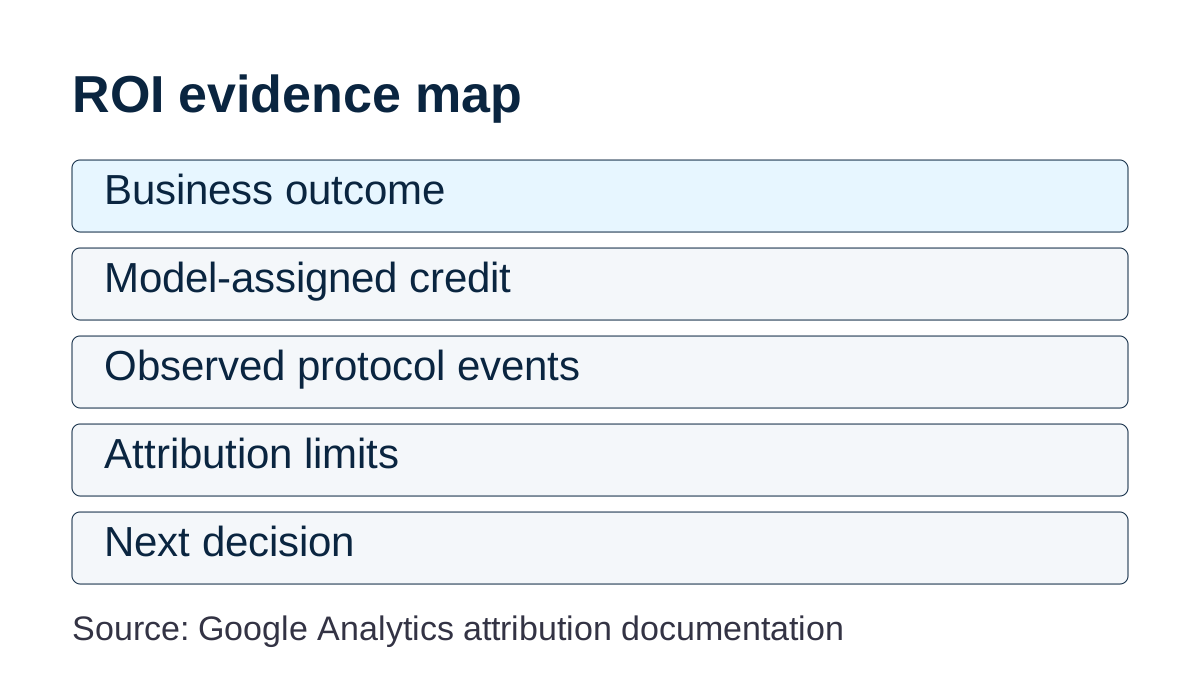
Show attribution as a model of credit
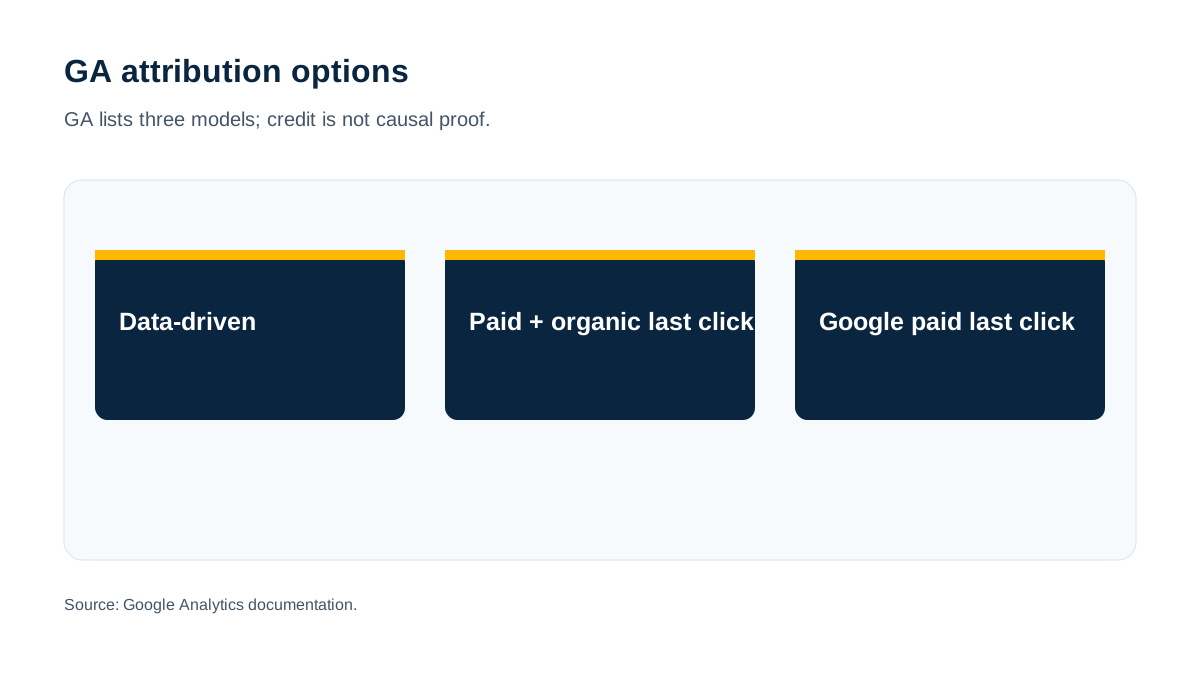
Google Analytics describes attribution as assigning credit for key events across touchpoints. Its documentation explains that different models assign credit differently. A channel’s attributed conversions are therefore outputs of a selected model and its available signals. They are not, on their own, proof that the channel caused the outcome. Name the model, report period and any data limits beside the number.
Keep channel attribution separate from on-chain behavior. A channel report may show clicks or conversions under analytics rules. A query may count protocol events for a wallet cohort. If the systems cannot link a user’s channel touchpoint with an on-chain address through a documented method, show both views separately and label the join unknown. Do not infer identity from timing or similar totals.
Patterns in the evidence: observed, linked, attributed and causal
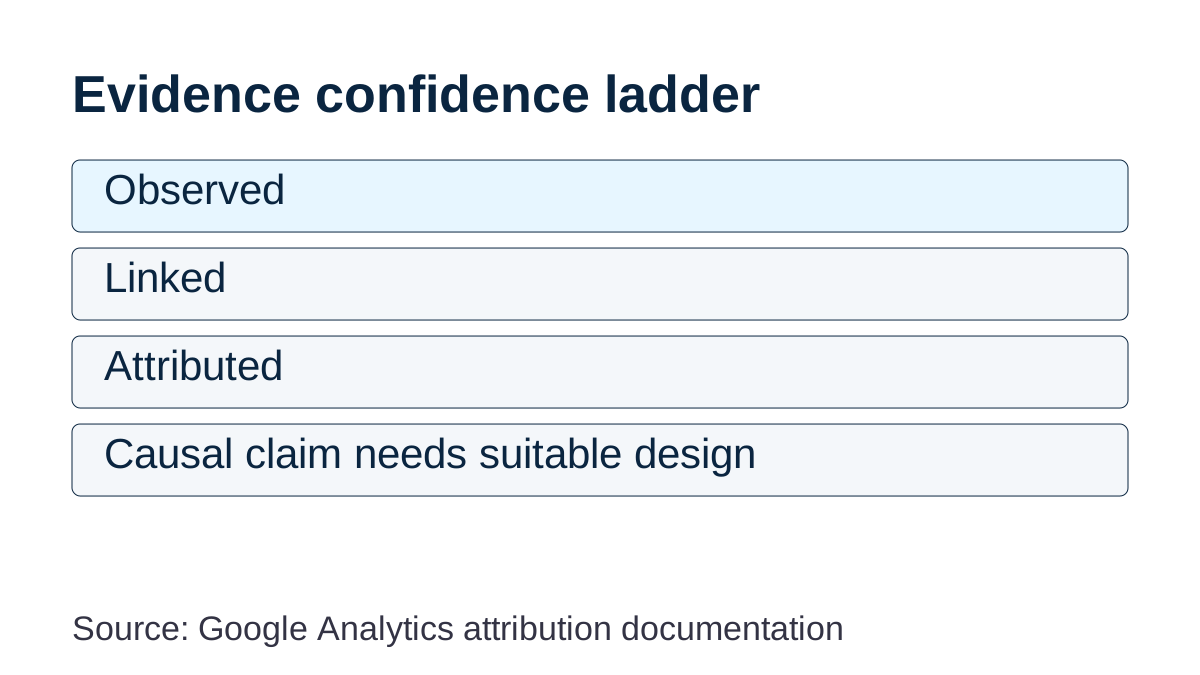
Use a simple evidence ladder. “Observed” means the event is recorded in a named source under a stated rule. “Linked” means a documented identifier connects the channel and outcome records. “Attributed” means a named model assigns credit. “Causal” requires a credible design that supports a causal claim. These labels describe the evidence, not a quality score or universal research standard.
Add the exact limitation. A query can omit contracts, chains, decoded events or historical periods. Analytics can lose signals through consent settings, blockers or cross-device journeys. Identity matching may be unavailable or inappropriate. List what is missing and what decision it affects. If the limitation could change the recommendation, downgrade the confidence or ask for a follow-up test.
Strategic interpretation: avoid false certainty
Do not call attributed revenue ROI unless the formula and cost base are explicit. Do not divide a gross outcome by only media spend while omitting incentives or production costs, then compare that value with a complete cost elsewhere. Do not add conversions from incompatible attribution models. Do not present token price movement as marketing-generated revenue without a defensible method.
Avoid hiding unknowns in a footnote. Put them next to the claim they qualify. Keep observed facts, model outputs and interpretations in separate rows. A neat dashboard does not make its inputs comparable. When a metric changes definition, show the break in the series instead of implying that the old and new values match.
Growth framework: build a one-page decision memo
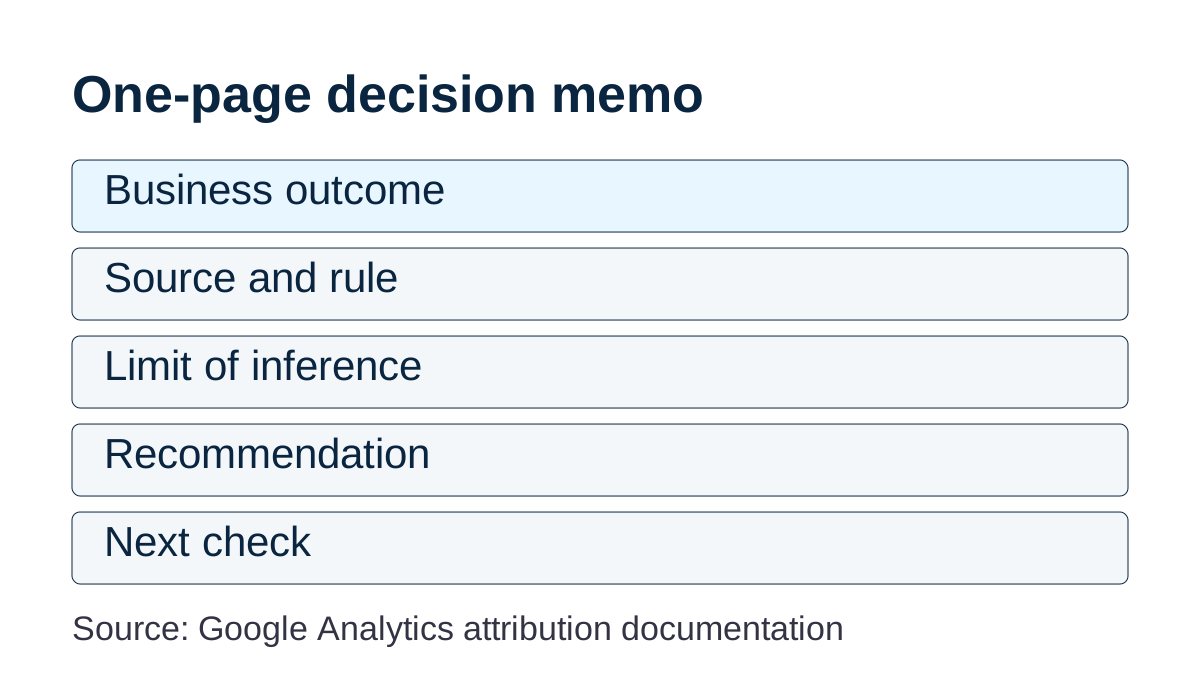
Use four columns: measure, source and rule, what it supports, and what it cannot establish. Include the business outcome, channel-attribution output, on-chain activity and known unknowns. A short note under each row should identify the time window and population. The visual below separates these categories so the reader can inspect each claim without mistaking a model output for observed causation.
End with one recommendation and one reason. Continue if the observed outcome and cost meet a threshold the team chose in advance. Change the channel or offer if the measured outcome is weak but the test can be improved. Investigate when the main gap is instrumentation or identity linkage. These are decision options, not universal rules. Record the owner, next measurement and review date.
The related attribution, metrics and KPI guides below provide definitions; this report focuses on what current evidence supports.
When a founder asks for one headline number, show the formula and its boundaries instead of hiding the components. A return calculation depends on what counts as value, which costs are included, and how the period is matched. If the value is gross revenue, label it as gross. If incentives are excluded, say so beside the calculation. Then show the attributed outcome separately from the observed protocol event. This lets the reader challenge an assumption without discarding the whole report. It also keeps the next budget decision tied to evidence the team can verify.
Keep the source query beside the metric, and note when the query was last reviewed. A versioned record helps distinguish a changed result from a changed method, especially when definitions evolve between reporting periods.
Reporting notes
Distinguish a missing value from zero. If analytics did not record an event, write “not measured” instead of reporting zero conversions. If an invoice has not arrived, mark the cost as pending instead of treating it as free. State whether the reporting period is closed and whether late events can revise the totals. These labels give a founder a fair view of uncertainty. They also show what the team should fix next: instrumentation, cost capture, identity linkage or experiment design. A precise limitation is actionable. A confident number with hidden gaps is not.
I report each measure with its definition and limit, so the founder can challenge an assumption without losing sight of the decision.
For related definitions, see my DeFi attribution framework, Web3 marketing metrics guide and DeFi growth KPI guide.
FAQ
What does marketing ROI mean for a Web3 protocol?
Define the outcome, period, source and cost base before calculating a return. If a required input is missing, label the result incomplete.
Does attribution prove that marketing caused a result?
No. Attribution models assign credit according to their rules. Causal claims need a design that supports them.
How should on-chain activity appear in a founder report?
Show protocol events separately from channel reports unless a documented method links the records.
What should a report say when attribution is incomplete?
Name the missing signal, its source and the decision it limits. Do not replace unknown evidence with a proxy without labeling it.
Closing: keep the evidence open to challenge
The next report should make it easier to see which source changed, which definition stayed fixed and what decision follows. If your team needs help reviewing that evidence across its growth system, I can provide an independent assessment.
Need an outside review of your Web3 growth evidence?
I assess six growth dimensions and identify the gaps your team can act on.
Run the Growth Audit →
| Evidence layer | Source | What it can support | Limit |
|---|---|---|---|
| Business outcome | First-party analytics or protocol records | Recorded event under a defined rule | Does not prove channel cause |
| Channel credit | Named attribution model | Model-assigned credit | Depends on model and available signals |
| On-chain behavior | Documented query | Observed protocol events | Does not identify acquisition source by itself |
References
- Google Analytics attribution documentation, checked 2026-10-15.
- Dune query engine documentation, checked 2026-10-15.