
DeFi marketing teams run campaigns. Not experiments. A campaign has a budget and a deadline. An experiment has a hypothesis and a kill signal.
The difference matters more than it sounds. Campaigns can run for months before anyone can say what worked. The post-mortem is a vibe, not a readout. Leadership gets "it underperformed." That tells them nothing about what to do next quarter.
The Growth Operator's real problem isn't that campaigns fail. It's that they fail invisibly. When there's no defined readout before launch, "it didn't convert" is the only data point you have to show for three months of spend.
What follows are five DeFi growth experiments you can run inside a single sprint. Each one has a hypothesis, a 30-day method, an on-chain readout, and a clear signal for when to stop. Every signal comes from the chain, not from impressions or CTR.
This article is part of the growth marketer's playbook for scaling DeFi protocols. If you want the full methodology behind how to structure your growth stack before running experiments, start there.
What Makes a DeFi Growth Experiment Different From a Campaign
Most DeFi content describes what to run. Almost none defines what "working" means before you start. That gap is why teams end up with dashboards full of wallet connect data that can't answer a single question about retention.
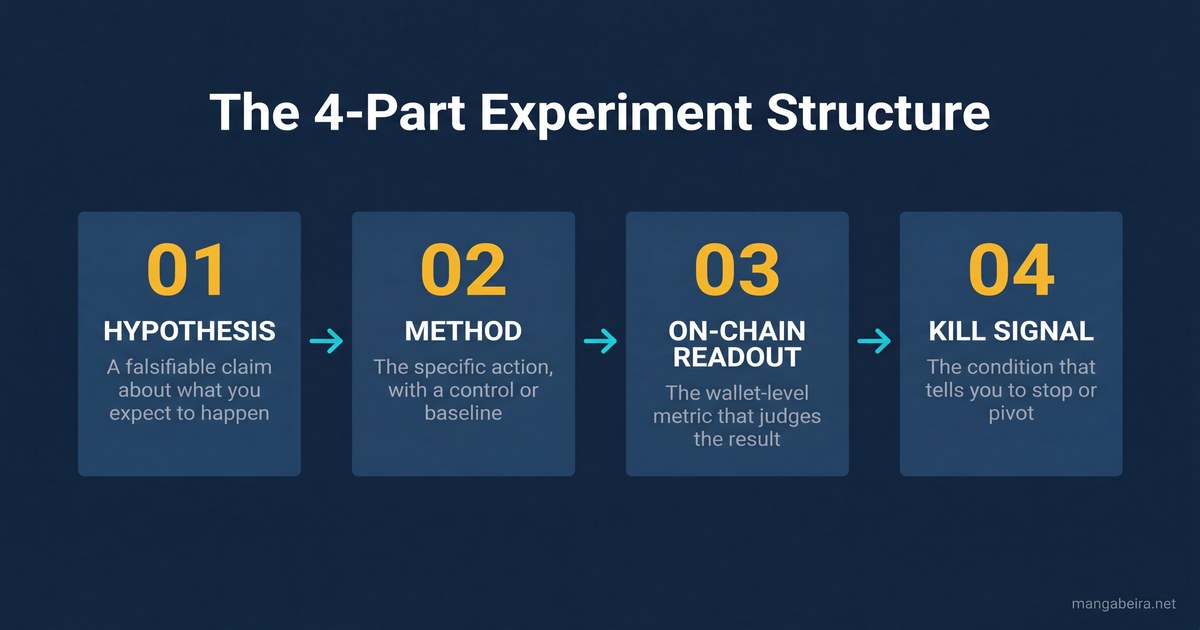
The four parts of a structured experiment
Every experiment in this article follows the same format. Learn it once and you can build your own.
The hypothesis is a falsifiable claim about what you believe is true. Not a goal. A prediction. "Task-based drops with wallet qualification filters will produce higher 30-day retention than broad, claim-based airdrops" is a hypothesis. "Improve retention" is not.
The method is the specific action you take, with a baseline or control where possible. The readout is the on-chain or in-product metric you'll use to judge the result. Not impressions. Not clicks. The kill signal is the specific condition under which you stop, pivot, or scale.
Why the readout has to be on-chain
GA4 shows clicks. UTMs show sessions. Neither tells you what the wallet did after it connected. An on-chain readout anchors the experiment to actual protocol behavior: deposits, swaps, governance votes, repeat transactions.
Off-chain metrics are leading indicators at best. They show you the top of the funnel. The experiment's signal lives where the money moves: on-chain. For wallet cohort definitions and activation threshold logic, see the DeFi marketing team metrics article.
The Core Distinction
A campaign that performed well without a defined readout is a guess with a good story. An experiment that failed has data you can learn from.
Experiment 1: Task-Based, Wallet-Qualified Drops
Funnel Stage: Acquisition
Hypothesis
"Task-based drops with wallet qualification filters will produce higher 30-day retention than broad, claim-based airdrops."
How to run it
Replace one broad drop with a task-based structure. Require at least one qualifying on-chain action before a wallet becomes eligible: a first deposit, first swap, governance vote, or LP position. The goal is to make the claim itself a proof of intent.
Set a minimum wallet age or activity threshold to filter wallets created specifically for the drop. Cap the total token allocation at a fixed amount. Define the claim window before launch. Thirty days is the standard. Once those parameters are set, don't move them.
This experiment builds directly on the Airdrop 2.0 approach covered in the alternatives to broad airdrops article. The sourced observations there give you a fuller picture of why qualification filters change the retention outcome.
What to measure
Run three readouts. First, 30-day retention of claiming wallets compared to protocol baseline (non-drop wallets of similar vintage). Second, Sybil rate (the percentage of claiming wallets with no prior on-chain history). Third, TVL attributable to the drop cohort at Day 7 and Day 30, queried via Dune.
What success looks like
Claiming wallets show 30-day retention at or above the protocol baseline. The Sybil rate stays below the threshold you set before launch. This is critical. Do not move that threshold post-drop. TVL attributable to the drop cohort holds at Day 30, not just at Day 7.
Kill Signal
If the Sybil rate exceeds the pre-defined threshold at Day 7, the qualification filter failed. Stop the next drop. Tighten the criteria before you run it again. A filter that passes bad cohorts isn't protecting your token. It's just adding a step before the farm-and-dump.
Experiment 2: Referral With On-Chain Proof
Funnel Stage: Acquisition / Referral
Hypothesis
"A referral program requiring on-chain activation from the referred wallet will produce lower Sybil rate and higher LTV than a click-based referral program."
How to run it
Build a referral structure where the referrer earns only when the referred wallet completes a qualifying on-chain action. Not when they click. Not when they sign up. Not when they connect. When they transact.
Track referral source at wallet connect via UTM bridge for off-chain amplification. For chain-native referrals, use an on-chain referral code or an invite wallet structure. Run the experiment for 30 days against a control cohort that used the prior referral mechanic, or against no referral mechanic at all.
The DeFi attribution framework covers the UTM bridge setup in detail, including how to link off-chain campaign touchpoints to wallet events without an engineering sprint.
What to measure
Three metrics drive this readout. Cost per activated wallet via referral vs. cost per activated wallet via your top paid channel. 30-day retention of referred wallets vs. non-referred wallets from the same acquisition window. And referral-chain depth: are referred wallets themselves referring others?
What success looks like
Cost per activated wallet from the referral channel is lower than cost per activated wallet from the top paid channel. Thirty-day retention of referred wallets equals or exceeds the baseline. If referral-chain depth is above zero, you have a compounding loop worth investing in.
Kill Signal
If referred wallets show lower 30-day retention than direct-acquisition wallets, the incentive is attracting the wrong cohort. The referral reward structure needs rethinking before you scale. A referral program with poor-retention referred wallets isn't growth. It's subsidized churn.
Experiment 3: KOL A/B, Cost Per Qualified Wallet vs. Cost Per Post
Funnel Stage: Acquisition
Hypothesis
"KOL campaigns measured by cost per qualified wallet will surface a different channel allocation decision than KOL campaigns measured by impressions or engagement."
How to run it
Split your KOL budget across two cohorts. Cohort A is optimized for reach: larger accounts, higher CPM, broad DeFi audiences. Cohort B is optimized for audience quality: smaller accounts with verifiable DeFi-native followings, lower CPM, but tighter alignment to your protocol's user profile.
Tag each KOL's campaign with unique UTM codes. For KOLs running wallet-connect CTAs, track the conversion from click to wallet connect to first activation event. Hold spend constant between cohorts. Run for 30 days. At Day 30, query Dune: how many wallets that came in via each KOL cohort reached the activation threshold you defined before launch?
For activation threshold definition and how to calculate cost per activated wallet across channels, see the DeFi metrics article. For the UTM bridge setup, see the attribution framework.
What to measure
Three metrics per cohort: cost per wallet connect, cost per activated wallet (the qualifying metric: wallet reached the activation threshold), and 30-day retention per cohort. The third one is what separates a KOL that drove real users from one that drove curious browsers.
What success looks like
One cohort produces materially lower cost per activated wallet. That cohort gets the next quarter's budget allocation. If there's no difference, both cohorts are driving equivalent quality, and the cheaper reach option wins on efficiency.
Kill Signal
If neither cohort produces wallets that pass the activation threshold, the problem isn't KOL selection. The activation funnel between wallet connect and first transaction is broken. Fix the onboarding before the next KOL spend. Pouring budget into a broken funnel just fills it faster with wallets that leave.
Experiment 4: Community Activation Gate (Discord Role Gating as a Retention Signal)
Funnel Stage: Activation / Retention
Hypothesis
"Discord members who complete a structured task sequence before accessing core protocol channels will show higher 30-day on-chain retention than members who join without a gate."
How to run it
Set up a role-gating structure in Discord. To access the main protocol discussion channels, new members must complete a defined sequence: watch an explainer video, complete a protocol quiz, or complete one qualifying on-chain transaction. The gate doesn't need to be all three. One clear requirement is enough to signal intent.
Run two member cohorts for 30 days: gated entrants vs. an open-entry historical baseline. Track on-chain activity for both cohorts using the wallet addresses submitted during Discord role verification. Nansen is useful here for labeling wallet types and filtering out known bot addresses before the cohort comparison runs.
This experiment builds on the community activation framework from the DeFi evangelists article. The community activation logic there explains why intent signals at the community level tend to predict on-chain behavior.
What to measure
Two readouts. First: 30-day on-chain activity rate (what percentage of each cohort made at least one protocol transaction within 30 days of joining Discord). Second: absolute size of the active wallet cohort at Day 30. The gate might improve quality while reducing volume. You need both numbers to make the decision.
What success looks like
The gated cohort shows materially higher 30-day on-chain activity than the open baseline. And the gate doesn't materially reduce the volume of members who complete the join process. Watch the funnel drop-off rate before you declare the experiment a success. A gate that filters for quality but loses 90% of entrants at the first step isn't working. It's just friction.
Kill Signal
If the gating flow has a drop-off rate above the threshold you set before launch, simplify the gate before scaling. If the on-chain activity rate between gated and open cohorts is identical, the gate isn't filtering for intent. It's just adding friction without changing the cohort quality. Both failures point to the same fix: reduce the gate's complexity and retest.
Experiment 5: Lapsed Wallet Re-engagement
Funnel Stage: Retention / Re-engagement
Hypothesis
"A targeted re-engagement campaign sent to wallets that activated but have been inactive for 30+ days will produce measurable on-chain reactivation at a lower cost than acquiring new wallets."
How to run it
Pull a cohort from Dune or Nansen: wallets that completed the protocol's activation threshold (first deposit, first stake, first swap) but have not transacted in 30 or more days. This is the most important cohort in your protocol: wallets that found you, engaged, and then went quiet.
Do not re-engage all lapsed wallets. Segment by wallet age and the value deposited at last transaction. Focus on wallets that showed genuine protocol engagement before going quiet. Farming wallets that claimed and left will skew your reactivation data.
The re-engagement mechanism depends on what you have available: a Discord DM campaign for wallets with linked Discord accounts, an on-chain push notification if the protocol supports it, a targeted ecosystem newsletter, or a small drop to the lapsed cohort specifically. Run for 30 days. Track reactivation, defined as at least one new transaction from a previously lapsed wallet.
For cohort segmentation methodology and the wallet retention definitions this experiment depends on, see the DeFi marketing team metrics article.
What to measure
Three metrics: reactivation rate (percentage of targeted lapsed wallets completing at least one transaction in the 30-day window), cost per reactivated wallet vs. cost per newly activated wallet from acquisition campaigns running in parallel, and 30-day retention post-reactivation: did they stay, or just claim and leave again?
What success looks like
Cost per reactivated wallet is lower than cost per newly activated wallet from acquisition. Reactivated wallets show at least 50% 30-day retention post-reactivation. That second number is the one that matters most. Reactivation without retention means the re-engagement hook was an incentive, not a protocol pull.
Kill Signal
If cost per reactivated wallet is equal to or higher than cost per new wallet, the re-engagement overhead isn't justified. Shift that budget to acquisition. If reactivated wallets churn within 7 days of reactivation, the hook was an incentive, not a reason to come back. That's a product retention problem, not a campaign problem, and no re-engagement experiment will fix it.
Running Your First DeFi Experiment This Sprint
Five experiments. Each runs in 30 days or less. The goal isn't to run all five at once. Pick the one that targets the weakest point in your current funnel and run it with enough rigor to get a real readout.
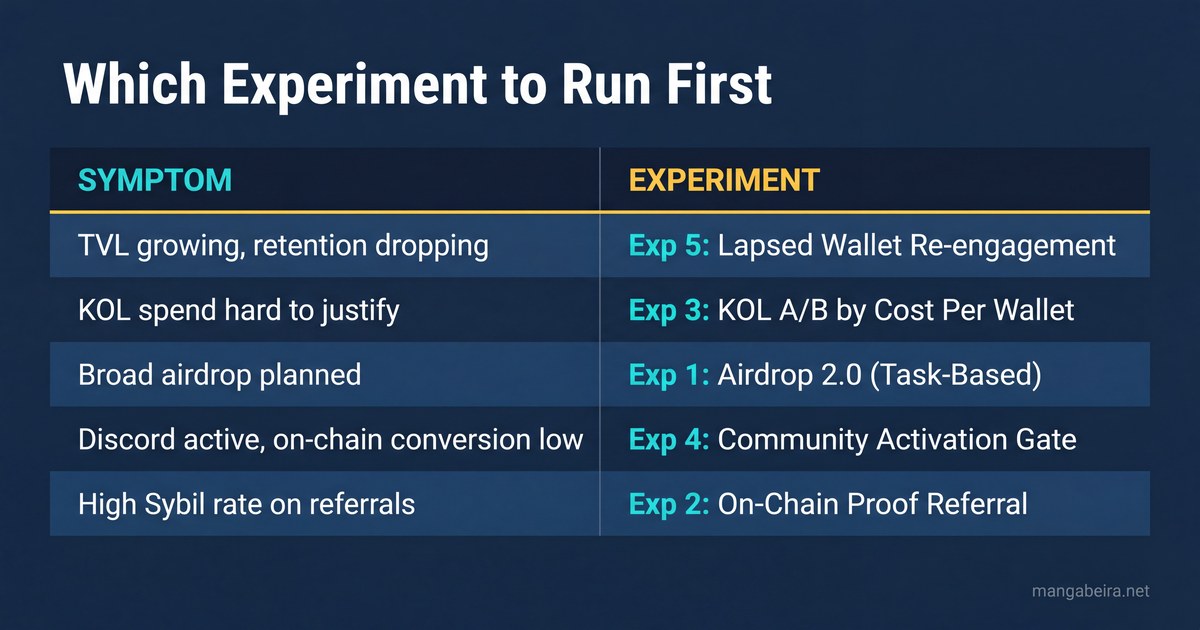
Here's how to choose:
Experiment Selection Matrix
TVL growing but retention dropping? Start with Experiment 5 (lapsed wallet re-engagement). You have activated users somewhere. Find out where they went.
Acquisition stalling and KOL spend hard to justify? Start with Experiment 3 (KOL A/B). You'll have a channel allocation answer within one sprint.
Broad airdrop planned for next quarter? Replace it with Experiment 1 (Airdrop 2.0) before launch. Rebuild the qualification filter first. Don't retrofit it after.
Discord active but on-chain conversion low? Run Experiment 4 (community activation gate). The community intent signal is there. The bridge to the chain isn't.
Referral mechanic already exists but Sybil rate is high? Restructure it as Experiment 2 (on-chain proof referral). The click-based structure is the problem, not the audience.
Pick one. Define the readout before you start. The on-chain signal will tell you what the impressions report never will.
For the full growth stack context around these experiments, including how to structure acquisition, activation, and retention as connected systems rather than separate campaigns, see the growth marketer's playbook and the DeFi growth KPIs framework.
Want a Full Audit of Where Your Growth Stack Is Losing Wallets?
The Web3 Growth Audit covers the full funnel, from acquisition through retention, with on-chain cohort analysis and a prioritized 90-day experiment roadmap. Fully async, no calls required.
See the Growth Audit →FAQs: DeFi Growth Experiments
What is a DeFi growth experiment?
A DeFi growth experiment is a structured test with a defined hypothesis, a 30-day or shorter time window, and an on-chain readout used to judge the result. Unlike a campaign, a growth experiment defines what "working" means before the test begins. It also specifies a kill signal (the condition under which you stop and adjust) if the on-chain metric doesn't appear. The kill signal is what separates a learning system from a spending system.
How do you measure success in a DeFi user acquisition experiment?
Success in a DeFi user acquisition experiment is measured by on-chain activation, not clicks or wallet connects. A wallet that connects but never deposits or transacts doesn't signal acquisition success. It signals a leaky funnel. The qualifying metric should be defined before the experiment starts. It's typically the first meaningful protocol transaction: first deposit, first swap, or first stake. That's the threshold where user intent becomes economic behavior.
What is a DeFi referral experiment and how does it work?
A DeFi referral experiment tests whether a structured referral mechanic drives higher-quality wallet acquisition than direct channels. The key variable is requiring on-chain activation from the referred wallet before the referrer earns anything. That requirement filters for genuine users rather than click-through Sybil accounts. The readout is cost per activated referred wallet vs. cost per activated direct-channel wallet. If referred wallets show lower 30-day retention than direct-acquisition wallets, the reward structure is attracting the wrong cohort, not the wrong channel.
How long should a DeFi growth experiment run?
Most DeFi growth experiments should run for 30 days before you evaluate results. Shorter windows produce noisy data. Longer windows slow the learning cycle and delay decisions that need to happen at sprint cadence. The exception: if a clear kill signal appears before Day 30 (Sybil rate exceeds the pre-set threshold at Day 7, or activation rate is zero in the first week), stop the experiment early and adjust. A kill signal that triggers early isn't a failure. It's the experiment working as designed.
What on-chain tools do DeFi marketing teams use to run growth experiments?
DeFi growth teams typically use Dune Analytics to query wallet cohorts and measure activation rates, grouping wallets by acquisition date and tracking their on-chain activity over time. Nansen is the standard tool for segmenting wallets by behavior, labeling wallet types, and filtering known bot addresses before cohort comparisons run. GA4 alongside UTM bridges links off-chain campaign touchpoints to wallet connects for the off-chain portion of attribution. These three tools together cover most of what the experiments in this article require.
Related Articles
How Growth Marketers Can Attribute ROI in DeFi Campaigns
Three attribution methods ranked by engineering cost. The UTM bridge setup. Four reports leadership actually wants on Monday.
Read the ArticleThe Metrics That Actually Matter for DeFi Marketing Teams
Which KPIs growth marketers own vs. reference. How to define activation thresholds and build the weekly update leadership reads.
Read the ArticleCommunity-Driven Growth: Building DeFi Evangelists
The community activation framework behind Experiment 4. How intent signals at the community level predict on-chain behavior.
Read the ArticleDeFi Growth KPIs: The Framework Behind the Experiments
The full KPI architecture: wallet retention cohorts, cost per activated wallet, and the metrics that connect experiment readouts to growth decisions.
Read the ArticleSources and Citations
• Dune Analytics. Wallet cohort queries and on-chain retention analysis. dune.com
• Nansen. Wallet labeling, behavioral segmentation, and bot filtering for DeFi protocols. nansen.ai
• Mangabeira, Gabriel. "How Growth Marketers Can Attribute ROI in DeFi Campaigns." mangabeira.net
• Mangabeira, Gabriel. "The Metrics That Actually Matter for DeFi Marketing Teams." mangabeira.net
• Mangabeira, Gabriel. "Alternatives to Broad Airdrops for DeFi Founders." mangabeira.net